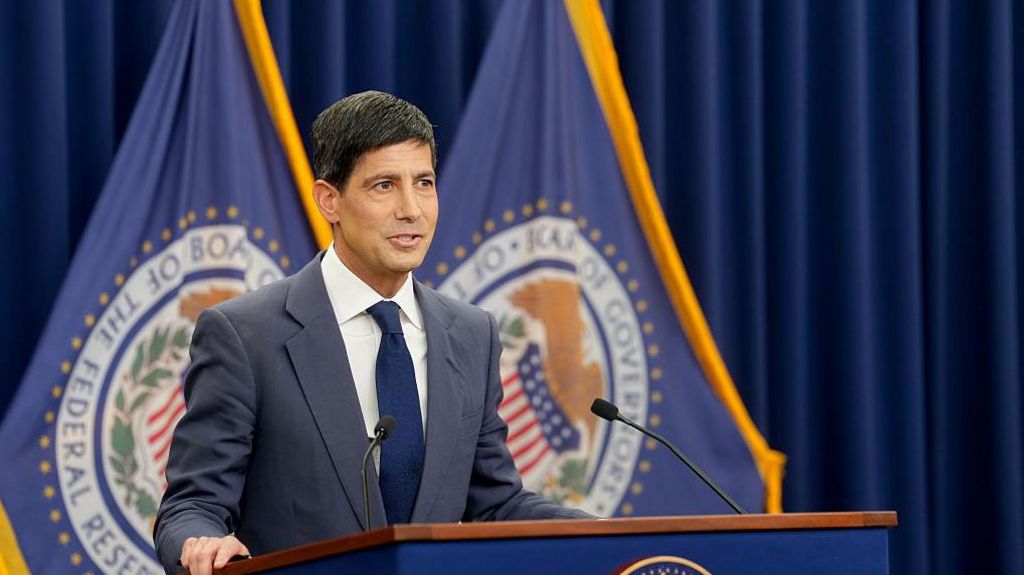
In Kevin Warsh’s first meeting at the helm of the U.S. Federal Reserve, the central bank’s rate-setting committee has voted unanimously to hold benchmark interest rates steady in a range between 3.5% and 3.75%, a decision that breaks with pressure from the White House for immediate rate cuts while reflecting persistent above-target inflation driven by Middle East conflict-related energy price shocks.
The decision comes as the Fed navigates tangled crosscurrents: growing uncertainty around the Trump administration’s still-unresolved framework to end hostilities linked to Iran, inflation that currently sits at 3.8% – well above the Fed’s long-term 2% target – and ongoing political pressure from President Donald Trump, who has openly pushed for rate cuts after successfully pushing former chair Jerome Powell for looser monetary policy. FOMC governors were initially divided heading into the meeting, with some factions arguing for an immediate hike to cool stubborn price growth, while others backed a cut to stimulate economic expansion as Trump demanded.
In the end, the committee aligned around holding rates steady, citing resilient economic fundamentals even amid elevated geopolitical risk. In its new, condensed official statement – a core campaign promise from Warsh, who has long criticized the Fed’s overly verbose past communication practices – the FOMC noted that “Economic activity is expanding at a solid pace despite elevated uncertainty that owes, in part, to the conflict in the Middle East. Productivity growth and capital investment are strong. Job gains have kept pace with the workforce, and the unemployment rate has changed little.” The statement concluded with a simple, direct commitment: “The Committee will deliver price stability.”
Clocking in at just 132 words, the new statement is less than half the length of the 350-word statement released after the committee’s April meeting, fulfilling Warsh’s pledge to cut redundant messaging and let policy action speak for itself. Beyond the shorter format, the Fed also removed prior language that hinted at a future bias toward rate cuts, a clear shift in monetary policy posture.
The closely watched dot-plot summary of committee members’ rate projections underscored that hawkish shift: nine of the 18 participating central bankers now expect at least one rate hike before the end of 2026, while only one projects a cut, and eight see rates holding steady at current levels. Warsh, who has publicly opposed the dot-plot as an unhelpful forward guidance tool, declined to submit his own personal projection but said he supported colleagues continuing to publish the summary.
Samuel Tombs, chief U.S. economist at Pantheon Macroeconomics, called the shifted dot-plot projections the “big news” emerging from Wednesday’s meeting, marking a notable turn from the Fed’s prior stance toward potential rate cuts.
Speaking at a post-meeting press conference, Warsh framed the leadership transition as an opportunity to reset the central bank’s operations and reaffirm its core mandate. “This is a natural and timely opportunity to reaffirm its mission, to review current practices,” he said, adding that the Fed’s traditional forward-looking guidance has done more to confuse than clarify monetary policy debates. “My new, slimmed-down statement just gives you the facts as best we can judge it,” he added.
Warsh also announced immediate plans to restructure the Fed’s policy-making process, launching five internal task forces to review core central bank operations: communication practices, the appropriate size of the Fed’s balance sheet, the use of economic data in policy decisions, the relationship between productivity growth and labor market outcomes, and the central bank’s inflation management framework.
The current inflation surge traces back to President Trump’s decision to launch military strikes against Iran earlier this year, which prompted Iranian forces to close the Strait of Hormuz – one of the world’s busiest and most critical global shipping lanes for oil. The closure triggered a sharp spike in global energy prices, which the U.S. Bureau of Labor Statistics has identified as the single largest driver of the recent jump in year-over-year inflation, which hit 3.8% in May.
In a surprising public comment at the White House earlier this June, Trump downplayed the inflation risk, telling reporters “I love the inflation. The numbers were great. You know what I really love? I love the inflation.” Economists widely note that high inflation erodes household purchasing power, particularly for low- and middle-income families, and that central banks typically raise interest rates to cool excess demand and bring price growth back to target. Rate cuts, which Trump has repeatedly called for, tend to lower borrowing costs for consumers and businesses and stimulate spending and growth, but can also further fuel inflation when price growth is already above target.