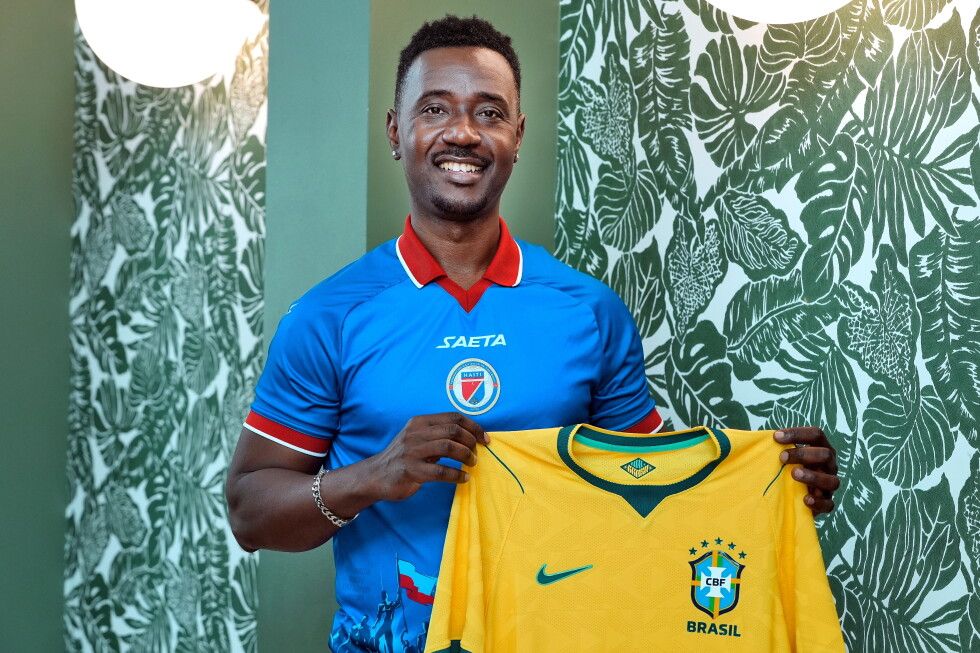
The 2026 FIFA World Cup, the first iteration of the tournament co-hosted by three nations — the United States, Canada, and Mexico — and the first held on U.S. soil since 1994, is set to deliver one of its most emotionally charged group stage matchups: Haiti versus five-time world champion Brazil. For Haitian fans at home and across the global diaspora, this pairing is far more than a simple David-versus-Goliath contest. It is a lifetime dream come true, pitting a beleaguered underdog national team against a soccer powerhouse that Haitians have adored for generations.
Peguy Joseph, a Haitian living in Florida who has cheered for Brazil his entire life, will get to attend the June 19 match in Philadelphia — on his birthday, no less — marking the first time he will ever not root for the Brazilian side. “It’s a double joy,” Joseph explained. “I’ll be happy if Haiti win — but if Haiti lose, I won’t be sad, because it’s Brazil! It’s the fanaticism. When you love it, you love it.” He is far from alone in this conflicted excitement: thousands of dual-aligned Haitian fans across the U.S. and beyond are grappling with a one-of-a-kind mix of national pride and lifelong fandom ahead of the historic game.
Even Brazilian fans are embracing the friendly energy of the matchup. Rafael Saldanha, a Brazilian resident of New York City who scored a ticket to the game, called the pairing a happy coincidence. “I was happy actually, when I learned that Brazil’s going to play Haiti, because I know these are two very friendly nations to each other,” he said. “Both are nations that have their own internal struggles. But at the same time, these are two countries whose populations manage to be extremely happy … regardless, or in spite, of the challenges posed on them every day.”
Haiti’s journey to this World Cup match is a story of against-all-odds resilience. The Western Hemisphere’s poorest nation has not qualified for the World Cup since 1974, and this cycle it faced extraordinary barriers to qualification: armed gangs control most of Port-au-Prince, where the national team’s home stadium is located, forcing the Grenadiers, as the squad is nicknamed, to play all their home qualifying matches on the Caribbean island of Curaçao, without the cheers of their local fanbase. Still, the team fought past higher-ranked rivals to book its place in Group C alongside Morocco, Scotland, and the beloved Brazilian powerhouse. Currently ranked 84th in the world against Brazil’s 6th place standing, Haiti enters the matchup as a 30-to-1 underdog, but fans and analysts alike are pointing to soccer’s long history of stunning upsets.
Haiti’s deep affection for Brazil’s national team stretches back more than 40 years, rooted in cultural connection and shared history. As the first Black-led republic in the world, many Haitians see themselves in Brazil’s storied legacy of Black superstars, from Pelé to Romario, Ronaldo Nazario, and Neymar — icons whose faces were painted on the bright tap-tap minibuses that crisscross Port-au-Prince for generations. It was at the 1982 World Cup that millions of Haitians first fell in love with Brazil’s iconic jogo bonito, the beautiful game, led by the legendary captain Sócrates. Subsequent decades cemented that loyalty: fans celebrated Brazil’s 1994 and 2002 World Cup titles as if they were their own, and the bond deepened in 2004 when Brazil led a United Nations peacekeeping mission to Haiti, organizing an exhibition match in Port-au-Prince that drew thousands of cheering fans lining the route from the airport to the stadium to greet Brazilian greats including Ronaldo and Roberto Carlos. Even after Haiti lost 6-0 that day, fans waved Brazilian flags in celebration of the historic visit.
In the years since, migration has only strengthened the connection between the two nations: thousands of Haitians relocated to Brazil after the devastating 2010 earthquake, and more have settled there in recent years fleeing ongoing gang violence and political unrest back home. For Haitian diaspora communities in the U.S., who have faced years of uncertainty over immigration policy, this World Cup run has become a unifying moment of pride that puts daily struggles on hold.
Joel Jean-Baptiste, a Haitian-American who grew up in Haiti and has supported Brazil his whole life, canceled a planned family vacation to Europe just to buy a ticket to the June 19 match. “For us, and for all Haitian kids, Brazil was number one,” he said. “Playing them in the World Cup would be — IS — the dream, a lifetime dream and has every Haitian national excited to see what’s going to happen this summer.”
Rachelle Leger, a Haitian-American community leader in Philadelphia, summed up the prevailing mood. “It’s almost like David and Goliath — we’re going up against a giant, a huge soccer giant,” she said. “We’re not looking at it like a rival; we’re looking at it as a moment in time. We’re just savoring it, we’re really proud of Haiti making it, we’re really proud to be there to support the team, even though (Haitians) support both teams.”
For those holding out hope for a historic upset, soccer scholar Kirk Bowman, a Georgia Tech professor who teaches courses on soccer and global politics and has written extensively on the sport’s globalization, notes that a Haitian underdog already made soccer history at the 1950 World Cup held in Brazil. That tournament, a hastily assembled U.S. team of part-time amateur players pulled off one of the biggest upsets in soccer history, beating a top-ranked England side 1-0. The game-winning goal was scored by Joe Gaetjens, a Haitian working as a dishwasher and semi-pro player in New York City. After the win, jubilant Brazilian spectators — who saw England as the main threat to their own title bid — carried Gaetjens off the field. Though Gaetjens was later killed under Haiti’s brutal Duvalier regime, his place in soccer lore endures.
“Haiti can believe in another Haitian ‘miracle on grass,’” Bowman said. “A Haitian already had one.”