WESTPORT, Ireland — On the eve of the G7 leaders’ gathering in Evian-les-Bains, France, Canadian Prime Minister Mark Carney has issued a stark warning about the systemic risks of overreliance on a small cohort of American artificial intelligence developers, following new U.S. export restrictions that forced AI firm Anthropic to pull its most advanced models offline.
The controversy began Friday when San Francisco-based Anthropic confirmed it had taken its two cutting-edge AI models, Fable 5 and Mythos 5, offline to comply with a Trump administration directive barring access to the systems by foreign nationals. This move marks the most sweeping restriction the U.S. government has imposed to date on access to state-of-the-art AI technology.
Anthropic had only just publicly released a limited version of Fable 5 earlier that same week. The more capable Mythos 5 model, first announced by the company on April 7, had already been restricted to a small pool of pre-vetted customers over serious cybersecurity concerns: Anthropic itself has acknowledged Mythos 5 is so “strikingly capable” that it can outperform experienced human cybersecurity experts at identifying and exploiting software vulnerabilities, making unregulated access a major global security risk.
Speaking to reporters during a visit to Ireland on Sunday, Carney framed the shutdown as a cautionary tale for nations around the world. “The situation we’re in collectively right now with Mythos and Fable is exactly the kind of disruption that can happen when you overrely on a narrow set of providers from a single country,” Carney said. He emphasized no party involved acted improperly in this instance, but argued that global powers would be making a critical mistake if they failed to learn from the event: “We will have done something wrong if we just accept this, don’t take the lesson, don’t build out and diversify our own AI ecosystems.”
“It is never a good idea to have only one option,” Carney repeated, doubling down on his call for global diversification in AI development and supply chains.
The Prime Minister noted that AI policy will top the agenda for Monday night’s working sessions at the G7 summit, adding that he held a 45-minute bilateral discussion on AI governance and strategy with French President Emmanuel Macron Friday evening. Carney cautioned against expecting sweeping, final agreements from this gathering, noting the complexity of AI regulation and cross-border coordination means there will be no “mission accomplished” moment after the summit.
Carney connected the AI export restrictions to Canada’s broader long-term strategy to diversify its trade and technology partnerships, a policy push he has championed amid ongoing trade tensions with the U.S. More than 70% of Canada’s total exports currently flow to the United States, and Carney has set an ambitious national goal to double the volume of Canadian exports to non-U.S. markets over the next 10 years. The Trump administration’s ongoing trade war has already created significant uncertainty that has cooled cross-border investment in Canada, he added.
On another key bilateral topic, Carney confirmed he does not have a formal one-on-one meeting scheduled with U.S. President Donald Trump at the G7, even as the United States-Mexico-Canada Agreement (USMCA) approaches its mandatory renewal. Instead, negotiations at this stage will be led by senior trade officials: Canada’s Minister responsible for U.S. Trade Dominic LeBlanc and chief negotiator Janice Charette will meet with U.S. Trade Ambassador Jamieson Greer and U.S. Treasury Secretary Scott Bessent on the sidelines of the Evian summit. “The right way to do it at this stage will be between the principal negotiators, which is going to happen in Evian,” Carney explained.
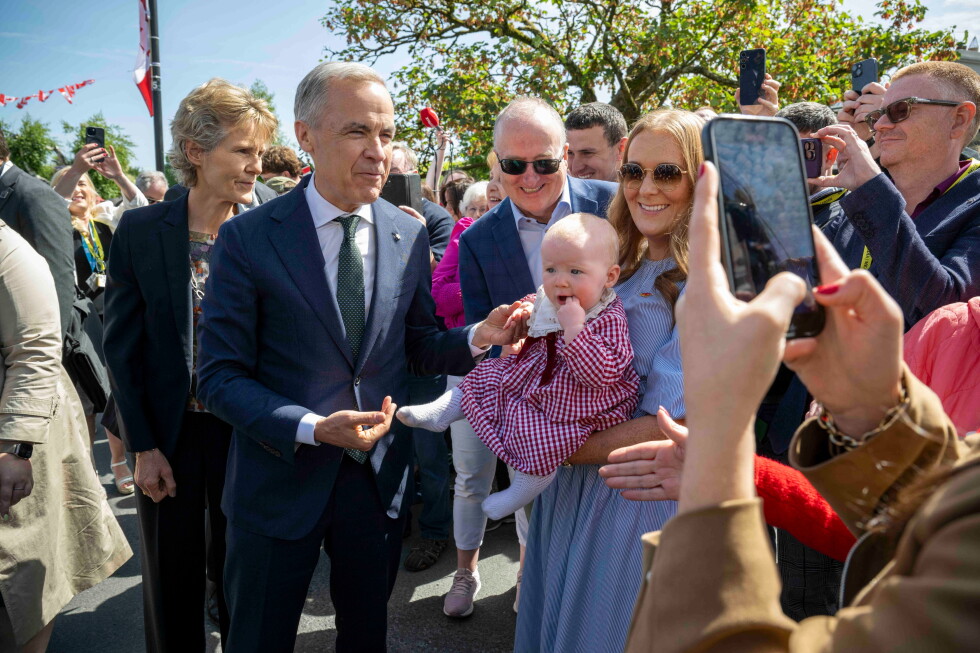
Sunday’s appearance in Ireland came after Carney visited his family’s ancestral village of Aghagower in County Mayo earlier in the day. Both of his grandparents, Robert Carney and Nora Moran, were born in the town before immigrating to Canada in the 1920s. Local resident Owen Morgan, who brought his 17-month-old son Malachy — dressed in a Montreal Canadiens hockey jersey — to meet the Prime Minister, said locals in County Mayo take great pride in Carney’s career. “People are very impressed,” Morgan said. “He’s very much standing up for Canadians and I think that’s very much admired.”