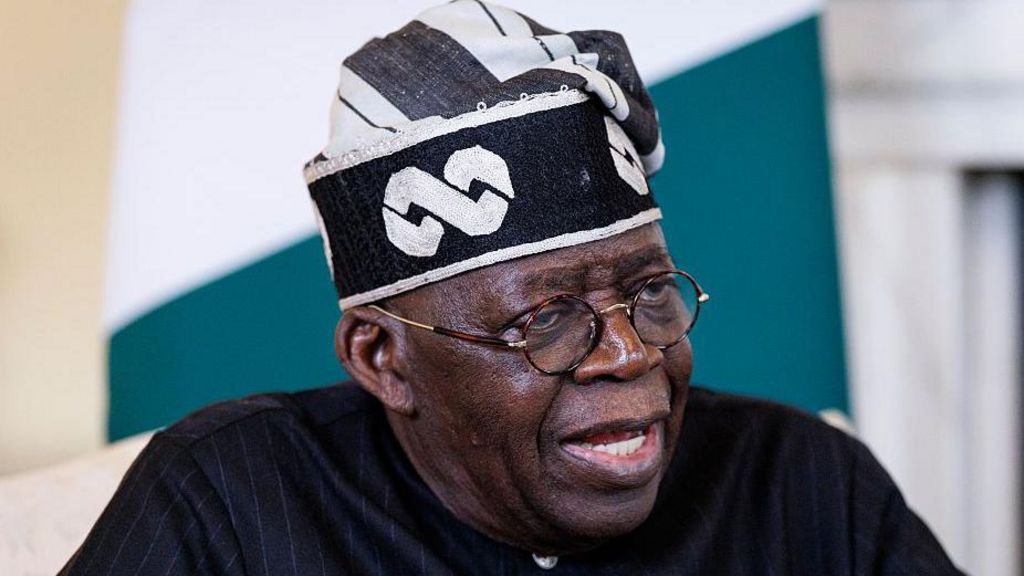
On Nigeria’s annual Democracy Day, a national holiday commemorating the 1999 transition back to civilian rule after decades of military dictatorship, President Bola Ahmed Tinubu delivered a stern national address that paired a tough ultimatum to domestic armed groups with major new announcements to boost the country’s struggling security apparatus.
Tinubu opened his remarks by acknowledging that this year’s celebrations were overshadowed by a fresh wave of mass school abductions that have reignited public anxiety across the country. The West African nation has grappled with persistent insecurity for decades, with insurgent attacks, village raids, and ransom-fueled mass kidnappings concentrated largely in northern and central states – a crisis that has grown more acute in recent months. The president specifically referenced recent abductions of schoolchildren in Oyo and Borno states, noting that security forces remain optimistic about securing the safe release of all captives.
“Democracy without security is not solid enough,” Tinubu told the nation, as he outlined a sweeping package of security investments. His administration is rolling out a recruitment drive for more than 50,000 new police officers, has approved thousands of additional military personnel, and has earmarked a record 5.41 trillion naira (equivalent to roughly $4 billion) for defense and security in the 2026 national budget.
Defending his administration’s performance since he took office in May 2023, Tinubu claimed that Nigerian military forces have killed 13,000 people classified as terrorists over the past 12 months. He added that civilian fatalities linked to insurgent activity have dropped 81% compared to 2015 levels, and that more than 124,000 armed fighters and their family members have surrendered and disarmed under the government’s Operation Safe Corridor, a national reintegration program for former insurgents.
These claims have been challenged by independent security analysts, who note that violent attacks continue to disrupt communities across multiple Nigerian states, and that insurgent activity is now spreading into previously stable southern regions of the country. The rising insecurity has coincided with a prolonged economic crisis that has left millions of ordinary Nigerians struggling to afford basic goods. Civil society organizations and labor unions have organized peaceful mass protests across major state capitals, calling for urgent government action to address both widespread insecurity and skyrocketing costs for food and transportation, driven by persistent high inflation. The groups have repeatedly raised alarms about the heavy toll of rising prices on low- and middle-income households.
Tinubu defended the controversial economic reforms his administration has implemented since taking office, including the elimination of a long-standing national fuel subsidy and the deregulation of Nigeria’s foreign exchange market. He argued that these unpopular measures were necessary to stabilize the country’s public finances and rebuild confidence among international and domestic investors, steps he says will lay the groundwork for long-term economic growth.
Beyond security and economic policy, the president used the 27th anniversary of civilian rule to pay tribute to the activists and national heroes who led the country’s pro-democracy movement. He gave special recognition to figures linked to the annulled June 1993 presidential election, widely believed to have been won by the late Moshood Kashimawo Olawale Abiola, whose victory was overturned by the military junta in power at the time, a turning point in Nigeria’s struggle for democratic governance.