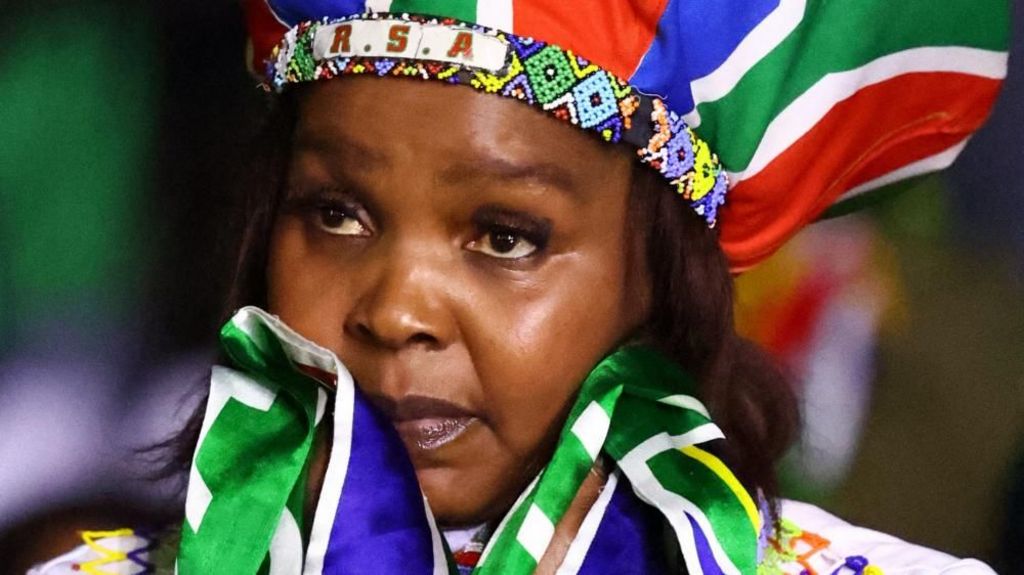
As the final whistle blew on the opening match of the 2026 expanded FIFA World Cup between South Africa and co-host Mexico, the 2-0 defeat for Bafana Bafana left South African supporters heartbroken — but what unfolded across social media revealed a far deeper rift than a disappointing on-pitch result. In a break from the long-held tradition of pan-African unity that defines continental participation in major global tournaments, fans across the continent threw their support behind Mexico, linking their choice to ongoing deadly xenophobic violence targeting African migrants in South Africa.
The 2026 World Cup, co-hosted by the United States, Canada and Mexico, features 10 African teams in its expanded 48-team format, marking a historic high for continental representation. Ahead of Thursday’s Group stage opener, many African football fans already made clear their decision to back Mexico, directly tying the choice to simmering anti-migrant tensions that have roiled South Africa in recent weeks.
Social media was flooded with playful but pointed content after the match: users changed their profile pictures to Mexican flags, adopted Spanish pseudonyms, and shared memes featuring sombreros under the trending tagline “Mexico versus xenophobia.” One user on platform X, referencing widespread reports of migrant mistreatment, asked bluntly: “You want people to cheer for you when you play soccer just because we’re African?” Another echoed the sentiment, leaning into the baseless narrative that foreign workers drive South Africa’s unemployment crisis to joke: “We’re supporting Mexico so that South Africa can go back home early to protect their jobs.” Prominent Kenyan lawyer Ahmednasir Abdullahi added a sharp, satirical take: “I hope South Africa is not blaming African migrants for the 2–0 defeat and two red cards in the match against Mexico.”
In-person fan sentiment reflected the same divide. Daniel Kaniki, a Congolese supporter who attended a public fan viewing event in Atlanta, Georgia, told reporters the split came down to basic solidarity. “Africa is like one country and if one is chasing others, we are not a family any more. That’s why I’m supporting Mexico today,” he explained.
Not all fans from across the continent sided against South Africa, however. Vanlare Quist, a Ghanaian fan also at the Atlanta viewing park, said he remained firmly in Bafana Bafana’s corner. As a proud African, he argued that anti-immigrant sentiment is driven by only a small minority of South Africans, not the nation as a whole. In Juba, the capital of South Sudan, public viewing center attendees uniformly backed South Africa, rooted in shared historical struggle: South Sudan’s fight for independence from Sudan has long drawn ideological connection to South Africa’s fight against apartheid white-minority rule.
“It was unfortunate that on social media we saw some African countries supporting Mexico and even wearing Mexico jerseys. As South Sudanese, we are behind South Africa and will continue to support South Africa – because they are representing Africa. So, all African countries must support South Africa during this World Cup,” 23-year-old student George Kenyi Charles Rehan told reporters from Juba.
Back in South Africa, supporters pushed back against the wave of online trolling after the defeat, doubling down on their pride in the national team. The South African government also released a statement commending Bafana Bafana for their “spirited performance,” noting that “while the final score was not what the nation had hoped for, the team represented South Africa with unity, determination, and a sense of pride on the world’s biggest stage.”
Many South African social media users rejected criticism of the country’s immigration policies, with one writing: “We qualified for the World Cup alone without your support and whether we win or lose we will remain South Africans who love their country. And illegal immigrants will still leave our country whether you hate us or not.”
The continental rift exposed by the World Cup opener is rooted in a years-long surge of anti-migrant sentiment that has escalated dramatically in recent weeks. Migrants from other African nations have faced targeted violence and intimidation, with extremist anti-migrant groups issuing a 30 June deadline for all undocumented foreign nationals to leave the country.
South African President Cyril Ramaphosa has publicly condemned vigilantism, stressing that “only authorised government officials can act against violations of our law.” But he has also acknowledged that public frustrations over immigration “deserve to be heard, and they deserve to be addressed.”
In response to the escalating threats, multiple African nations have begun repatriating their citizens from South Africa. Nigeria became the latest country to announce evacuations this week, joining Ghana, Zimbabwe and Malawi, all of which have already moved to bring their citizens home amid safety concerns.
The roots of the current crisis stretch back to the end of apartheid in 1994, when thousands of people from across the continent moved to South Africa seeking greater economic opportunity. Today, however, South Africa struggles with an official unemployment rate exceeding 30%, a crisis that has fueled scapegoating of foreign workers and sparked regular anti-migrant protests and deadly xenophobic attacks in major urban centers.
Despite the opening defeat, South Africa still has two remaining Group stage matches to climb out of the bottom of the table and qualify for the knockout round of the expanded tournament, leaving the nation with an opportunity to prove its quality on the pitch even as tensions off the field continue to simmer.