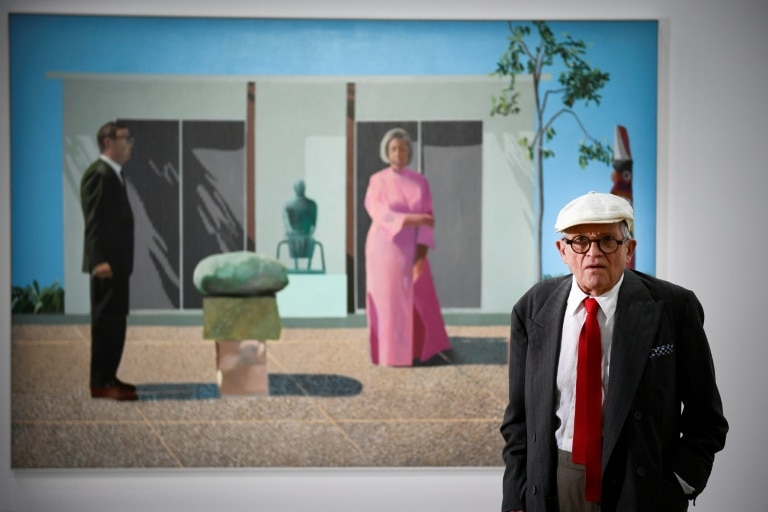
One of the most transformative and influential figures in modern global art, David Hockney, has passed away peacefully at his London home at the age of 88, just one month shy of his 89th birthday, his public relations representative Erica Bolton confirmed in an official statement released Friday.
Widely celebrated as a foundational pioneer of the 1960s Pop Art movement, Hockney maintained an unwavering commitment to creation, experimentation, and public exhibition of his work right up until his death. Across his 70-year career, he built a vast, diverse body of work defined by cross-medium experimentation, rigorous intellectual exploration of perception, perspective, and visual representation, and a lifelong celebration of the vibrancy and beauty of the world around him.
Born in 1937 in West Yorkshire, northern England, Hockney launched his artistic training at the Bradford School of Art before going on to study at London’s Royal College of Art, where he graduated with the institution’s prestigious Gold Medal distinction. A conscientious objector during the era of mandatory military service, he completed his alternative service working as a hospital orderly, and defied the conservative social conventions of post-war Britain from an early age: he lived openly as a gay man and dedicated himself fully to his artistic vision at a time when such openness carried significant risk.
By the mid-1960s, Hockney had emerged as a leading voice in a new generation of groundbreaking British artists. After relocating to California in 1964, his work captured the sun-drenched, carefree energy of 1960s West Coast life, alongside the rolling, bucolic landscapes of his native Yorkshire, and intimate portraits of the people and places that shaped him. His iconic 1972 work *Portrait of an Artist (Pool with Two Figures)* made global headlines in 2018 when it sold at auction in New York for $90.3 million, setting a new record for the most expensive work sold by a living artist at auction — a title he held until 2019, when Jeff Koons’ *Rabbit* surpassed the mark.
A lifelong innovator never afraid to embrace new tools and technologies, Hockney worked across far more mediums than traditional painting and drawing: he built a celebrated body of work in printmaking, photography, and even stage design, and was an early adopter of digital art tools. When Apple first released the iPad in 2010, Hockney immediately adopted the device as a core creative tool, even collaborating with software developers to build custom art apps tailored to his creative process, according to a profile from the U.K.’s National Portrait Gallery.
Hockney earned global critical acclaim and formal recognition from both his home country and international governments throughout his career. In 1997, he was appointed to the Order of the Companions of Honour by the British monarchy, and earlier this year, he joined the small ranks of non-French citizens awarded the Legion d’Honneur, France’s highest civilian honor.
News of his death sparked an outpouring of tributes from art institutions and peers within minutes of the official announcement. Art historian Richard Morris paid tribute to Hockney on the social platform X, noting that his greatest achievement was making technically rigorous, groundbreaking painting look effortless. “He carried forward one of the most sustained investigations into vision, space and representation by any post-war artist. British art has lost a giant,” Morris wrote.
Paris’ Centre Pompidou, which collaborated with Hockney on two of his most iconic retrospective exhibitions, called him “unquestionably one of the major figures of contemporary art,” adding that the body of work he leaves behind remains “dazzling, alive and eternal.”
Remarkably, Hockney continued creating and sharing new work right up until his passing. London’s Serpentine Gallery is currently hosting the artist’s first exhibition at the institution, which was curated in close collaboration with Hockney himself and features a collection of his newest paintings. Upcoming retrospective exhibitions are already in development at London’s Tate and the Munch Museum in Oslo.
In addition to his unmatched artistic legacy, Hockney is survived by his long-time partner and companion Jean-Pierre Goncalves de Lima, two of his brothers, and a large extended family of nieces, nephews, great-nieces, and great-nephews. Bolton’s statement noted that Hockney, who never lost his distinctive northern Yorkshire accent, remained a defiant, lifelong smoker who praised the pleasure the habit brought him, and continued smoking up until his death.