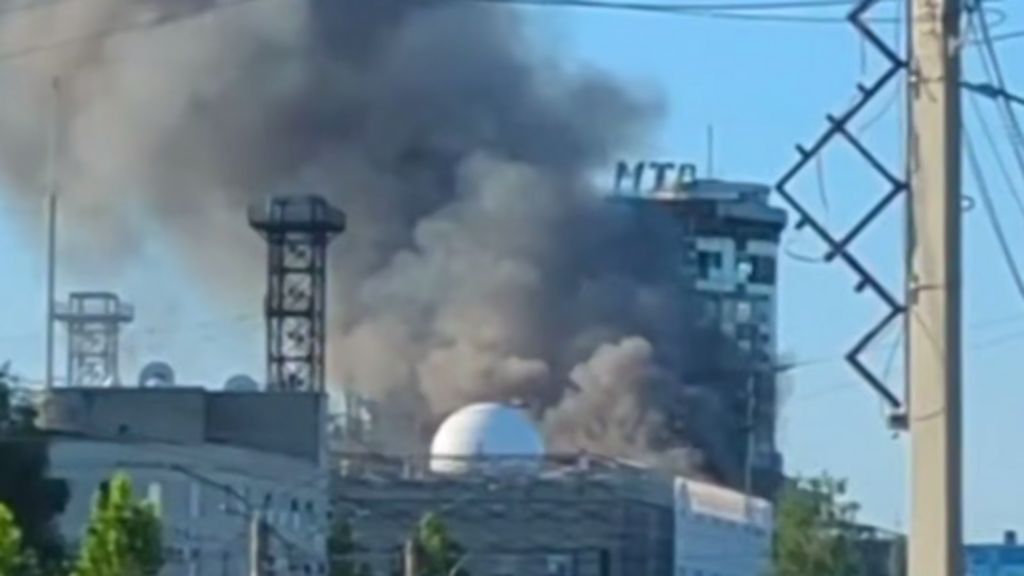
In a significant escalation of cross-border strikes, Ukrainian forces have carried out a rare long-range missile attack on a major Russian military production facility deep inside Russian territory, Ukrainian President Volodymyr Zelensky has confirmed. The strike, carried out overnight using newly developed FP-5 Flamingo cruise missiles, targeted a drone and missile manufacturing plant in Cheboksary, a city located in Russia’s Chuvash Republic more than 900 kilometers from the active front lines in eastern and southern Ukraine.
Zelensky announced the operation in an official post on his Telegram channel Wednesday, confirming that the strike hit the VNIIR-Progress plant, a facility that produces critical components for Moscow’s military drone and missile programs used in its full-scale invasion of Ukraine. He also published purported footage of the operation, showing a missile in flight toward the target followed by plumes of smoke rising from the facility after impact. Oleg Nikolaev, the head of the Chuvash Republic, confirmed a missile strike had hit the city and reported three people injured, though he did not publicly confirm damage to the military facility.
The FP-5 Flamingo missile used in the attack carries a 1,150-kilogram warhead and has an advertised maximum range of 3,000 kilometers, a capability that places Moscow and nearly all of Russia’s major population and industrial centers well within Ukrainian strike range. This development marks a notable advancement in Ukraine’s domestic long-range strike capacity, as Kyiv works alongside its Western allies to expand its missile arsenal to put increased pressure on Russia’s war machine.
Alongside the Cheboksary strike, Ukrainian military officials also confirmed additional simultaneous strikes on other Russian positions and critical infrastructure: the Moscow-occupied Sea of Azov port of Mariupol, a Russian oil refinery in Samara, and an oil tanker belonging to Russia’s shadow fleet operating in the Black Sea.
The Cheboksary attack comes amid a months-long pattern of intensified Ukrainian strikes on key Russian facilities far from the front, though deep penetration missile attacks of this nature remain rare. Kyiv has repeatedly stated that any infrastructure supporting Russia’s invasion, including energy and military production sites, qualifies as a legitimate military target, arguing that disrupting these supply chains raises the cost of Moscow’s invasion and forces it to consider negotiated peace. So far, however, Russian President Vladimir Putin has rejected all of Kyiv’s proposals for peace talks. Just last week, Putin claimed there was no purpose in holding a face-to-face meeting with Zelensky after the Ukrainian leader had requested direct negotiations to end the conflict. The Kremlin leader also repeated his claim that Russian forces are advancing across the entire front line, despite open source and independent reporting showing the front has remained largely static for months.
The overnight exchange of fire between the two sides extended far beyond the long-range strike. Russia’s defense ministry announced that its air defense systems intercepted or shot down 326 Ukrainian drones launched across multiple Russian regions overnight. On the Ukrainian side, the country’s air force reported it had downed 181 of 207 Russian drones launched at Ukrainian targets overnight, and confirmed 21 direct Russian hits across 14 separate locations across the country.
Local Ukrainian officials reported that Russian strikes over the preceding 24 hours have left at least two civilians dead and 26 more injured, including two children, across four Ukrainian regions. Among the latest Russian attacks is a drone strike on the northeastern Ukrainian city of Kharkiv, where police experts were seen assessing the damage to impacted sites, per Reuters reporting.