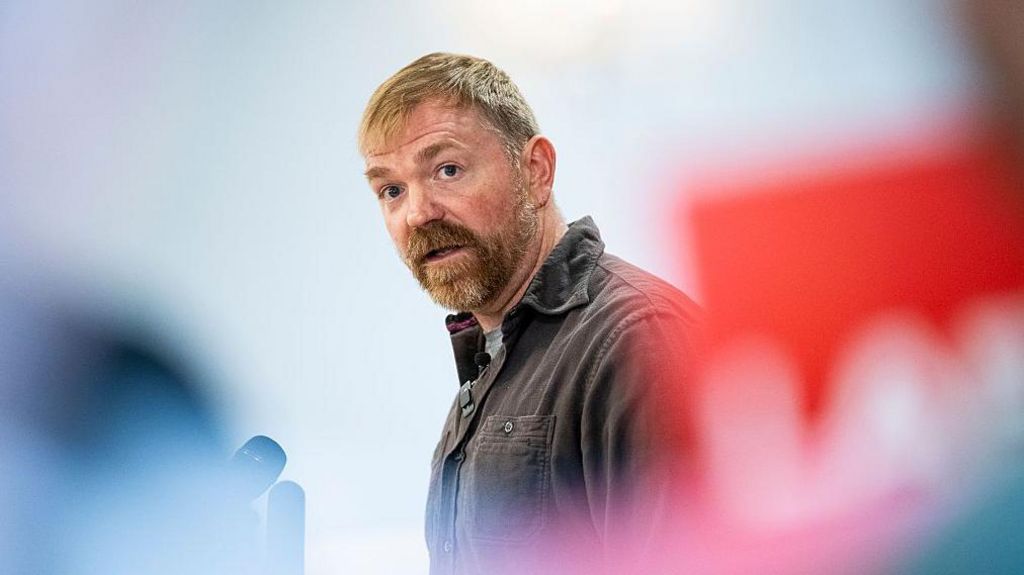
On the eve of Maine’s critical Democratic Senate primary, first-time candidate Graham Platner stood before hundreds of supporters at a Portland town hall, visibly emotional after receiving a handcrafted card emblazoned with the message “We are your Graham-ily, and we’ve got your back.” The moment capped a turbulent week for the political outsider, who had been hit by a string of damaging national investigative reports exposing a pattern of controversial behavior that would have ended the campaigns of most conventional politicians. Yet for the loyal base that has propelled his unlikely rise, none of the scandals have shaken their commitment.
Platner’s path to the primary has been anything but smooth. Over the past several months, controversies have mounted: a chest tattoo resembling a Nazi-era Totenkopf symbol, unearthed 14-year-old online comments dismissing personal responsibility for rape survivors, leaked allegations of infidelity during his early marriage, and most recently, accusations from three former girlfriends of violent, erratic emotional abuse. His former campaign chief of staff penned a scathing Washington Post op-ed warning that Platner “exhibits a pattern of dishonest behavior that is impossible to ignore,” and a recent poll from the opposing campaign shows his unfavorable rating among Maine voters has jumped 20 points to 49% following the latest allegations.
But what has made Platner’s campaign a political phenomenon is his ability to retain support despite the growing baggage, a reflection of both Maine’s unique political culture and the deep anger of rank-and-file Democratic voters toward the national establishment. A former Marine Corps combat veteran turned oyster farmer and small business owner, Platner has cut a relatable figure, touring the state in jeans and a baseball cap, speaking openly about his struggles with post-traumatic stress disorder and his family’s journey with infertility. By his own count, he has hosted more than 80 town halls across the sparsely populated state, where face-to-face retail politics still holds enormous sway. His anti-elite, anti-lobbyist message and left-leaning policy platform — which echoes progressives like Bernie Sanders and Alexandria Ocasio-Cortez, calling for universal healthcare, free college, and a wealth tax on the ultra-wealthy — has tapped into a deep well of frustration with business-as-usual Washington politics.
His rise has already upended the state’s Democratic race: party establishment favorite Governor Janet Mills was pressured by national leaders to enter the race, but she dropped out earlier this spring after falling far behind in fundraising and polling, stunned by Platner’s early viral momentum. Even some voters who acknowledge discomfort with Platner’s past say they have no choice but to back him to defeat long-serving Republican incumbent Susan Collins, who has held the seat for three decades. “I would vote for him exclusively to keep Susan Collins from winning,” explained Portland voter Ann Oliver, echoing a sentiment shared by many anti-Collins Democrats who prioritize party control over candidate perfection.
The outcome of Tuesday’s primary carries national stakes. A Platner victory would leave the pivotal general election race in play, with control of the U.S. Senate hanging in the balance. National Democrats fear a repeat of the Tea Party era, where grassroots enthusiasm elevated unelectable candidates that cost the party winnable seats. If Platner wins, he will face off against Collins, a formidable moderate Republican with deep Maine roots, a $20 million campaign war chest, and a history of winning over cross-party voters in a state that has not backed a Republican presidential candidate since 1988. Collins’ operation is already preparing to flood the airwaves with negative ads focusing on Platner’s scandals, while national Republicans have already called his candidacy a gift that could help them hold the seat.
Yet for his supporters, Platner’s authenticity outweighs any past missteps. “He’s got a little bit of baggage, but who gives a shit? He is a saint here to me,” said Kevin Claik, a retiree who drove 48 kilometers to attend Sunday’s town hall. Autumn Crisovan, a Portland recreational sports worker who opposes lobbyist influence in politics, said Platner’s grassroots campaign signals a much-needed shift for the country: “It’s nice to see there are people who are trying to fight and that it gets the ball rolling for everyone else.”
Platner has leaned into the anti-establishment framing, echoing the scandal-resilience playbook that worked for Donald Trump, framing the attacks as a coordinated effort by elite media and party insiders to defeat the people’s candidate. “What everybody fails to understand is they think this is a race about me,” he told supporters Sunday night. “What they don’t understand is this is a race about us. It’s about the people of Maine. It’s about the recognition that only in each other, only in our communities, do we find the power necessary to take back our politics.”
Political analysts note that Platner’s working-class, rugged nonconformist image resonates deeply with rural Maine voters, a demographic that has drifted toward Republicans in recent presidential elections that Platner could potentially flip. “He is straight out of central casting for a firebrand politician who doesn’t take any bullshit,” noted Colby College political science professor Nick Jacobs. “There is a deep connection to place that seems genuine, because it is quite pervasive throughout his style and substance.”
Platner has attempted to frame past controversies as stories of redemption, apologizing for each misstep: he removed the Nazi-resembling tattoo, explaining he got it drunk on vacation with fellow Marines without knowing its meaning; he asked voters to forgive his old rape comments as the words of a younger man on his worst day; and he acknowledged his past infidelity, saying he and his wife have worked through the issue and strengthened their marriage. Even some national progressives have stood by him, though with caveats: California Congressman Ro Khanna, who campaigned with Platner last week, acknowledged the abuse allegations were “wrong, was misogynistic, was toxic or volatile” but said Platner has expressed shame for his actions.
As Maine voters head to the polls Tuesday, the race remains unresolved, with national political observers watching closely to see if a political novice with a long list of scandals can pull off an upset that would reshape the balance of power in Washington for years to come.