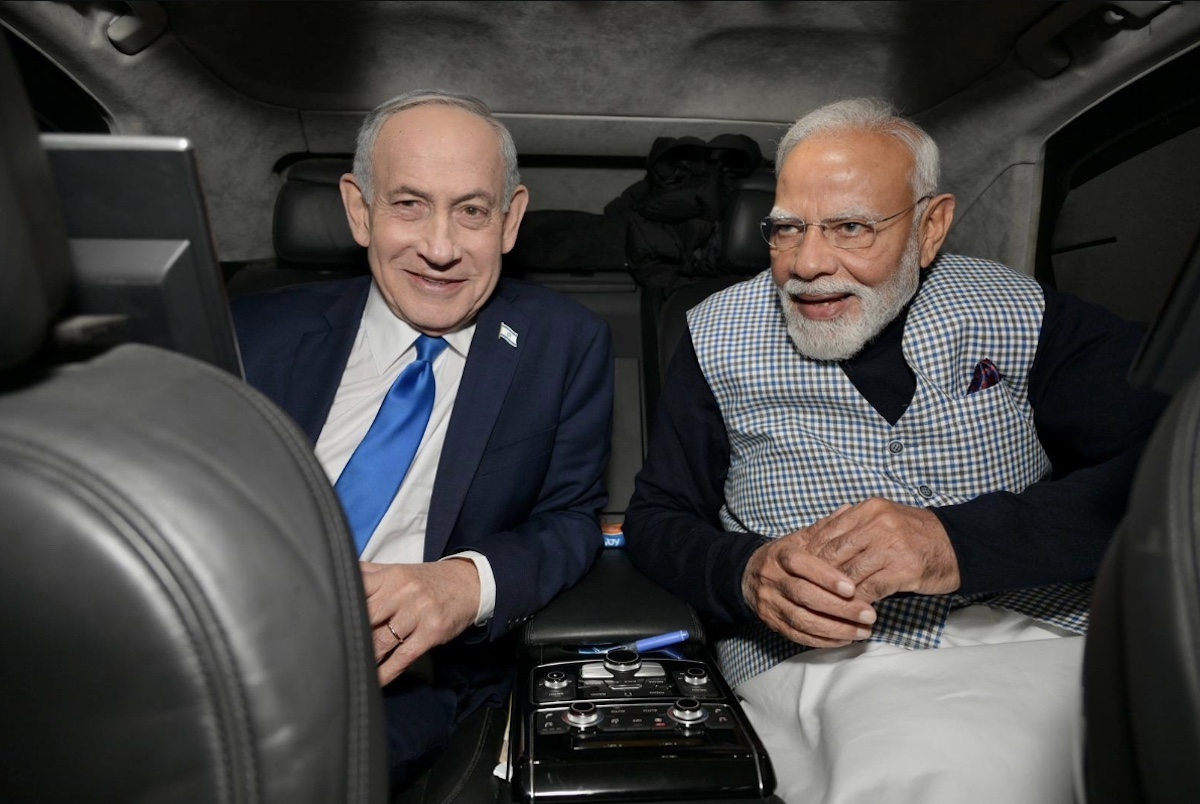
In February 2026, on the cusp of Indian Prime Minister Narendra Modi’s historic visit to Israel, Israeli Prime Minister Benjamin Netanyahu presented one of the most far-reaching foreign policy blueprints of his decades-long tenure to his cabinet: a sweeping, interconnected ‘hexagon of alliances’ designed to counter what he terms ‘radical axes’ across the Middle East and broader Eurasian region.
At the heart of this proposed framework sits a core triangular partnership between Israel, India, and Greece — three nations that have steadily deepened defense, technology, and security collaboration in recent years, while sharing overlapping concerns about growing regional volatility and shifting power dynamics. Netanyahu positioned Israel as the central anchor of the network, identifying India as the initiative’s most critical partner: a rising global economic and military power that serves as a strategic bridge between Asia and the Eastern Mediterranean. Beyond the core trio, the doctrine calls for inclusion of additional Mediterranean states such as Cyprus, alongside moderate Arab nations, key African powers, and a handful of unnamed Asian countries.
The origins of Netanyahu’s new doctrine do not emerge from a geopolitical vacuum. It was developed in direct response to the recent emergence of a new alignment between Pakistan, Saudi Arabia, Turkey, and Egypt, a bloc widely referred to in geopolitical circles as the ‘Islamic NATO.’ That grouping gained formal momentum in September 2025, when Pakistan and Saudi Arabia signed a binding Strategic Mutual Defense Agreement. Confronted with this expanding rival bloc, Netanyahu’s initiative seeks to build a counter-architecture unified by shared technological prowess, deep economic interdependence, and common commitments to democratic governance.
In his public remarks, Netanyahu left no ambiguity about the alliance’s stated purpose: it is intended to form ‘an axis of nations that see eye-to-eye on the reality, challenges, and goals against the radical axes, both the radical Shia axis, which we have struck very hard, and the emerging radical Sunni axis.’ This dual-front framing marks a notable shift in Israel’s public posture, positioning the country not merely as a defensive actor responding to regional threats, but as a lead organizer shaping a new regional order.
The bilateral foundations of the initiative already hold tangible weight. India stands as Israel’s largest single export market for defense equipment, a statistic that reflects deep, long-standing strategic trust between the two nations. India’s vast, fast-growing tech ecosystem also complements Israel’s global reputation for innovation, creating natural synergies for joint collaboration. For Prime Minister Modi, who has overseen the deepening of security ties with Israel while carefully preserving India’s long-standing warm relations with Iran and key Arab states, the visit carried significant symbolic weight. To date, however, New Delhi has deliberately avoided committing to the hexagon as a formal, binding alliance.
The Israel-Greece partnership, the third leg of the core triangle, is similarly rooted in years of growing collaboration. The trilateral cooperation framework between Israel, Greece, and Cyprus was first established in 2016, and held its latest round of high-level meetings in Israel in December 2025. While originally focused on energy infrastructure and cross-regional connectivity, the grouping has steadily expanded its scope into security and defense coordination, much of it oriented around shared concerns over Turkish regional ambitions. In 2025 alone, Athens finalized a $760 million deal to acquire 36 PULS rocket artillery systems from Israeli defense manufacturers.
Despite the initiative’s sweeping ambition, it faces significant structural and geopolitical obstacles that threaten to derail its transformation from a doctrinal vision to a functional alliance. India’s position remains the most delicate and uncertain. Netanyahu’s push to cast India as the key pivot of the counter-bloc has left New Delhi in a geopolitical quandary. While deeper military and strategic ties with Israel and Mediterranean partners strengthen India’s foothold in West Asia, formal alignment would risk forcing New Delhi into open confrontation with Iran, a nation with which India has shared deep historical and economic ties for decades. India has also been expanding its own strategic partnership with Saudi Arabia, a country Netanyahu implicitly identifies as part of the rival bloc. India’s long-standing commitment to strategic autonomy sits uneasily with membership in an explicitly anti-bloc coalition, analysts note.
A formal, NATO-style pact is widely seen as improbable due to the divergent national interests and competing geopolitical priorities of all prospective members. For example, while Greece has deepened defense ties with Israel, it has also recently pursued cautious diplomatic rapprochement with Turkey. As fellow NATO members, Athens cannot afford to permanently antagonize Ankara, a reality that complicates its full participation in an explicitly anti-Turkish aligned bloc.
Critics also push back against Netanyahu’s core framing of the Middle East as a binary landscape divided between cohesive ‘radical’ and ‘moderate’ blocs. Rather than uniting behind a single ‘radical Sunni axis,’ many Sunni-majority states have pursued ad-hoc diplomatic coordination in response to Israeli regional actions, including joint statements condemning Israeli strikes on Syria and the ongoing Gaza conflict. Netanyahu’s binary division, critics argue, erases the far more fluid, multipolar nature of modern regional geopolitics.
Regardless of whether the hexagon of alliances ultimately evolves into a durable geopolitical bloc, the unveiling of the doctrine itself offers meaningful insight into Israel’s shifting strategic posture. It signals that after years of operating primarily through unilateral military action across the region, Israel now seeks to reposition itself as a coalition-builder rather than a lone actor. The doctrine reflects a core Israeli strategic conviction that the post-Gaza regional order will be defined by competing, bloc-based alliance systems, and that Israel must lock in its position before the new regional architecture solidifies to its disadvantage.
Netanyahu’s ‘axis vs. axis’ framing carries tangible risks: it could harden existing regional polarization, giving Israel’s rivals greater incentive to deepen their own coordination. At the same time, it reflects a clear strategic recognition that in an increasingly fragmented global order, bilateral partnerships alone are no longer sufficient to guarantee national security — interconnected institutional and geopolitical networks have become indispensable.
Ultimately, whether the hexagon crystallizes into a lasting alliance or remains an aspirational strategic vision will depend far more on the choices of its prospective members than on Netanyahu’s ambition. India, in particular, holds the key. To date, New Delhi has maintained deliberate ambiguity about the initiative, signaling that while the core idea has strategic appeal, India will only participate on its own terms — or not at all.