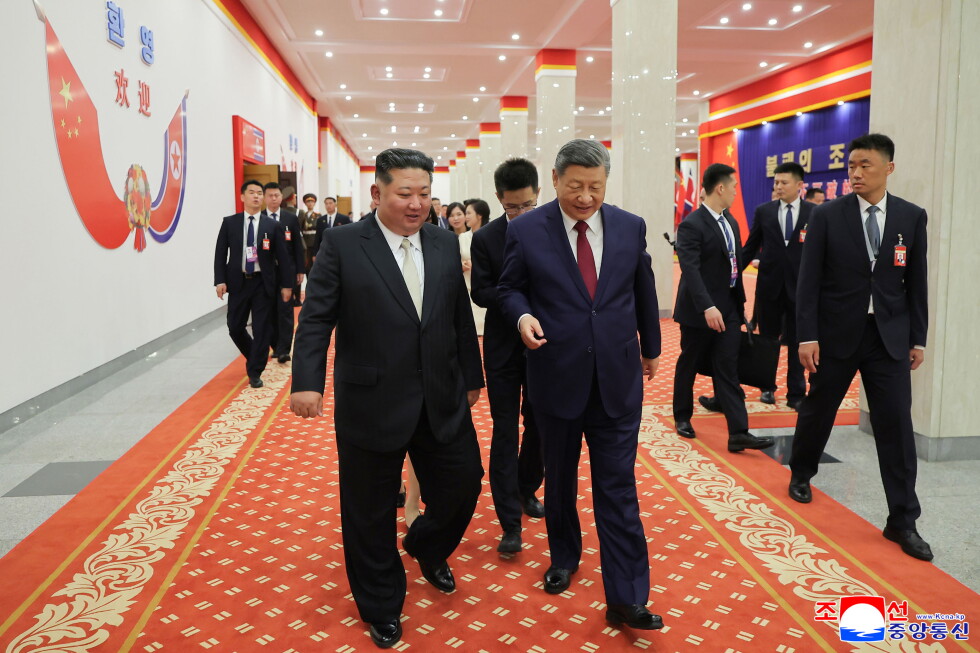
During Chinese President Xi Jinping’s high-profile two-day visit to Pyongyang this week, his first meeting with North Korean leader Kim Jong Un in seven years, an unusual omission has drawn sharp international attention: neither Chinese nor North Korean state media made any public mention of North Korea’s advancing nuclear weapons program, a top priority for U.S. policymakers and regional allies. For years, this silence suggests, a quiet shift in China’s long-stated position on the Korean Peninsula nuclear issue has come to fruition, reshaping regional security dynamics.
Before denuclearization negotiations between Washington and Pyongyang collapsed entirely in 2019, the United States and its regional partners South Korea and Japan held out hope that Beijing — as Pyongyang’s closest diplomatic and economic backer — would use its unique leverage to push North Korea to abandon its nuclear ambitions. For years, Beijing routinely publicly committed to the goal of “denuclearization” of the Korean Peninsula, a framework that positioned the country as a key stakeholder in diplomatic efforts, offering sanctions relief and political recognition in exchange for disarmament.
That narrative has now fundamentally changed. Unlike Xi’s 2019 visit to North Korea, during which Chinese media explicitly quoted the president saying China would play a constructive role in advancing Korean Peninsula denuclearization, no such language appeared in state media coverage of this year’s summit. Analysts say this omission is no accidental editorial choice, but a deliberate strategic signal that Beijing has adjusted its priorities for the region.
From Beijing’s perspective, the silence reflects a pragmatic reassessment of North Korea’s nuclear progress. Since Kim Jong Un took power in 2011, Pyongyang has rapidly expanded its nuclear capabilities: just last week, Kim inaugurated a new facility for producing nuclear weapons material and vowed to grow the country’s nuclear arsenal “at an exponential rate.” South Korean President Lee Jae Myung recently confirmed that North Korea now produces enough fissile material annually to build 10 to 20 nuclear bombs, and is nearing the completion of intercontinental ballistic missile (ICBM) technology capable of striking the U.S. mainland. Kim has enshrined North Korea’s status as a nuclear weapons state in the country’s constitution, framing the arsenal as the ultimate guarantee of sovereignty against foreign intervention. Chinese observers have increasingly concluded that diplomatic efforts to reverse this progress are no longer practical.
Beijing’s top regional priority has long been stability on the Korean Peninsula, rather than rigid adherence to denuclearization as a first-step demand. A collapse of the Pyongyang regime, Chinese policymakers fear, would trigger a humanitarian crisis that could send millions of refugees across China’s long shared border with North Korea. For years, Beijing’s wording of “denuclearization of the entire Korean Peninsula” was carefully crafted to also include demands for the removal of U.S. nuclear-powered security commitments and capabilities deployed to protect South Korea. In recent months, Chinese analysts say, Beijing has explicitly reordered its priorities: stabilizing the Korean Peninsula comes first, with denuclearization pushed to a secondary goal.
For Kim Jong Un, this silence is a clear diplomatic victory. The North Korean leader has long demanded that the international community recognize North Korea as a legitimate nuclear weapons state, a status he says is key to securing the lifting of crippling United Nations sanctions. The absence of public criticism from China, Pyongyang’s most important partner, marks a major step toward that goal.
For Washington, Seoul and Tokyo, however, the shift is unwelcome news. After last month’s summit between U.S. President Donald Trump and Xi Jinping, the White House said the two leaders had reaffirmed their shared commitment to North Korean denuclearization — but China’s official readout only stated that the two sides had discussed the nuclear issue, without any mention of a shared commitment. North Korean senior official Kim Yo Jong, Kim Jong Un’s sister, went a step further, dismissing the U.S. readout as “false information” and declared that any U.S. push for North Korean disarmament was an “anachronistic dream.”
Some regional security analysts point to an additional layer of Chinese strategy: Beijing may seek to maintain North Korea as a key actor within its sphere of influence, using the unresolved nuclear issue as leverage in its broader geopolitical competition with the United States. “By tacitly accepting North Korea’s nuclear status, Beijing strengthens its position as an indispensable stakeholder in any future negotiations,” explained Seong-Hyon Lee, a senior fellow at the George H.W. Bush Foundation for U.S.-China Relations.
Even so, analysts emphasize that China’s acceptance of North Korea’s nuclear expansion has clear limits. “While Xi’s visit signals a ‘strategic embrace of Kim,’ it is ‘not a blank check for North Korea,’” noted Leif-Eric Easley, a professor at Seoul’s Ewha Womans University. North Korea’s ongoing rapid expansion of nuclear and missile capabilities is already testing the boundaries of what Beijing will tolerate, as it pushes the United States and its regional allies to harden their deterrence posturing, destabilizing the status quo China seeks to protect.