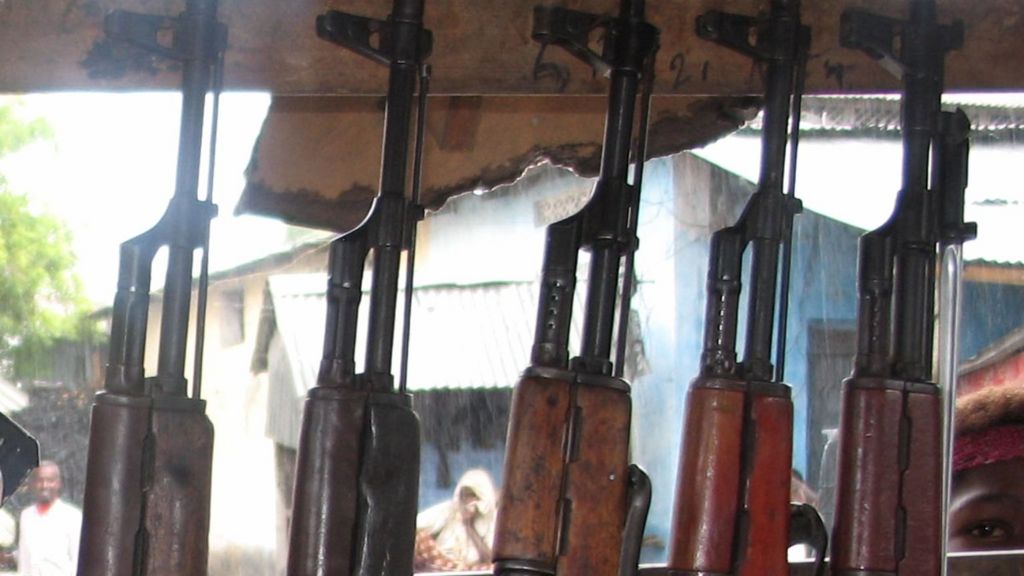
Nearly 20 years after Somalia’s capital Mogadishu was plunged into a new chapter of brutal civil conflict, 34-year-old shopkeeper Yusuf Ali still carries the unspoken psychological scars of his experience as a child combatant. While the city’s physical landscape has slowly rebuilt in recent years, almost no formal support exists for survivors like Ali, who carry intergenerational trauma from decades of near-constant war.
Ali’s story is rooted in decades of instability that began long before he picked up a weapon. When former President Siad Barre’s regime collapsed in 1991, Somalia fractured into chaotic clan warfare that left the country without a functional central government. Just one year after Ali was born, his father was killed in the 1993 Battle of Mogadishu, the infamous clash that saw Somali fighters down two U.S. Black Hawk helicopters and kill 18 American service members. Growing up fatherless in the impoverished northern Mogadishu district of Huriwaa, Ali was shaped by the violence that surrounded him from childhood.
A turning point came in June 2006, when the Union of Islamic Courts (UIC), a coalition of Sharia courts, seized control of Mogadishu and brought a fleeting period of stability after years of clan conflict. For Western policymakers, however, the UIC marked the first major advance of political Islam in Africa after the September 11, 2001 al-Qaeda attacks on the U.S. Washington accused the group of having ties to al-Qaeda, and viewed its rise as a direct security threat. The UIC’s youth military wing, al-Shabab, would go on to become one of the globe’s most persistent militant insurgent groups.
Six months after the UIC took power, a U.S.-backed Ethiopian military invasion launched to oust the Islamist government, with American drones providing surveillance and air support. The invasion was deeply unpopular across Somalia, sparking a fierce armed resistance that united al-Shabab and a coalition of insurgent splinter groups called the Muqawama, or Resistance. By the spring of 2007, heavy fighting had intensified, with artillery and air strikes targeting densely populated civilian neighborhoods suspected of sheltering insurgents.
Ali recalls the night a barrage of shells hit his neighborhood, striking a nearby home and killing a young girl around his age. “Our house shook and I felt like the soil under my feet had moved. I’ve seen death, but nothing prepared me for that night,” he told reporters. His family fled to Elasha Biyaha, a sprawling informal settlement northwest of Mogadishu that became a refuge for hundreds of thousands of displaced civilians.
In the displacement camp, anti-invasion rhetoric from local mosque sermons fired up young people, who were told to defend their country from what were labeled “Gaalo” – the Somali term for non-Muslim infidels. Drawn by the call to resistance, 16-year-old Ali joined the Muqawama, where former army commanders trained him in small arms and hit-and-run ambush tactics. He soon found himself back on the streets of Mogadishu, fighting unpaid in brutal urban combat against Ethiopian troops and allied soldiers from the U.N.-recognized transitional Somali government.
“Street by street, from windows and doorways, we were firing on Ethiopian soldiers and the Somali soldiers with them,” Ali said. “It was either killed or be killed – and this was a cause we were willing to die for.” For two years, much of Mogadishu was reduced to rubble, as all warring parties faced growing international accusations of war crimes. Growing international pressure eventually forced Ethiopian troops to withdraw in 2009, but the Islamist movement fractured into competing factions, with former allies turning on one another.
Ali found himself at a crossroads. Disillusioned by the infighting, and urged by his family to build a new life, he was smuggled across the border to South Africa to live with an uncle, where he worked in his uncle’s shop for five years. A wave of deadly xenophobic attacks targeting foreign-owned businesses eventually drove him back to Mogadishu in the early 2010s.
When Ali returned, he found a capital that had made tangible progress: a functioning international airport, paved roads, new restaurants, and street lighting that made once-dangerous neighborhoods safe after dark. But political instability remained rampant. Al-Shabab had reemerged as a powerful hardline militant group controlling large swathes of rural southern Somalia, where it imposed a strict interpretation of Sharia law, banned music, and enforced restrictive gendered dress codes. The group maintained a sprawling network of spies within Mogadishu, carrying out regular targeted assassinations of government officials and international workers. “No-one trusted each other. No-one dared to speak about politics publicly. Your own neighbours could be spying on you and you wouldn’t even know it,” Ali said.
Today, Ali is married with a 4-year-old son, and runs his own shop in his childhood neighborhood of Huriwaa, once a major al-Shabab stronghold. But reminders of his time as a child soldier are everywhere. He still passes the homes where he fired weapons during street battles, and wonders if the current residents know of the blood that was once shed there. He has never received any form of counseling or mental health support for his trauma – and he is far from alone. Many other former child soldiers he knows have developed drug addictions to cope with their pain, with no access to treatment.
“In Somalia, we don’t talk about our problems,” Ali explained. “I try to find peace through prayer. We pray and keep things to ourselves. This is the culture here and is the reason why many people are hurting but most don’t realise it.”
Human rights experts warn that widespread untreated trauma is a silent, pervasive crisis across Somalia. “The normalisation of violence in some areas means that trauma often goes unrecognised and untreated, making it a silent but pervasive crisis,” said Ilyas Adam, a human rights legal consultant with the Coalition of Somali Human Rights Defenders. “When trauma is normalised, oftentimes individuals do not recognise their need for help. Complicating matters are the cultural barriers, where mental health is not openly discussed.” Adam noted that untreated post-traumatic stress disorder can have long-term debilitating impacts, including chronic mental illness, social exclusion, stigma, and an increased risk that survivors will be re-recruited into armed groups.
Global health data confirms Somalia’s catastrophic lack of mental health infrastructure. A 2021 World Health Organization report found that community-based mental health services were almost non-existent across the country, and as of 2023, the entire nation of 18 million people had just 82 trained mental health professionals.
Worse still, the recruitment of child soldiers continues across Somalia decades after Ali first took up arms. The United Nations recorded more than 2,800 cases of child recruitment by armed groups between 2021 and 2024. While the vast majority of these cases are attributed to al-Shabab, the U.N. also documented 101 cases of recruitment by Somali government forces. Mursal Khalif, a member of parliament and head of the Ministry of Defence’s Child Protection Unit, said anti-recruitment efforts still face resistance, with some Somalis viewing such initiatives as a foreign “Western agenda.” Still, Khalif noted that slow progress is being made, including new vocational training programs designed to help former child soldiers build sustainable livelihoods.
In Ali’s home neighborhood of Huriwaa, however, almost no support services have reached residents. Government officials and international aid workers rarely enter the area, and only do so under heavy armed security. Every evening, as the call to prayer rings out from the local mosque – the site of a 2008 Ethiopian raid that abducted 41 children suspected of being insurgent trainees – Ali is reminded of the cycle of violence that has defined his entire life. Even now, two decades after the 2006 invasion, conflict continues: just this week, government forces and opposition fighters exchanged gunfire in Mogadishu during a dispute over delayed national elections, and more foreign countries have troops deployed in Somalia than at any point in the past 30 years. “The fighting is still ongoing, people are suffering and two decades later, more countries than ever before have troops deployed in Somalia,” Ali observed.