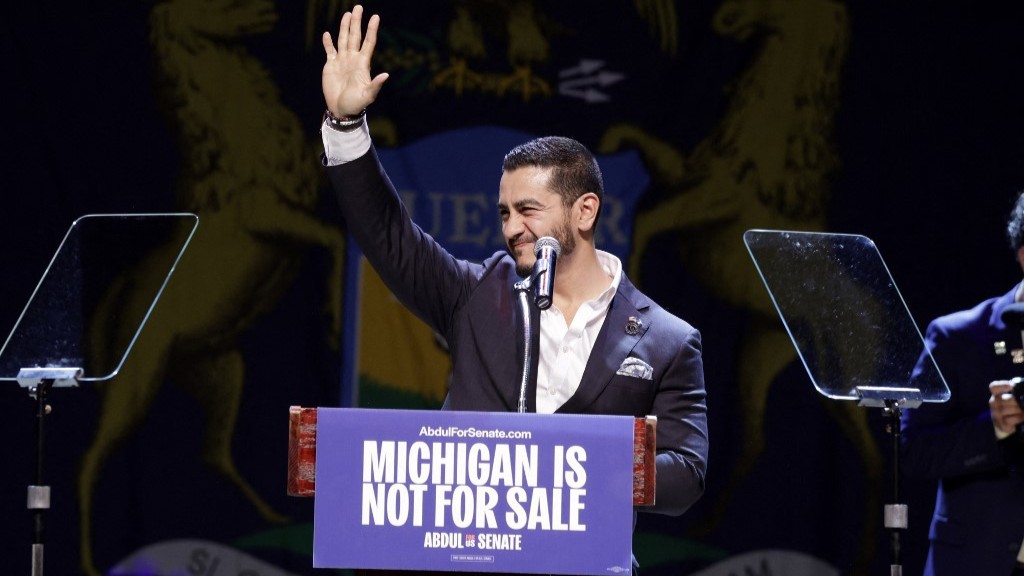
In a seismic upset that has sent shockwaves through U.S. Democratic politics, progressive public health advocate Abdul El-Sayed has claimed the Democratic Party’s U.S. Senate nomination for Michigan, defeating centrist incumbent Congresswoman Haley Stevens in one of the costliest and most closely watched primary contests in modern American history.
NBC News projected El-Sayed’s victory late Tuesday, following a months-long bruising campaign that saw outside interest groups pour more than $60 million into the race — the bulk of that sum directed at blocking El-Sayed from advancing to the general election. With 92.9 percent of expected ballots counted by 8:30 a.m. BST Wednesday, the progressive challenger held a narrow but decisive lead, capturing 48.7 percent of the vote compared to Stevens’ 47.3 percent.
Within moments of the projection, former primary candidate Mallory McMorrow, a state legislator who dropped out of the race weeks before election day, threw her full support behind El-Sayed, unifying progressive factions ahead of the November general election.
The outcome stands as a major political defeat for high-profile pro-Israel lobbying groups, most notably the American Israel Public Affairs Committee (AIPAC), which poured more than $30 million into independent expenditure campaigns to boost Stevens and defeat El-Sayed, one of the Democratic Party’s most prominent and vocal pro-Palestinian voices.
As preliminary vote counts began trickling in early Wednesday, El-Sayed addressed cheering supporters at a Detroit watch party, framing the moment as a stepping stone rather than a final victory. “I wish I could tell you that I was declaring victory right about now,” he told the crowd, while already turning his attention to the general election matchup against former Republican Congressman Mike Rogers.
The 41-year-old former Detroit health director will now face Rogers in November, in a competitive general election race that could decide which party controls the U.S. Senate for the final two years of Donald Trump’s second presidential term. Directing his message to his November opponent, El-Sayed declared: “I know you’re listening, Mike. Mike, we are coming for you.”
El-Sayed’s projected primary win marks a defining watershed moment for both the progressive wing of the Democratic Party and Michigan’s large Arab American electorate. Voters from both groups coalesced around El-Sayed over months of grassroots organizing rooted in widespread opposition to Israel’s military campaign in Gaza and deep frustration with the Democratic Party’s longstanding alignment with pro-Israel advocacy groups.
Throughout the primary, El-Sayed repeatedly criticized AIPAC and its affiliated political action committees for attempting to “buy” the election through unprecedented levels of outside spending. Stevens, for her part, pushed back against claims that she was overly influenced by out-of-state interest groups, arguing that her long record of delivering policy results for Michigan voters made her the stronger candidate.
El-Sayed has repeatedly described Israel’s military operations in Gaza as a genocide — a framing that aligns with positions held by dozens of international human rights organizations and Palestinian advocates, but one that has been rejected by both Israeli officials and every recent U.S. presidential administration. The progressive candidate has also argued that the billions of dollars in annual U.S. military aid sent to Israel should instead be redirected to domestic priorities including expanding healthcare access, building more affordable housing, funding public education, and upgrading crumbling national infrastructure.
His policy positions on the Gaza conflict have resonated deeply with Michigan voters, many of whom organized grassroots opposition to former President Joe Biden during the 2024 Democratic primaries over his unwavering support for Israel’s military campaign.