A fierce political debate has erupted in the UK Parliament after Reform UK leader Nigel Farage called for “pure cold rage” over the conviction of a murderer in a high-profile stabbing case, drawing sharp condemnation from Prime Minister Keir Starmer for overriding the explicit wishes of the victim’s grieving family.
The case at the center of the controversy is the 2023 murder of 18-year-old Henry Nowak, who was stabbed to death in Southampton by 23-year-old Vickrum Digwa, a British Sikh man. Digwa was found guilty of murder last week, but new details that emerged after the verdict amplified existing tensions. Circulating police body camera footage shows Digwa falsely claimed Nowak had assaulted him, leading officers to handcuff the teenager even as he repeatedly told them he had been stabbed and could not breathe. Nowak died at the scene.
Right-wing political and media figures have seized on the case to push claims of so-called “two-tier policing”, alleging authorities deliberately prioritized Digwa’s account over Nowak’s because of the victim’s white identity and the perpetrator’s non-white background. Under mounting pressure from Restore, a new far-right party founded by former Reform UK MP Rupert Lowe – who once led Southampton Football Club and is currently mired in scandal over an unexplained £5 million donation from crypto billionaire Christopher Harborne – Farage doubled down on the rhetoric this week.
In a post on X Tuesday, ahead of a violent far-right riot in Southampton that saw known neo-Nazis clash with police, Farage wrote: “The fear of being called racist was greater than dealing with Henry Nowak’s murder. We should respond to this with pure cold rage. Britain’s historic way of life is being thrown away.” A close ally of Farage told Middle East Eye the Reform leader was standing firmly by his conviction that two-tier policing is a national reality, and that he has no concern about being outflanked on the far right by Lowe’s new party. “The issue isn’t Nowak, but what caused Nowak,” the source said.
What makes Farage’s call for rage particularly controversial is that it directly contradicts a clear public plea from Nowak’s own family. On Monday, outside the courtroom following the guilty verdict, Henry’s father Mark Nowak addressed reporters, urging political actors not to twist his son’s death for divisive ends. “We do not want his death to be used to create further division, hatred or tension. We want his story to make our streets safer for everyone,” Mark Nowak said. “As the prosecution lawyer summed up in court: This is not a case about Sikhism. This is not a case about racism. This is a case about murder.”
When the matter came to Parliament on Wednesday, Starmer echoed the family’s plea and launched a blistering attack on Farage for his actions. The prime minister accused the Reform leader of exploiting the tragedy to stoke national grievance and division, in open disregard of the family’s explicit request.
Starmer said: “A grieving family have asked us not to respond in the way that the leader of Reform has responded… They have lost their son in the most appalling circumstances. They make a simple plea of us as human beings to please not exploit that. Rage – that’s his response to a father who has lost his son and asked for that not to happen. Exploiting this tragedy to create grievance and division would be wrong in any circumstance, but to do it when the family are expressly saying ‘please don’t’ is unforgivable.” He also rejected the core of Farage’s claim, stating: “I don’t believe there is two-tier policing in this country.”
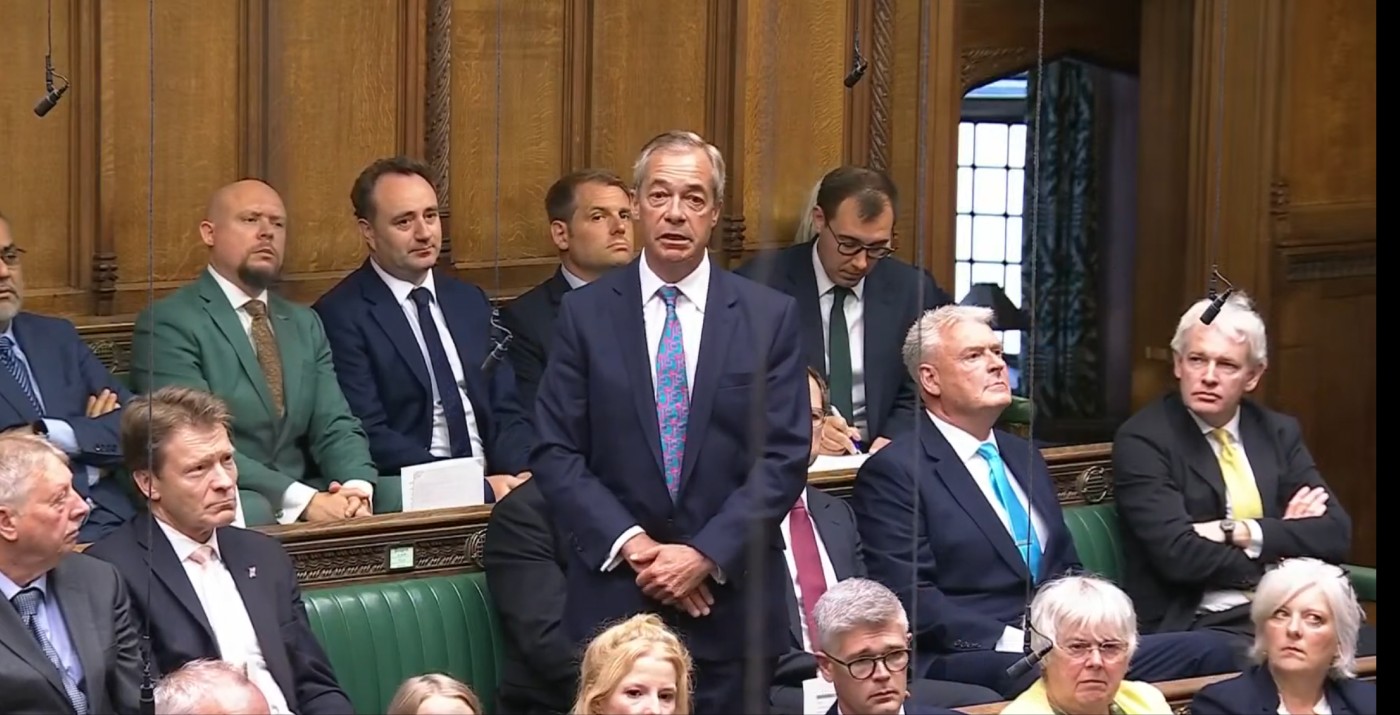
During his own parliamentary address, Farage doubled down on his claims, repeating that “it is now clear to growing millions in this country that we are living under two-tier policing” and calling on Starmer to acknowledge what he called reality. When Farage referenced the violent unrest that had erupted in Southampton the previous night, multiple members of parliament interrupted in outrage, calling on him to condemn the rioting – a demand he did not fulfill. He only warned that public anger “is in danger of getting considerably worse if the public lose trust in being treated fairly by the police.”
This incident has laid bare the growing friction between mainstream UK politics and an emboldened far right, which has increasingly sought to frame individual violent crimes as evidence of systemic bias against white Britons, even when victims’ families reject that framing.