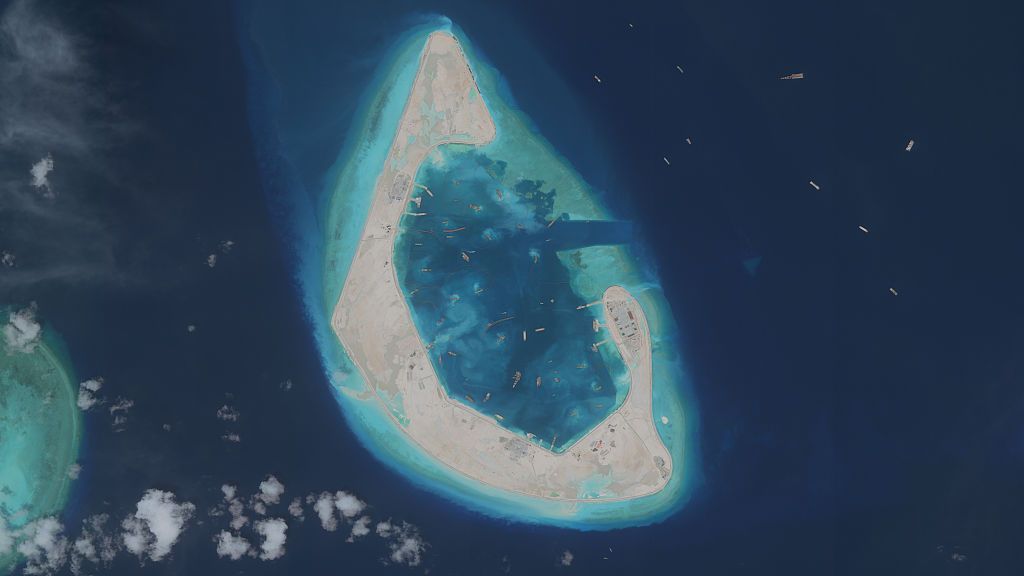
For decades, the South China Sea has remained one of the world’s most intractable territorial flashpoints, with overlapping claims from multiple regional powers turning submerged reefs and tiny atolls into focal points of geopolitical tension. Now, a startlingly fast transformation at one remote outpost has underscored a new, shifting phase of this long-running conflict: quiet land-building by every major claimant, reshaping the strategic map faster than diplomatic efforts can catch up.
Antelope Reef, a teardrop-shaped submerged formation located in the northwestern Paracel Islands chain, stood as little more than a faint turquoise mark on nautical maps until this year. Over the course of just six months, an unprecedented dredging operation has turned this once-underwater feature into a 6-square-kilometer crescent of solid reclaimed land, dotted with early construction and ringed by a protected lagoon that hosts dozens of working vessels. Those vessels are almost exclusively large cutter-suction dredgers, part of China’s globally unmatched fleet of maritime construction equipment — some units can extract up to 6,000 cubic meters of seabed sediment per hour, a volume equivalent to filling two full Olympic-sized swimming pools. Maritime analysts say the speed of the Antelope Reef project is likely unprecedented in the history of large-scale land reclamation.
China is not the only claimant pursuing this strategy, however. After years of observing China expand its territorial footprint through land reclamation, Vietnam has accelerated its own building activities on the reefs it controls in the region. Smaller-scale reclamation is also underway by other claimants, including the Philippines.
The Paracel Islands, where Antelope Reef is located, are one of two major disputed archipelago chains in the South China Sea, alongside the Spratly Islands. Multiple nations, including China, Taiwan, Vietnam, the Philippines, Malaysia, and Brunei, lay competing claims to the area’s landforms, resource rights, and maritime boundaries. Most of the islands and reefs in the chains were submerged and uninhabited until recent decades. China first took full control of the Paracel Islands in 1974, following a short armed conflict with then-South Vietnamese forces.
In recent years, China completed large-scale reclamation on three major Spratly Islands — Mischief Reef, Fiery Cross Reef, and Subi Reef — transforming them into permanent landmasses large enough to host military airports and defense infrastructure. These projects supported China’s long-standing claim to nearly the entire South China Sea under the widely contested nine-dash line it marks on official maps. Today, large fleets of Chinese coast guard vessels and maritime militia patrol the area within the nine-dash line, effectively outmatching efforts by smaller claimants to challenge Chinese control. Frequent standoffs and clashes between Chinese forces and the far smaller Philippine coast guard have become common in overlapping claim areas in recent years.
Visible straight shoreline grading on the new Antelope Reef has led some analysts to speculate China is preparing to build another military-grade runway, matching the infrastructure it already operates on the three Spratly outposts. But given that China already maintains a fully operational airbase on nearby Woody Island in the Paracels, and the region is already within easy strike range of major Chinese military facilities on Hainan Island, a new runway would likely be redundant. Instead, analysts say the rapid reclamation is almost certainly a calibrated strategic message to Hanoi.
Vietnam and China have a long history of territorial disputes over the South China Sea, which Hanoi refers to as the East Sea. In recent years, Vietnam’s leadership has softened public anti-China rhetoric and prioritized building closer bilateral ties with Beijing. Vietnam’s newly elected President and Party General Secretary To Lam made his first international state visit to China in 2026, where both sides used unusually conciliatory language to acknowledge their ongoing differences over the Paracel and Spratly chains. While Vietnam has issued a formal diplomatic protest over China’s Antelope Reef construction, the statement was deliberately restrained and measured.
Behind this diplomatic softening, however, Vietnam has pursued its own aggressive campaign of land reclamation across the reefs it controls, using the same large cutter-suction dredger technology China pioneered. According to the Washington-based Asian Maritime Transparency Initiative (AMTI), Vietnam has carried out sand pumping operations on at least 20 reefs over the past three years, creating 11 new purpose-built harbors. Hanoi now controls more than 11 square kilometers of reclaimed land in the region — roughly half the total area held by China. Vietnam has also begun constructing military-aligned infrastructure such as navigation beacons, leading observers to summarize Hanoi’s approach as: if you cannot outcompete China, you match its land-building strategy.
“The Vietnamese have been less willing to be at the forefront of the public diplomatic battle over their disagreements with China,” explained Greg Poling, director of AMTI. “They’re much more comfortable letting the Filipinos lead that public push. But on the water, we have seen the Vietnamese being far more willing to stand up to Beijing. As a result, China has mostly backed off from efforts to block Vietnamese oil and gas drilling, for example.”
Ray Powell, director of Stanford University-based South China Sea monitoring program Sealight, says this quiet Vietnamese expansion is exactly what prompted China’s rapid work on Antelope Reef. “Vietnam has been taking advantage of China’s focus on tensions with the Philippines… The reclamation at Antelope Reef could be considered as China’s answer, reminding Vietnam who the major power in the region is.”
So what does this new wave of land reclamation mean for the other claimants locked in the dispute? For 30 years, the Association of Southeast Asian Nations (ASEAN) has led attempts to negotiate a binding code of conduct between China and the four ASEAN member states that are also South China Sea claimants. A non-binding Declaration of Conduct was reached in 2002, but it carried no legal weight, and China has largely disregarded its provisions for de-escalation. Every year, ASEAN leaders reiterate their commitment to reaching a binding agreement, but no meaningful progress has materialized after decades of talks.
Frustrated by the stalled diplomatic process, the Philippines launched a formal case against China’s territorial claims at the Permanent Court of Arbitration in The Hague in 2013. The court issued a sweeping ruling in favor of the Philippines, concluding that China’s sovereignty claims within the nine-dash line had no basis in historical or international law, and that its reclamation activities violated the Philippines’ exclusive economic zone rights. China has refused to recognize or abide by the ruling, prompting the Philippines to adopt a new strategy of public confrontation, sending outnumbered coast guard vessels to challenge Chinese fleets in contested waters. These encounters have resulted in frequent tense clashes, but have done little to shift the region’s vast power imbalance.
In recent years, the Philippines has also deepened military cooperation with the United States, and built new security partnerships with Japan and Australia. The U.S. has provided strong diplomatic backing for Manila’s position, alongside $500 million in military aid and new defense equipment. U.S. Navy vessels periodically conduct Freedom of Navigation Operations through the South China Sea alongside allied partners, to affirm the region’s status as international waterways open to all traffic, despite China’s claims. But these missions are largely symbolic, and have not altered the on-the-ground status quo.
Today, the Philippines is also expanding its own limited footprint in the Spratlys. Manila is lengthening the runway on Thitu Island (known locally as Pagasa Island), building a new coast guard base there, and reinforcing the grounded landing craft BRP Sierra Madre, which has hosted a small Philippine military detachment on Second Thomas Shoal since it was run aground in 1999, despite constant harassment by Chinese vessels.
Poling notes that most claimants have now abandoned hope of reaching the binding code of conduct that was once the core goal of regional diplomacy. “China just continues to do whatever it wants on the water, eroding the sovereignty of other claimants. So what I think you are eventually going to see is a non-binding agreement. But perhaps that will open up diplomatic space for Vietnam, the Philippines, Malaysia and the others to pursue more effective negotiations among themselves without having to go through ASEAN.”
This new landscape, where every claimant pursues incremental expansion of the territory it already holds, while accepting China’s position as the region’s dominant and most assertive power, has become the new reality of the South China Sea dispute.