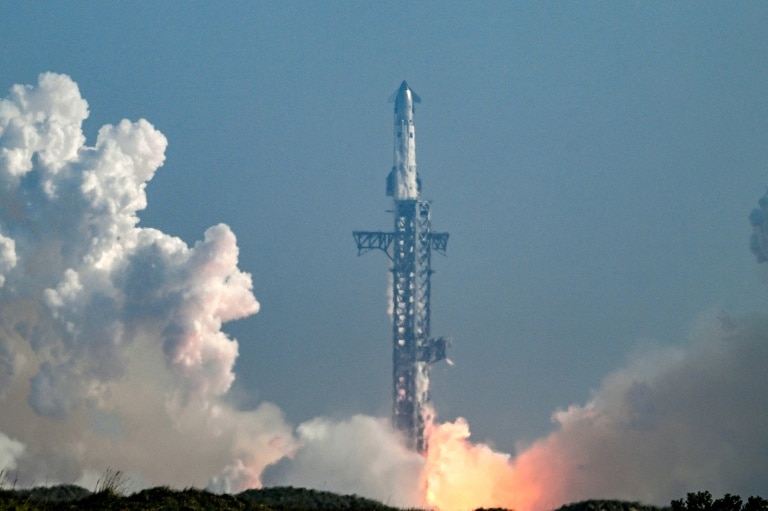
Elon Musk’s aerospace and satellite technology powerhouse SpaceX has unveiled plans for a record-breaking initial public offering (IPO), seeking to raise roughly $75 billion that would catapult the company to a $1.765 trillion valuation, according to a regulatory filing submitted by the firm on Wednesday.
Under the terms of the offering, the company will put 555,555,555 shares up for sale at an opening price of $135 per share. If the offering closes successfully, SpaceX will blow past the previous global IPO fundraising record set by Saudi energy giant Saudi Aramco, which pulled in $25.6 billion when it went public in 2019. With approximately 13 billion outstanding shares, the IPO pricing sets the firm’s full valuation at the $1.765 trillion mark.
Industry analysts note that the landmark listing could also make Musk — already the world’s wealthiest individual — the first person in history to reach a trillion-dollar net worth. The IPO comes amid a sweeping consolidation of Musk’s sprawling business empire. In February, SpaceX acquired Musk’s artificial intelligence startup xAI, which itself absorbed the X social platform, formerly known as Twitter, just 12 months earlier. Analysts widely project further consolidation by 2027, when they expect SpaceX to merge with Musk’s electric vehicle and clean energy firm Tesla, which has increasingly expanded its focus into robotics, grid energy storage and autonomous transport. The two companies already collaborate on major joint projects, including the Terafab facility, a massive semiconductor manufacturing plant currently in development.
One of SpaceX’s most mature revenue-driving businesses is its StarLink satellite broadband service, which launched commercial operations in 2020. The service upended the global satellite internet industry by delivering fast connectivity at a far lower price point than existing competing offerings, and now counts more than 10.3 million subscribers across 164 global markets. StarLink has drawn global attention for its deployment to critical users including Ukrainian military personnel amid the ongoing Russian invasion and Iranian pro-democracy protesters facing government internet shutdowns, and has emerged as a key consistent cash flow source for the capital-intensive aerospace firm.
Beyond commercial satellite operations, SpaceX holds a central role in NASA’s Artemis program, the U.S. space agency’s initiative to return humans to the Moon for the first time since the historic Apollo missions more than 50 years ago. While the company was not involved in April’s Artemis II lunar flyby mission, it is developing a lunar lander alongside Blue Origin, founded by billionaire Jeff Bezos, for the program’s upcoming crewed landing target set for 2028. NASA plans to conduct in-orbit rendezvous tests between its core spacecraft and the new landers in 2027, ahead of the planned landing the following year, though agency officials acknowledge that timelines for the ambitious program are subject to adjustment.
SpaceX has also been open about its long-term goal of landing the first humans on Mars, with Musk’s executive compensation package tied to the goal of establishing a self-sustaining colony of one million people on the red planet. Musk has repeatedly framed the Mars colonization project as critical to ensuring the long-term survival of humanity as a species in the face of potential planetary catastrophic events.
Until SpaceX’s stock officially begins trading on public exchanges, direct share purchases will be limited to large institutional investors such as large banks and pension funds, as well as accredited high-net-worth individuals. By the time retail investors are able to buy shares on the open market, many of the early windfalls that turned early backers of tech startups into millionaires and billionaires may already be off the table, market observers note.
The unprecedented $1.765 trillion valuation is largely viewed by industry analysts as a reflection of investor faith in Musk’s ability to deliver on the company’s ambitious, often science fiction-like long-term goals, from Mars colonization to deploying orbital data centers, rather than a valuation based purely on SpaceX’s current operational revenue. Even after the public listing, Musk is projected to retain majority control of the company, holding more than 80% of total voting power. This controlling stake will allow him to unilaterally shape the outcome of all matters requiring shareholder approval, according to Wednesday’s regulatory filing.
Founded in 2002, SpaceX has pioneered a new era of private commercial spaceflight. In 2012, one year after NASA retired its iconic Space Shuttle fleet, SpaceX completed the first ever docking of a private commercial spacecraft with the International Space Station (ISS), and has since carried out dozens of successful regular cargo resupply missions to the orbiting laboratory. For most of the 2010s, NASA relied on Russia’s state space program to transport astronauts to and from the ISS, a dynamic that changed in 2020 when SpaceX became the first private space company to launch crewed missions to the station, restoring the United States’ independent human spaceflight capability. The company’s heavily produced live streams of rocket launches have attracted massive global audiences on social media, and drawn tens of thousands of spectators to launch sites across the United States.