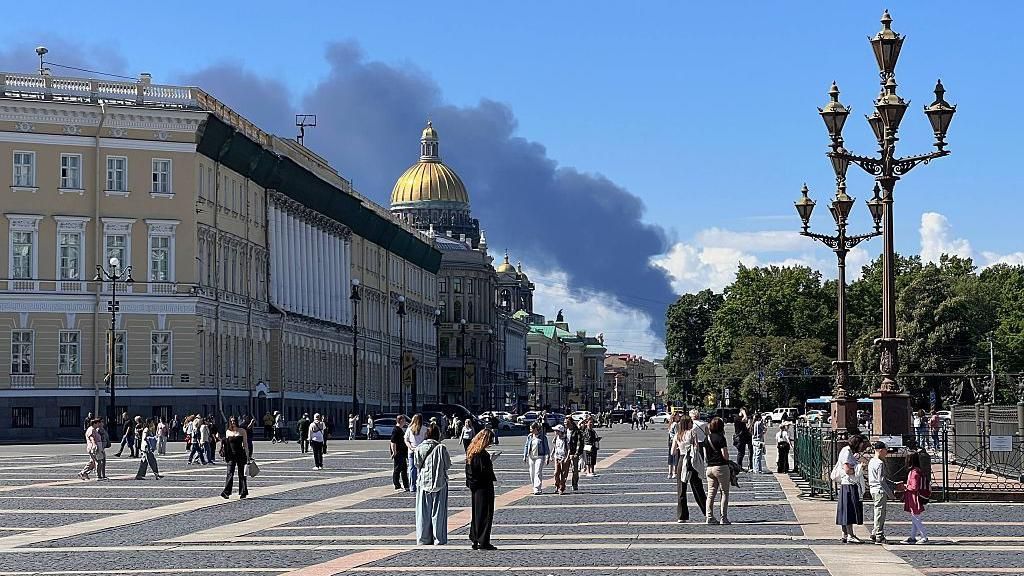
In a coordinated attack timed to overshadow Russia’s flagship international economic gathering, Ukraine launched a wave of drone strikes on the outskirts of St Petersburg early Wednesday, just hours before the opening of the annual St Petersburg International Economic Forum, an event designed to draw foreign direct investment back to Russia amid sweeping Western sanctions. As dawn broke over Russia’s second-largest city, thick plumes of black smoke billowed into the sky from a burning oil terminal, a visible marker of the attack that disrupted operations across the region. Local Russian authorities confirmed that air defense systems intercepted 59 drones launched overnight, but debris from the downed unmanned vehicles hit three separate districts of St Petersburg. Remarkably, no fatalities were reported in the strikes, though critical infrastructure was impacted: mobile internet connectivity was disrupted across parts of the city, and St Petersburg’s Pulkovo International Airport was temporarily shut down to all air traffic as a security precaution. The ripple effects of the attack extended beyond Russia’s borders, with neighboring Latvia and Estonia both issuing temporary air raid alerts for their northern border regions. Hours after the initial attack, Ukrainian President Volodymyr Zelensky publicly confirmed responsibility for the strikes, confirming that targets included the burning St Petersburg oil terminal and a key Russian naval outpost in Kronstadt, a coastal town just off St Petersburg’s shoreline. In a post on his official social media channels, Zelensky framed the attack as part of what he called Ukraine’s “long-range sanctions plan” — a widely understood euphemism for long-distance strikes against Russian infrastructure that supports its invasion of Ukraine. “The Ukrainian plan of long-range sanctions is being implemented exactly as it is needed to bring peace closer,” Zelensky wrote. Kronstadt holds major strategic significance for Russia, as it serves as the primary forward base for the Russian Navy’s Baltic Fleet. Unverified footage posted to social media by Ukrainian military personnel showed drones approaching docked Russian naval vessels at the base, with the video cutting out moments before expected impact. Robert Brovdi, commander of Ukraine’s unmanned systems forces, later claimed via Telegram that the Russian corvette Boikiy had sustained direct damage in the attack. The timing of the strike carries significant symbolic weight, as the St Petersburg International Economic Forum — long nicknamed the “Russian Davos” — is the cornerstone event on Russia’s annual political and economic calendar. Prior to Moscow’s full-scale invasion of Ukraine in February 2022, the forum regularly drew high-profile Western delegations, including Fortune 500 CEOs and sitting heads of state. This year, for the first time in nearly 10 years, a low-profile unofficial delegation from the United States is scheduled to attend, led by Rodney Mims Cook Jr., head of the U.S. Commission of Fine Arts and the official overseeing former President Donald Trump’s White House ballroom renovation project. Controversial U.S. right-wing commentator Candace Owens and pro-Putin American actor Steven Seagal are also listed as attendees. A senior official with Ukrainian defense technology firm Fire Point, Denys Shrilierman, leaned into the timing of the attack in a playful post on X (formerly Twitter), writing: “Due to such distinguished guests and the importance of the event itself, we couldn’t ignore it – and urgently flew to [St Petersburg].” The post was paired with drone footage of unmanned vehicles crossing the Baltic sky followed by clips of thick black smoke rising from unnamed locations along St Petersburg’s seafront. The St Petersburg strikes mark a notable milestone in Ukraine’s evolving strike capabilities: in the more than four years since Russia launched its full-scale invasion, Kyiv has built a rapidly expanding domestic defense sector, allowing it to regularly produce and deploy long-range drones that can strike targets deep inside Russian territory. Ukraine has focused most of these long-range attacks on energy and oil infrastructure, framing these facilities as critical components of Russia’s war machine that fund its military operations. The strikes on St Petersburg came amid continued tit-for-tat attacks across the front lines and behind enemy lines. On the same Wednesday as the St Petersburg attack, a Russian-installed official in the Moscow-controlled Donetsk region of eastern Ukraine reported that seven civilians were killed when a drone struck a passenger bus traveling along a regional highway. For its part, Russia continues to launch large-scale combined missile and drone strikes across major Ukrainian cities, resulting in consistent civilian casualties. Just two days before the St Petersburg attack, Russian strikes across multiple Ukrainian regions killed at least 22 civilians and injured dozens more, according to Ukrainian emergency officials. In the wake of the St Petersburg strikes, Kremlin spokesman Dmitry Peskov confirmed that Moscow planned a coordinated response to the Ukrainian attack. “Our responses will be systemic in nature,” Peskov told reporters Wednesday, offering no additional details on what form the retaliation would take.