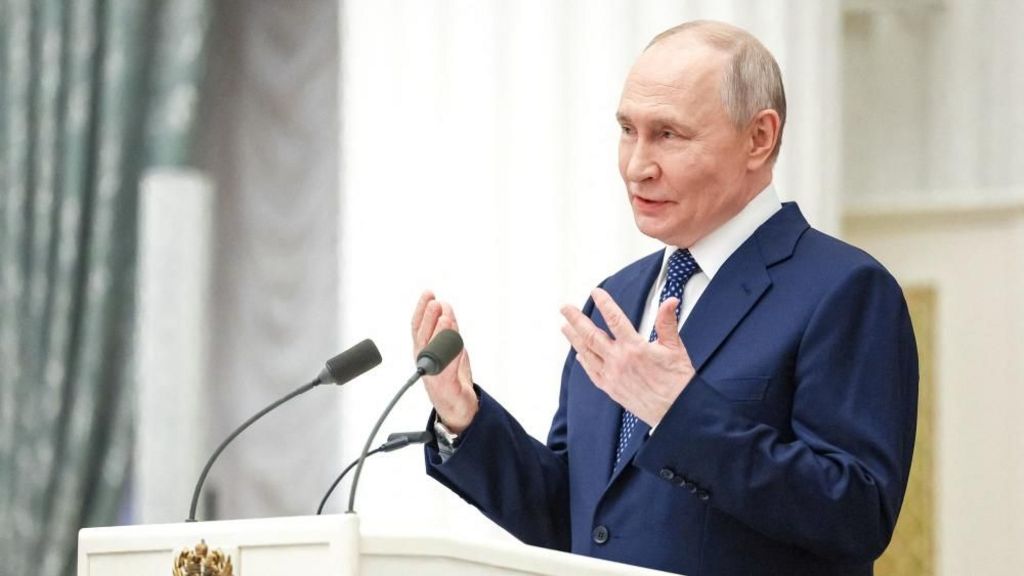
Five years into Russia’s full-scale invasion of Ukraine, the Russian state remains unapologetic in its prosecution of the war, with President Vladimir Putin doubling down on his commitment to achieve Moscow’s stated aims even as the originally planned short operation has devolved into a grinding, costly stalemate.
The defining posture of modern Russia in 2026 is best captured by a blunt remark from popular folk singer Nadezhda Babkina, who, after receiving a state honor from Putin at the Kremlin, declared that Russia’s multi-ethnic national unity would never allow surrender, adding “Anyone who doesn’t like that can go and poison themselves.” That uncompromising tone echoes longstanding messaging from Russian Foreign Minister Sergei Lavrov, who once framed Russia as unashamed of its identity and actions on the global stage – a description that fits Putin himself, who has never expressed remorse for ordering the 2022 invasion and shows no intention of halting military operations.
Just ahead of this year’s St Petersburg International Economic Forum, Russia’s flagship event designed to attract global investment and showcase the country to international audiences, Moscow launched another massive wave of missile and drone strikes across Ukrainian territory. While high-profile Western investors and political figures abandoned the forum years ago, organizers claim delegations from more than 130 countries and territories are still set to attend. Even so, a years-long active war on a neighboring country is hardly an ideal selling point for a nation courting foreign capital – a contradiction that does little to shift Moscow’s behavior.
Putin’s public demands remain unchanged: he continues to insist Ukraine cede full control of the entire Donbas region to Russia. What has shifted, however, is Moscow’s earlier high hopes for a favorable peace deal brokered by U.S. President Donald Trump. Last year, following the Anchorage summit between Trump and Putin, senior Russian officials repeatedly praised the so-called “spirit of Anchorage”, suggesting the two leaders had reached a mutually beneficial understanding that would force Kyiv to accept Moscow’s maximalist terms. Today, that optimism has faded: Putin’s top foreign policy aide Yuri Ushakov recently told Russian state television he has never used the phrase, a quiet signal that the once-touted diplomatic breakthrough has all but evaporated.
That dashed hope is one of many factors fueling Putin’s growing frustration. What was planned as a quick, short-term “special military operation” has become a bloody war of attrition entering its fifth year, leaving Russia with massive battlefield casualties, deep economic damage from sweeping international sanctions, and eroded technological capacity. The conflict has increasingly moved into Russian territory as well: Ukrainian drones now regularly strike deep inside the country, targeting key energy infrastructure including oil refineries. A large-scale drone attack on the Moscow region last month exposed gaps in the capital’s air defense network, prompting officials to scale back the iconic annual 9 May Victory Day parade on Red Square amid security fears. Sanctions and prolonged war have also strained Russia’s public finances, with a growing budget deficit and stagnant economic output becoming persistent problems.
Rather than drawing down military operations to address these challenges, the Kremlin has opted for escalation, as demonstrated by the recent large-scale air raids on Ukrainian cities. Moscow frames the escalation as a response to a Ukrainian strike on a building in Starobilsk, a city in occupied eastern Ukraine, which Russia says was a student dormitory that left 21 dead. Ukraine confirms it targeted the headquarters of Russia’s elite Rubicon drone unit in the area but has not confirmed whether the building matched the one Russia identified.
As Putin prepares to address delegates at the St Petersburg forum – a traditional venue for him to lay out his worldview and criticize the West – there is no indication he will use the speech to signal any shift in Russia’s position on the war. That said, faint signs of a growing domestic debate over the future of the conflict have begun to emerge, even within Russia’s tightly controlled media ecosystem.
Writing in *Russia In Global Affairs*, a journal closely tied to Russia’s foreign policy establishment, prominent political scientist Vasily Kashin recently concluded that the core goal of removing the current Ukrainian government is fundamentally unachievable at this stage without a long-term full military occupation of the entire country – a step that is technically out of Russia’s reach. Other Russian commentators have echoed similar uncertainty: pro-Kremlin tabloid *Moskovsky Komsomolets* quoted political analyst Alexander Nosovich noting that the expert community is split, with one camp pushing to continue the war until all stated goals are met and the other arguing it is time to end the conflict, warning that the worst outcome is not defeat, but an endless open-ended war.
In a striking break from the dominant narrative that frames Russia as a nation defined by victory, lawyer Dmitry Krasnov argued in the same outlet that throughout Russian history, lost wars and humiliating truces have often paved the way for critical reforms, breakthroughs and eventual future victories, suggesting major geopolitical setbacks can sometimes be more useful than military triumphs. When reporters attempted to access the article online days later, it had been removed, with a 404 access denied error appearing. While a limited public discourse over the war is emerging, it still operates within clear, strict boundaries set by the Kremlin.
With no shift in Putin’s position and no diplomatic breakthrough on the horizon, an end to the devastating conflict remains as distant as ever.