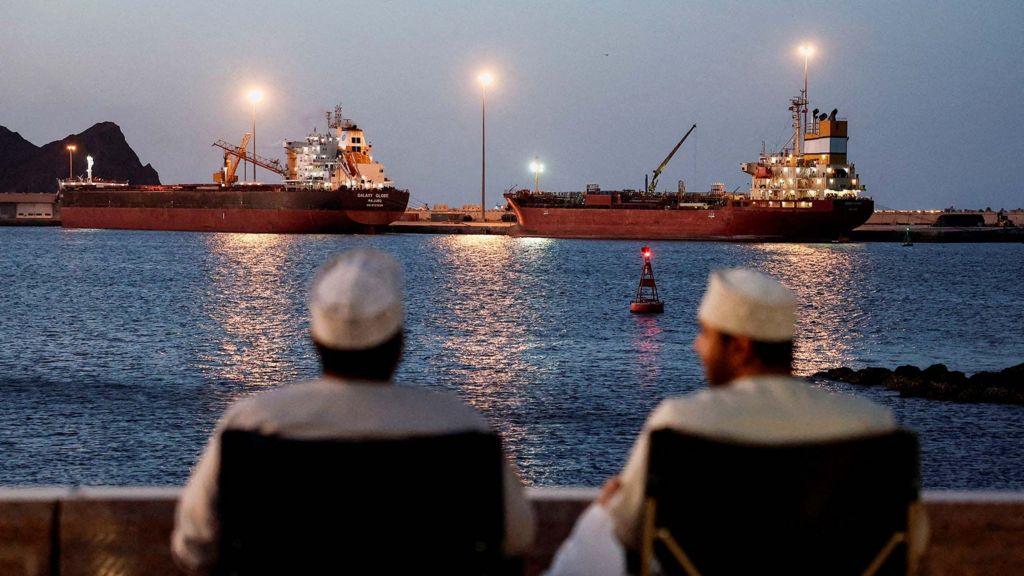
For Pakistani captain Hassan Khan, who asked to keep his real identity hidden for safety, the glassy calm of the Gulf waters can often lull him into a fleeting moment of normalcy — before the weight of his situation crashes back. Three months have passed since his vessel, along with roughly 1,600 other commercial ships, became trapped in or near the Strait of Hormuz after the outbreak of the US-Israeli war with Iran in late February.
Once the beating heart of global energy trade, carrying one-fifth of the world’s daily oil and gas supplies, this vital chokepoint has been reduced to a deadly no-man’s-land. Missiles streak across the sky above while uncharted mines drift beneath the surface, bringing all commercial transit to a grinding halt. An estimated 20,000 sailors remain stuck on vessels stranded on the wrong side of the strait, cut off from the open ocean and facing a daily battle against fear, exhaustion, and growing resource scarcity.
On Khan’s ship, the crew has attempted to cling to familiar routines to maintain some semblance of normalcy. But the old dynamic has vanished entirely. Rarely do any crew members volunteer for the infrequent, tightly restricted shore leave. Lighthearted crew banter has been replaced by tense, anxious silence, broken only by the constant vibration of mobile phones as sailors check in with frantic family members back home. Even in their sleep, crew members startle awake at the smallest unexpected noise. “The stress never leaves our minds,” Khan explained. “Everyone is worn out, completely drained both physically and mentally.”
The logjam of trapped vessels began days after the war started, when Iran closed the Strait of Hormuz — the only navigable exit from the Gulf to the Indian Ocean — and barred all commercial traffic from passing without explicit government approval. “It’s like being stuck in a pond with only one drain, and that drain is Hormuz,” described Shafiqul Islam, captain of the Bangladesh-owned bulk carrier *Banglar Joyjatra*, which is carrying 37,000 tonnes of fertiliser bound for South Africa.
Islam has made two attempts to exit the Gulf over the past three months, and both have ended in disappointment. Following an April 8 ceasefire announcement, Islam learned that another commercial vessel had secured passage approval from the Islamic Revolutionary Guard Corps (IRGC). He steered *Banglar Joyjatra* toward the strait alongside four other trapped ships, only to be turned away by Iranian military warnings before they could reach the waterway.
Nine days later, a second opportunity appeared to open up when Iranian officials announced the strait would be “fully open” to all commercial traffic in compliance with the ceasefire terms. But Iran abruptly reversed its decision after the United States refused to lift its ongoing naval blockade of Iranian ports. By that time, Islam’s ship was already within 30 nautical miles of the strait, and he was forced to turn back amid repeated radio warnings of imminent attacks. Islam counts himself lucky, however: just two days into the conflict, his ship was anchored only 200 meters from Dubai’s Jebel Ali Port, a facility that was targeted in an Iranian retaliatory strike. Since then, he and his 30-member crew have witnessed dozens of attacks firsthand. “Sometimes missiles pass right over a nearby ship, and other times falling debris lands on the deck of the next vessel,” Islam said. “When attacks run all through the night, none of us can even close our eyes to sleep.”
“ We have seen horror and destruction with our own eyes,” added Rashedul Hasan, the *Banglar Joyjatra*’s chief engineer. Their fear is well-founded: the International Maritime Organisation (IMO) confirms that at least 11 sailors have been killed and one more remains missing across 39 verified violent incidents in the area.
While the April ceasefire has reduced large-scale hostilities, the region remains on edge. Military activity continues to be a daily sight: sailors regularly spot drones, fighter jets, naval warships and submarines patrolling the waters. “The military vessels use bright searchlights and broadcast warnings over loudspeakers. They do this to deter any ship from trying to cross,” explained Sajid Masood, a Pakistani cook working on a stranded oil tanker who also requested a pseudonym for security.
Beyond the constant threat of violence, trapped crews are facing a growing humanitarian crisis as critical supplies run short and prices skyrocket. While the Gulf’s major hubs, including Dubai, Abu Dhabi and Kuwait City, maintain established ship supply networks, delivery schedules have become completely unpredictable. For vessels that have shifted to safe anchorage off UAE ports, the cost of basic provisions has jumped exponentially. Hasan told reporters that a recent 180-tonne water delivery that would have normally cost between $1,500 and $2,000 wound up costing the crew $11,000. An anonymous South Korean sailor trapped on a different vessel accused some suppliers of price gouging, saying “it feels like many vendors are deliberately exploiting this crisis to charge inflated prices and make excessive profits.”
The situation is set to worsen as summer approaches. Regional air temperatures already topped 30 degrees Celsius in May, and are expected to climb as high as 45 degrees Celsius in the coming months, increasing ships’ daily water demand for cooling and crew use. On Khan’s vessel, the crew still has enough staples to get by, but fresh produce and legumes have become almost impossible to source. “We can still get beef and chicken, but the easy access to fresh foods we had before is gone,” Khan said.
For shipping companies, the crisis has already resulted in billions of dollars in lost revenue and cargo delays, and many are already planning to cut staffing costs to offset losses. For the trapped sailors, the human cost is far higher: most sailors’ employment contracts are expiring, and large-scale crew rotations have been put on hold indefinitely. Many seafarers are now rethinking their decision to work in the industry, saying the crisis has exposed just how quickly access to international waterways can become a weapon in future conflicts.
Masood, whose contract ends in just one month, says he is now reconsidering his decades-long career at sea. But for now, his only focus is getting home to his family in Pakistan, where he planned to bring back gifts: Barbie dolls for his two daughters and a toy airplane for his young son. “I thought I would be home weeks ago, but we’re still stuck here,” he said. “Every single day my family messages asking when I’ll come home, and I have no answer to give them.”
A small number of vessels — roughly 750 since late February, according to maritime analytics firm Kpler — have managed to secure passage through the strait. Jonathan Schroden, a researcher at Washington DC-based non-profit think tank CNA, noted that most of these successful transits are for vessels owned by companies from China, India, or Pakistan, and rely on direct government diplomacy with Tehran. “On top of diplomatic support, it appears ship owners have also paid a transit fee running into millions of dollars per vessel,” Schroden added.
For the *Banglar Joyjatra*, diplomatic negotiations with Iran are the crew’s only path out. The Bangladeshi government has been working alongside the ship’s owner, state-run Bangladesh Shipping Corporation (BSC), to secure exit approval. Initially, BSC and the government agreed to pay the transit fee Iran demanded, but the plan collapsed after the United States threatened to impose sanctions on any entity that complied with Iran’s terms. “We are caught between two sides now,” said BSC managing director Commodore Mahmudul Hasan. “We are facing a double crisis that we can’t seem to escape.”
Even for crew members who have managed to hold onto hope, the uncertainty of each passing day wears on. Hasan, the *Banglar Joyjatra*’s chief engineer, says he still believes the crew will get through this “critical moment” — but for thousands of trapped sailors across the Gulf, every day stuck at anchor is another day of fear, uncertainty, and waiting for a way home.