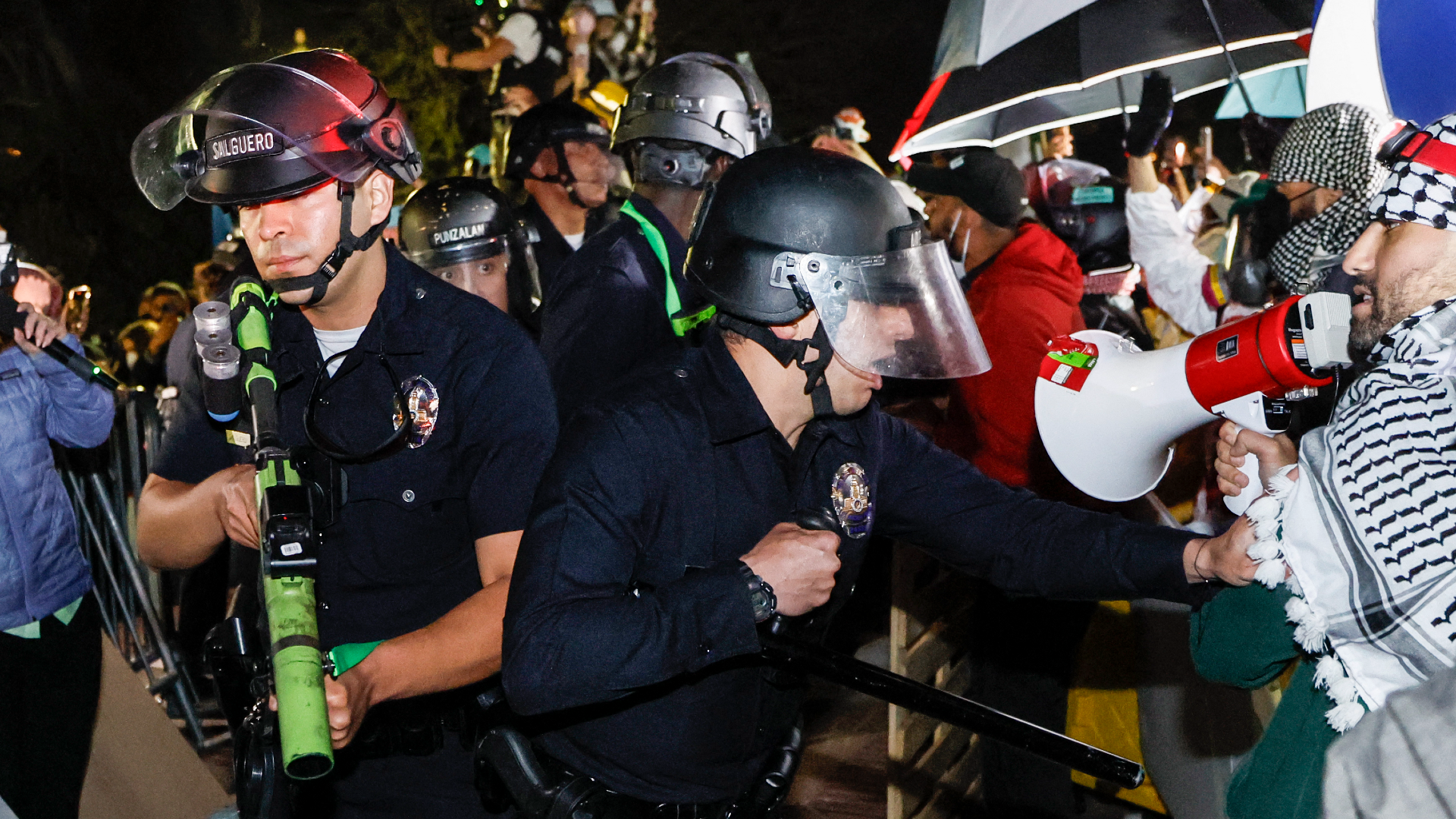
On May 2, California Highway Patrol (CHP) cleared a pro-Palestine student encampment on the campus of the University of California, Los Angeles, launching one of the most high-profile police interventions at a U.S. university protest this year. This week, more than two months after the clearance operation, CHP released an official report defending the agency’s actions, arguing that the 57 so-called “less lethal” kinetic projectiles fired at encampment protesters were fully justified under state law.
The CHP’s report outlines a confrontational narrative of the clearance operation. It claims responding officers faced sustained “assaultive resistance” from protesters, who allegedly hurled dangerous projectiles at law enforcement. These included frozen water bottles, containers of urine and other unidentifiable liquids, unopened 12-ounce soda cans, fragments of plywood, wooden poles, and both full and empty fire extinguishers of varying sizes. The report further alleges that protesters deployed fire extinguishers and unknown chemical irritants directly against officers, leaving some temporarily blinded and struggling to breathe. In response to what it frames as an imminent threat to officer safety, CHP defends its use of force, emphasizing that no kinetic projectiles were fired indiscriminately into the crowd. The report breaks down the ammunition used: 33 bean bag rounds fired from 12-gauge shotguns, and 24 sponge rounds launched from 40mm grenade launchers. On the topic of de-escalation protocol, the report adds that a police captain issued 29 repeated audible dispersal orders before the use of force, complying with legal requirements for advance notification.
This official justification has been immediately called into question by independent law enforcement experts who reviewed publicly available footage of the operation. Former police lieutenant Jeff Wenninger, a specialist in investigating officer use-of-force incidents, is one of two experts who examined video recorded by independent news outlet CalMatters. He argues CHP’s report lacks any tangible evidence to back up its claim that protesters posed an imminent threat to officers. Contrary to the report’s narrative, Wenninger’s review found no visual evidence that protesters attacked or threatened law enforcement before projectiles were fired.
He further documented multiple clear violations of California state use-of-force law during the operation. Wenninger confirmed that one officer illegally fired a sequence of bean bag rounds directly into a dense crowd of protesters. A separate independent review of footage by the Los Angeles Times corroborated these findings, confirming that officers not only fired into large crowds of protesters, but also repeatedly aimed projectiles at protesters’ heads – a practice explicitly banned by state law. Current California regulations prohibit aiming kinetic projectiles at heads, necks, and other vital organs, and limit their use exclusively to situations where officers face an immediate threat of death or serious bodily harm. The CHP report verbatim cites this legal threshold to justify its actions, but Wenninger says the evidence simply does not support that claim.
The CHP report was not a voluntary review: it was mandated by a state law passed after police used similar kinetic projectiles to severely wound multiple protesters during the 2020 George Floyd uprisings, which imposed strict new reporting requirements for the use of less-lethal ammunition. Public health research backs up critics’ concerns about these weapons: an analysis published by the Harvard University Health Law Journal confirms that while marketed as “less lethal,” these rounds are inherently inaccurate at long ranges and can cause fatal injury even at close range.
The clearance operation that prompted this debate was the culmination of three days of escalating tension on the UCLA campus. Reporting from UCLA’s independent student newspaper the Daily Bruin has reconstructed the timeline of events that led up to the May 2 police intervention. Between the evening of April 30 and the early hours of May 1, the pro-Palestinian encampment was attacked by more than 100 counter-protesters and outside agitators, who used chemical sprays, fireworks, and wooden clubs to assault encampment residents. Dozens of protesters were injured in the attack, and many required hospital treatment. Despite the ongoing violence, police took more than three hours to intervene and disperse the attackers, drawing widespread criticism from pro-Palestine students who said law enforcement had failed to protect them. When CHP moved in to clear the encampment the following night, students confronted officers shouting, “Where were you yesterday?” referencing the unaddressed violence 24 hours prior.
The confrontation at UCLA is part of a global wave of pro-Palestine student encampments that have taken place on university campuses since the outbreak of the 2023 Israel-Gaza war. Dozens of university administrations around the world have responded by calling in local and state law enforcement to clear protest sites, resulting in thousands of arrests and repeated incidents of police violence against demonstrators.