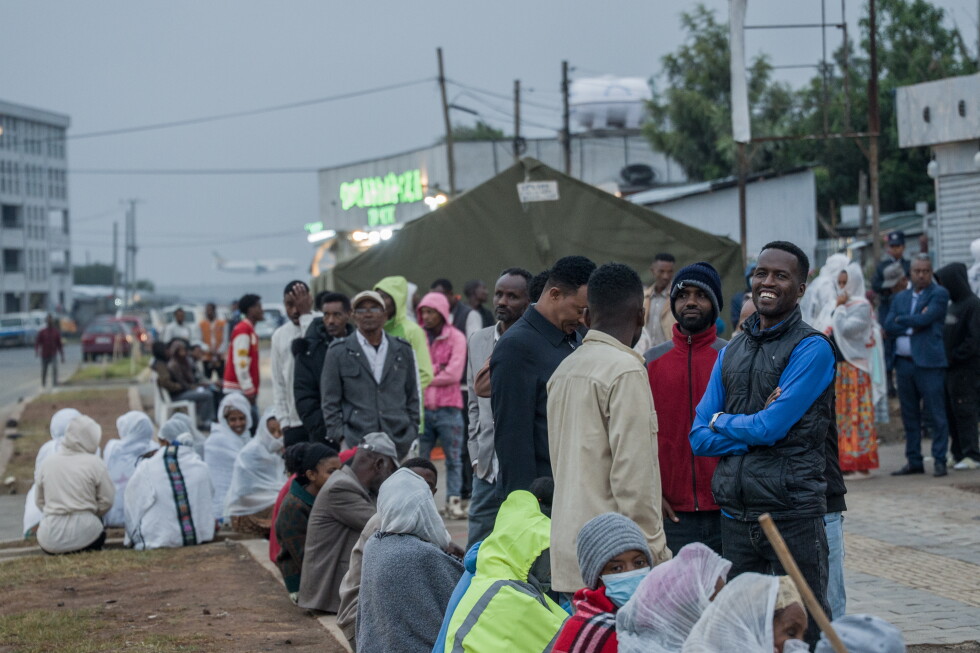
Voting kicked off across Ethiopia on Monday for a highly contested national parliamentary election that pollsters and political analysts almost universally predict will deliver another term in office to incumbent Prime Minister Abiy Ahmed and his ruling Prosperity Party. As the East African nation, which is Africa’s second most populous and home to the African Union’s continental headquarters, opened polling stations at 6 a.m. local time, a heavy deployment of military personnel was visible across the capital city of Addis Ababa, while international and local observers issued widespread calls for a calm, violence-free voting process.
Long lines of voters began forming well before polling stations opened, a sign of strong engagement among many eligible Ethiopians who turned out to make their political preferences count. Roughly 50 million registered voters, out of Ethiopia’s total estimated population of 130 million, are eligible to cast ballots across the country. On top of selecting 547 members of the federal House of Representatives—who will later convene to vote for the country’s next prime minister—voters are also electing representatives to thousands of local government council seats. Official preliminary election results are expected to be announced later on Monday.
From the start of the voting period, the election has been mired in controversy. Ethiopia’s fragmented opposition parties have raised widespread alarms over what they describe as rapidly shrinking political space ahead of the vote, with many alleging that their candidates and campaign teams were blocked from accessing public spaces, restricted from canvassing for support, and barred from reaching voters fairly across much of the country. The Ethiopian government has also faced sustained international criticism over documented reports of human rights abuses targeting opposition activists, government critics, and independent journalists operating in the country.
Noah Yesuf, a prominent Ethiopian human rights defender, went so far as to deem the entire election illegitimate from its opening stages. “The fairness of an election is judged by whether there is a level playing field for the opposition and a conducive environment for citizens to freely participate,” Yesuf told the Associated Press in an interview on polling day.
Public sentiment toward the political process remains deeply divided among ordinary Ethiopian voters. Many citizens have expressed growing voter apathy, rooted in years of unfulfilled promises from political leaders that have left large portions of the population disillusioned with the democratic process. Yet other voters remain committed to participating, even amid widespread uncertainty about whether their ballots will deliver tangible change.
Senait Dereje, a 37-year-old small business owner running a shop in Addis Ababa, said she remained determined to cast her ballot despite her own doubts. “I have registered to vote. I am not sure if my vote will bring the change that I want and that will help change my livelihood,” Dereje told the AP. “I know many friends refuse to vote as they have given up on the politicians but I have not and I see it as a referendum like vote on the mixed record of the government.”
Two core themes have shaped the 2024 election cycle: national reconciliation and economic development. After years of devastating internal conflict in restive regions including Tigray, Oromia, and Amhara that left hundreds of thousands dead and displaced millions more, the government has framed the vote as a step toward unifying a fractured nation. On the economic front, the ruling Prosperity Party has campaigned on pledges to deliver large-scale infrastructure projects and inclusive growth to lift millions of Ethiopians out of poverty.