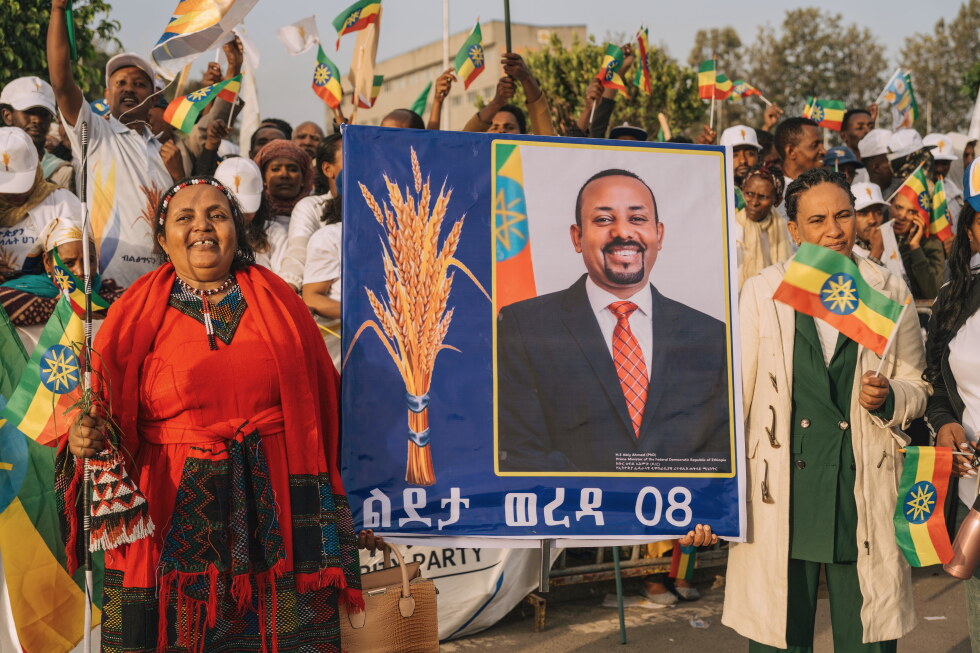
Ethiopia is set to hold its general national election on Monday, with early projections pointing to a sweeping victory for Prime Minister Abiy Ahmed’s ruling Prosperity Party, hobbling a deeply divided and under-resourced opposition bloc that has struggled to mount a competitive challenge.
Currently holding more than 500 of the 547 seats in the country’s House of Representatives, the Prosperity Party is widely expected to secure a commanding new majority, which would lock in Abiy’s position as prime minister for a second five-year term. Roughly 50 million registered voters out of Ethiopia’s total 130 million population are eligible to cast ballots for federal parliamentary representatives, as well as members of regional local government councils. Under Ethiopia’s electoral system, elected parliamentarians ultimately select the country’s prime minister.
However, widespread insecurity across two of Ethiopia’s most populous regions — Amhara and Oromia — is projected to depress voter turnout significantly. The election comes in the wake of years of internal armed conflict, including the devastating two-year Tigray war that ended with a November 2022 peace deal, and ongoing low-level clashes in multiple northern regions. National reconciliation post-conflict and delivering large-scale infrastructure development, two key pledges from Abiy’s administration, have anchored the ruling party’s campaign messaging.
Monitoring the vote is a team of 73 African Union observers led by former Kenyan President Uhuru Kenyatta, who previously mediated the Tigray peace negotiations that produced the 2022 agreement. Arriving in Addis Ababa on Saturday, Kenyatta stressed that Ethiopia’s election carries outsize importance for the entire African continent, as the country hosts the African Union’s permanent headquarters. “Ours is to call for peaceful situation as Ethiopians are known for,” he noted.
The vote has not been without sharp controversy. Abiy’s government has faced repeated international accusations of systematic human rights violations targeting political critics, independent journalists and opposition activists, despite 2020 promises to advance democratic reform and national peace. Abiy was awarded the 2019 Nobel Peace Prize for brokering a resolution to a decades-long border conflict with neighboring Eritrea, but relations between the two nations have collapsed in recent years. Ethiopia accuses Eritrea of backing rebel factions to destabilize its northern regions, stoking fears that Tigray, already grappling with a catastrophic humanitarian crisis and widespread famine, could be dragged back into full-scale proxy war.
The Tigray People’s Liberation Front (TPLF), the former dominant regional party in Tigray, has been labeled an illegal terrorist organization by the federal government. The region will skip the national vote for the second consecutive cycle, leaving Tigray without any representation in the federal parliament for a sixth straight year. TPLF leaders have threatened to withdraw from the 2022 peace agreement, a move the federal government calls an intentional provocation to restart conflict, while local relief agencies warn that hundreds of thousands of residents face acute food insecurity amid reports the central government has restricted access to critical humanitarian resources in the region.
Analysis of the election’s integrity has split independent observers. Bayu Samuel, a political analyst based in Addis Ababa, argued that the vote is on track to be largely free and fair, pointing to new digital voting technologies that reduce fraud risks and growing public political awareness among the electorate. That assessment is rejected by opposition groups, which uniformly decry systemic advantages that favor the ruling Prosperity Party.
Mistresilasie Tamerat, head of the opposition Ethiopian People’s Revolutionary Party and the election’s youngest candidate, called the process “far from genuine and democratic.” “The system favors the ruling party, and we can’t even freely operate (or) meet with our constituents,” she said. Eyoel Solomon, spokesperson for the main opposition National Movement of Amhara (Ezema), said the party’s core priority is ending the ethnic-based politics that has divided the country for decades. “We have seen citizens being attacked because of their identity. We have seen them being persecuted simply for living in areas deemed by others not to be ‘theirs,’” he explained.
Most national campaign activity has been concentrated in the capital Addis Ababa, where heavy military deployments have been visible across the city in the lead-up to voting. Unusually for a national election, public campaigning has been muted, with far fewer large public rallies and almost no door-to-door voter outreach by candidates, even as the vote has dominated public discussion across the capital. To boost turnout, Ethiopia’s independent electoral commission has declared Monday a national public holiday, closing all federal government offices to allow citizens to cast ballots without work disruptions.