BOGOTÁ, COLOMBIA – On a watershed Sunday for the South American nation, millions of Colombian voters headed to polling stations for the first round of a deeply consequential presidential election, where competing visions for national peace have split the country decades after a brutal, interminable armed conflict.
This contest, widely framed as a public verdict on the policies of departing President Gustavo Petro, arrives exactly one decade after Colombia signed what was billed as a historic peace agreement with the Revolutionary Armed Forces of Colombia, better known as FARC. The 2014 pact once raised bold hopes that Colombia could finally escape its generations-long cycle of clashes between state forces and rebel insurgencies, but widespread violence has reemerged in the years that followed, reaching a fever pitch in the months leading up to this election. Organized criminal factions have stepped up coordinated drone attacks, political campaigning has been repeatedly disrupted by armed assaults, and last June, a 39-year-old sitting politician and presidential aspirant, Miguel Uribe Turbay, was assassinated in a shooting at a public campaign rally.
For Colombia, where the pursuit of peace has long anchored the national political identity, the core question of how to resolve persistent conflict has once again driven a sharp wedge through the electorate. Though 14 candidates appear on the official ballot, the race has narrowed to a tight three-way contest between three contenders with fundamentally opposing approaches to the nation’s security crisis.
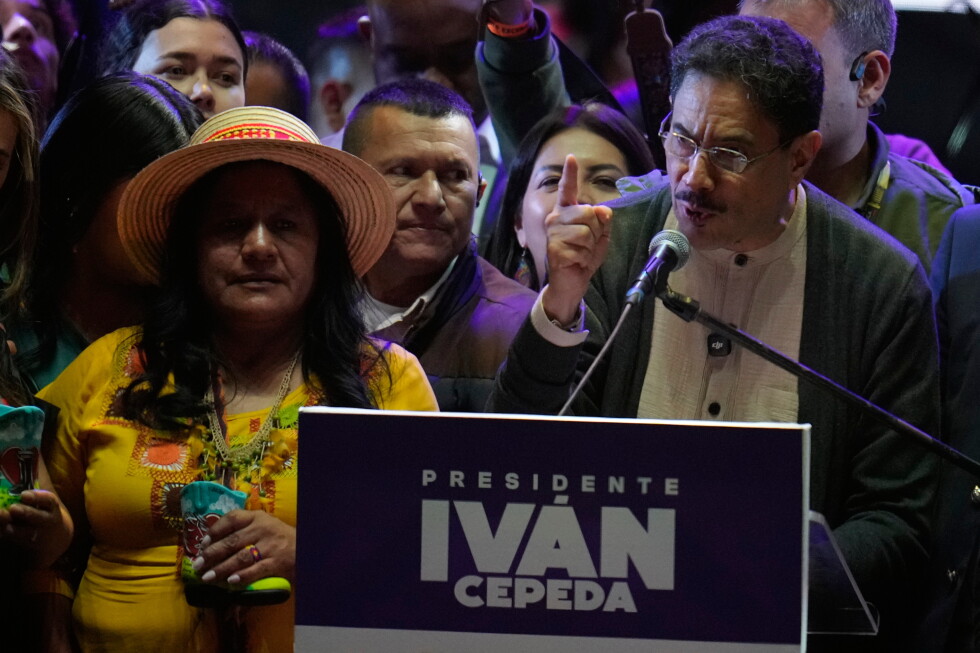
Leading in pre-election opinion polls is Senator Ivan Cepeda, a veteran peace activist and close ally of the outgoing Petro administration. Cepeda has pledged to continue building on Petro’s flagship “total peace” initiative, which seeks to open negotiations with all remaining active rebel and armed criminal groups to negotiate new ceasefires and lasting peace accords that address the roots of the ongoing violence. Critics point out that the existing peace strategy has largely fallen short of its goals: criminal networks have exploited government ceasefires to expand their territorial control and operations. Even so, Cepeda and Petro retain solid support from large swathes of the electorate thanks to progressive domestic reforms enacted under Petro, including a significant increase to the national minimum wage.
Challenging Cepeda from the right are two candidates, Abelardo de la Espriella and Paloma Valencia, both of whom have campaigned on promises of far harsher, military-first crackdowns on armed groups.
De la Espriella, a brash celebrity lawyer known by his nickname “The Tiger,” has seen his support surge in recent weeks. He has positioned himself as a political outsider who aims to replicate the hardline gang crackdown that El Salvador’s government carried out in recent years. That campaign succeeded in sharply lowering gang-related homicide rates but has drawn widespread international condemnation for systematic human rights abuses and extrajudicial detentions.
Valencia, meanwhile, is widely recognized as the political protégé of former Colombian president Álvaro Uribe, the influential hardline leader who held office from 2002 to 2010. Uribe’s government launched a massive military offensive that defeated large swathes of the FARC insurgency, but the campaign also resulted in thousands of civilian casualties. Both de la Espriella and Valencia have openly voiced their admiration for former U.S. President Donald Trump, who has advocated for far more aggressive pressure on Latin American nations to crack down on transnational criminal groups than most modern U.S. administrations.
Under Colombian electoral rules, a candidate must win an absolute majority of 50% of the vote to claim victory in the first round – an outcome that is almost unheard of in the nation’s modern electoral history. If no candidate hits that threshold, the top two finishers will advance to a head-to-head runoff election scheduled for June.
The deep divide over security policy is reflected clearly in the views of ordinary Colombian voters, who carry varying personal experiences of the nation’s long-running conflict. Maria Eugenia, a 57-year-old seamstress working in downtown Bogotá, told reporters she supports a full-scale military offensive against growing criminal groups, even if it comes with human rights tradeoffs. While she applauded Petro’s investments in improving Colombia’s public medical infrastructure, she said she is voting for de la Espriella because violence in rural regions of the country has spun out of control.
“Of course, whenever you take a hard line, there’s always going to be debate,” she said. “But some people are going to have to fall to clean up what needs to be cleaned.”
Just steps from her workshop, 26-year-old Cristian Morales offered a sharply contrasting view. He acknowledged that Petro’s peace plan has fallen short on many of its core promises, but argued that incremental reform of a strategy aimed at ending cycles of violence is far preferable to swinging to the opposite extreme of harsh military confrontation. Morales said he plans to cast his vote for Cepeda, pointing to the candidate’s commitments to protecting Colombia’s unique biodiversity and expanding public access to education as priorities, alongside his peace agenda. He argued that bold promises to fully uproot Colombia’s deeply entrenched conflict in a single four-year presidential term are unrealistic.
“The solution to this conflict isn’t aggressive confrontations. It will only end in more bloodshed,” Morales said. “It’s so difficult because it’s either dialogue or arms, and an internal conflict isn’t good for anyone.”