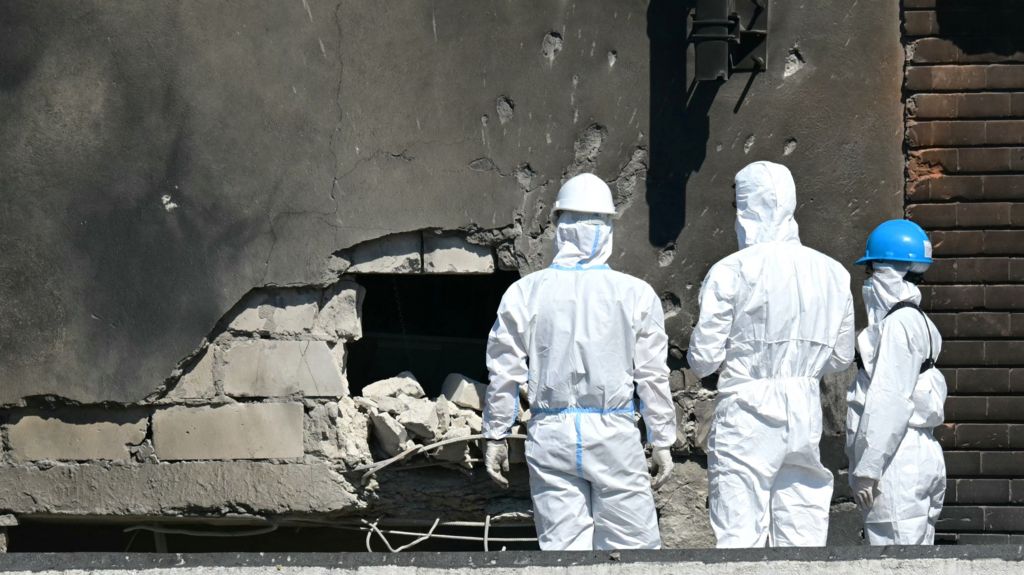
For many Romanians, the full-scale Russian invasion of Ukraine has stopped being a distant conflict unfolding across a border. It has arrived on their doorsteps, leaving a gaping hole in an apartment building and a population gripped by anxiety over future attacks. The incident in the northeastern Romanian city of Galati, which occurred in the early hours of Friday while most residents were asleep, marks the most severe incursion of the war into NATO and European Union member Romania since Russia launched its full-scale invasion in 2022. On Saturday, reporters climbed 11 stories to the building’s damaged roof, where a jagged, two-meter wide concrete puncture from the downed drone was covered with a temporary plastic tarp. The blast sparked an immediate fire that left the apartment directly below the roof heavily damaged, and a mother and her teenage son were hospitalized with bruising and minor burns. Disaster experts and local residents have emphasized that the outcome could have been far deadlier: the drone struck the building’s concrete lift shaft, which absorbed the majority of the explosion’s force. If the strike had hit a residential side of the structure, an entire floor or more could have been destroyed. Costel Patrichi, the building’s resident manager, described the chaotic morning of the incident. Just before 2 a.m., his phone buzzed with an official air threat alert warning that an unidentified drone was moving toward the city from the nearby Ukrainian border, located only a few dozen miles away. Seconds after the alert arrived, a deafening explosion shook the entire building. Like many Galati residents, Patrichi expressed deep frustration at the failure of Romanian air defenses to intercept the incoming drone. “They told us we are protected by NATO, not to worry. But look where we are now!” he told reporters. He added that the strike has shattered any sense of safety for local residents: “Now I’m afraid. If I go back to my flat tonight, I will sleep with fear. Because this could happen again.” This pervasive sense of vulnerability echoes the constant fear that Ukrainian civilians face nightly, as Russian attack drones regularly target residential infrastructure across the country, killing civilians and destroying homes. But for Romania, a NATO member, the strike represents a dangerous new escalation of the war. Moscow has repeatedly denied any connection to the drone, with Russian President Vladimir Putin claiming there is no evidence linking the weapon to Russian forces. But Romanian officials have pushed back firmly against these denials, confirming the drone is a Russian-produced Geran-2, also widely known as a Shahed. Romanian President Klaus Iohannis told the BBC that the identification is unambiguous: this was a Russian drone, matching the design of another unexploded Russian drone that crashed in Romanian territory just four to five weeks prior. The drones in the region are part of a sustained Russian campaign targeting key Ukrainian Danube River ports, which serve as a critical export hub for Ukrainian grain. On the day of the Galati strike, Romanian defense officials tracked a swarm of 43 Russian drones moving west along the border. According to Iohannis, one of the drones was damaged by Ukrainian air defenses, veered off course, and crossed into Romanian territory before striking the apartment building. NATO allies have formally condemned the incident, calling Russia’s conduct in the war reckless and blaming Moscow’s unprovoked aggression for the incursion. But the international response has been marked by deliberate caution, as leaders work to avoid a direct military confrontation between nuclear-armed Russia and the 31-member alliance. Bucharest government officials confirmed that they briefly considered invoking Article 4 of the NATO treaty, which would trigger an emergency collective security consultation, but rejected the move to prevent widespread public panic. The more drastic step of invoking Article 5 – NATO’s collective mutual defense clause, which defines an attack on one member as an attack on all – has not been put forward for discussion, as no alliance member has accused Russia of launching a deliberate attack on Romanian territory. In response to the strike, Romania has ordered the closure of a Russian consulate in the Black Sea port city of Constanta as a formal diplomatic warning. Iohannis noted that the next step in Romania’s planned diplomatic escalation would be the expulsion of Russia’s ambassador to Bucharest, but no such move has been ordered as of yet. Bucharest has also called on NATO to accelerate the delivery of promised additional air defense equipment to Romania’s eastern border region, and the Romanian government has moved forward with plans to acquire its own fleet of attack drones, including future joint development projects with Ukrainian defense firms. The European Union has also accelerated work on a new round of economic sanctions targeting Moscow. For residents of Galati, diplomatic maneuvers and sanctions have done little to ease the constant sense of danger. Adrian, a local resident who surveyed damage to his family’s apartment in the struck building, called the incident “insane”, noting that the strike occurred in a dense residential neighborhood in the middle of the city. “No-one feels safe now,” he said. Adrian placed full blame for the incident on Russia and Vladimir Putin, adding that existing international sanctions have done little to deter Russian aggression. “But I don’t think the sanctions are enough,” he said. “Because they could take everything from Russia, and they would still attack.” As the war enters its fourth year, the risk of the conflict spilling beyond Ukraine’s borders into neighboring NATO territory is higher than it has ever been, and ordinary Romanians on the front lines of the border region are left living with the constant possibility of another strike.