The head of the World Health Organization touched down in the Democratic Republic of the Congo (DRC) Thursday, bringing a public message of resolve that the 17th Ebola outbreak recorded in the impoverished central African nation can be contained, even as ongoing armed conflict in the epidemic’s epicenter complicates response efforts.
Tedros Adhanom Ghebreyesus, WHO’s Director-General, landed in Kinshasa, the DRC’s capital, Thursday evening. He is scheduled to travel Friday to Ituri province in the country’s unstable northeast, where the current outbreak is centered. In comments delivered shortly after his arrival, Tedros emphasized that the outbreak can be defeated, adding that the global health body rejects the imposition of travel bans on the DRC, arguing such measures provide little public health benefit. “Together, we will overcome this outbreak,” he stated, pledging to use “everything in my power to help you” in the response effort.
According to the latest WHO data updated through May 24, the outbreak, formally declared on May 15, has already killed 10 confirmed and 223 suspected Ebola patients, out of more than 1,000 combined confirmed and suspected cases across the country. WHO officials have warned that the actual scope of transmission is likely far larger than official counts, as the virus circulated undetected for an unknown period before it was identified.
Decades of persistent violence in northeastern DRC have created major barriers to mounting an effective response. The mineral-rich region has been plagued by clashes between armed groups for more than 30 years, and fighting between the Rwanda-backed M23 rebel group and government forces has intensified over the past 18 months, displacing thousands of people and disrupting access to affected communities. Tedros issued an urgent appeal to all warring factions in the region to lay down their arms. “Conflict and displacement make everything harder,” he said. “I am making a direct appeal to all warring parties in this region: please, declare a ceasefire. No cause, no conflict, no grievance is worth condemning innocent people to death from a preventable disease.”
The current outbreak is driven by the Bundibugyo strain of Ebola, for which no specifically approved vaccine or treatment currently exists. However, Jean Kaseya, head of the Africa Centres for Disease Control and Prevention (Africa CDC), announced Thursday that a targeted vaccine and pharmaceutical treatments should be ready for deployment by the end of 2026. “What we can tell you for sure, by the end of this year, 2026, Africa CDC will make sure that we have a vaccine and medicine against Bundibugyo,” Kaseya told reporters during an online briefing, adding that African leaders have committed the necessary investment to accelerate development of the medical tools.
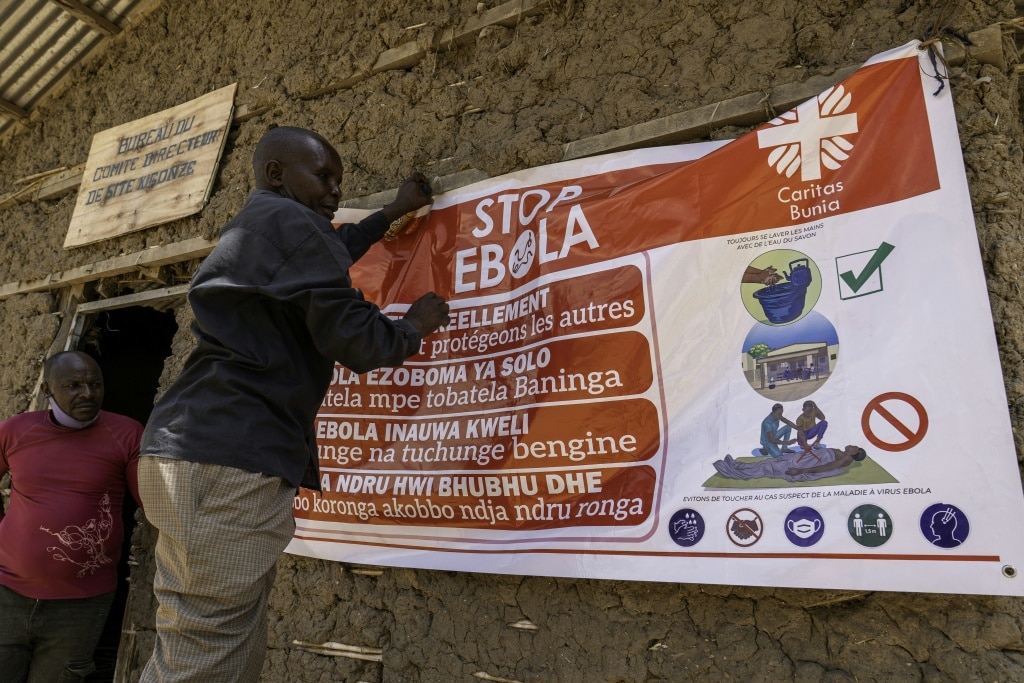
International support for the response is already flowing into the country. The WHO confirmed it has delivered 4.6 tonnes of emergency response supplies to Bunia, the capital of Ituri province, while UNICEF, the United Nations’ children’s agency, is preparing to ship an additional 100 tonnes of aid to support affected communities. The WHO has also convened its expert advisory groups, which have recommended launching clinical trials for existing vaccine and treatment candidates that may prove effective against the Bundibugyo strain, and the organization says it will collaborate closely with authorities in the DRC and neighboring Uganda to coordinate research and regulatory evaluation of these products.
Neighboring Uganda, which has recorded one confirmed Ebola death and six additional cases linked to the outbreak, has already moved to close its entire border with the DRC effective immediately. On the international stage, the United States has announced it will bar entry to any person infected with the virus, and the Trump administration is planning to open a dedicated treatment facility for infected U.S. citizens in Kenya, rather than repatriating patients for care in the United States as it has done during past Ebola outbreaks. The plan has sparked local pushback: a Kenyan human rights group filed a court petition Thursday seeking to block the facility’s operations, and Kenyan health officials have warned that hosting the center would add additional strain to the country’s already overstretched public health system.
Ebola has a long history of deadly outbreaks across Africa. Over the past 50 years, the virus has killed more than 15,000 people across the continent. The deadliest outbreak in the DRC’s modern history struck between 2018 and 2020, killing nearly 2,300 people out of 3,500 confirmed cases.