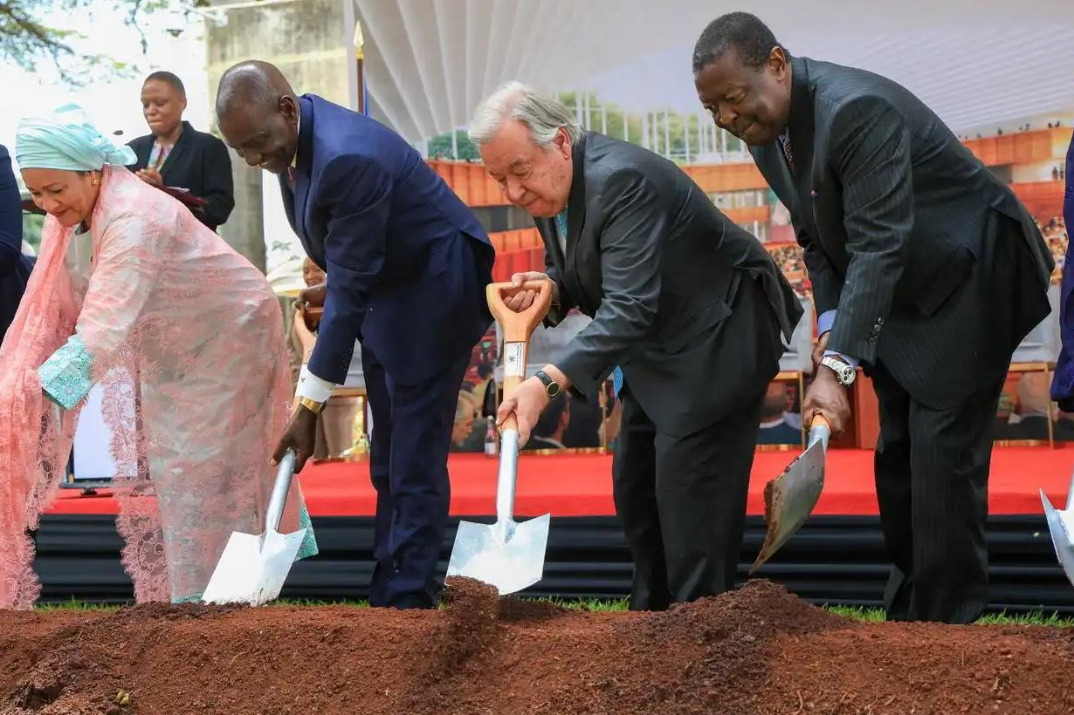
On a symbolic Monday in Nairobi, Kenya, the United Nations launched construction of a cutting-edge new conference complex at its regional headquarters, marking a $340 million strategic investment that will reshape the body’s global footprint and amplify the voice of developing nations in global governance. Once completed, the redevelopment project — which includes a 1,600-seat assembly hall and climate-resilient office infrastructure — will catapult Nairobi into the ranks of the UN’s largest diplomatic hubs, bringing multilateral decision-making closer to the regions that are increasingly setting the global agenda on climate action, sustainable development, and peacebuilding.
The ground-breaking ceremony was co-led by UN Secretary-General António Guterres and Kenyan President William Ruto, who highlighted the transformative scope of the expansion: the project will grow the hub’s total delegate capacity from 2,000 to 9,000, and increase the number of available meeting rooms from 14 to 30. When finished, Nairobi will become the UN’s third-largest duty station by conferencing scale, outranking Vienna and trailing only New York and Geneva.
Guterres emphasized that the expansion is far more than an infrastructure upgrade — it is a tangible commitment to reforming global governance to better reflect shifting global realities. “Nairobi is neither a satellite nor an outpost. It is a pillar — the only United Nations headquarters in Africa and in the Global South,” Guterres told attendees. He added that the project embodies the UN’s recognition that Africa is not just a region facing challenges, but a core driver of innovative solutions and a critical moral voice in the global pursuit of peace, security, sustainable development, and universal human rights. The Secretary-General also noted that Nairobi’s strategic location and cost-effective operating environment make it an ideal site for broader UN reform, with additional organizational functions set to be relocated to the Kenyan capital in coming years to boost operational efficiency and cut overhead costs.
Aligned with the UN’s global climate goals, the new complex is built around sustainability and universal accessibility. The completed office blocks already operate as the UN’s first net-zero carbon buildings, powered entirely by on-site solar installations, with the full campus targeted to achieve full energy neutrality by 2029. The investment also dovetails with Kenya’s long-running effort to position Nairobi as Africa’s preeminent hub for diplomacy, climate policy, and international development cooperation.
President Ruto noted that the upgrade comes at a critical moment for multilateralism, which faces growing strains from deepening geopolitical divisions and widening global economic inequality. “As the only UN headquarters in the Global South, Nairobi stands as a powerful symbol that the United Nations truly belongs to all the peoples of the world,” Ruto said, committing the Kenyan government to continued investment in supporting infrastructure — from expanded road networks and water systems to enhanced security and environmental restoration across the capital — to accommodate the UN’s growing presence.
Currently, the Nairobi UN campus hosts more than 70 UN agencies, funds, and programs, with over 4,000 personnel based on the compound and nearly 6,000 total UN staff working across Kenya. Diplomats from across the Global South welcomed the expansion as a long-overdue correction to historical underrepresentation. William McDonnell, Barbados’ permanent representative to the UN in Kenya, noted that smaller and developing nations have long been sidelined in major global negotiations held in Northern hemisphere hubs. The new complex will provide a modern, fully accessible venue on par with UN facilities in New York, Geneva and Vienna, creating a more inclusive platform for Global South nations to shape global outcomes. “With the development of this campus and conferencing facility, this trend should — and hopefully will — change,” McDonnell said.
Kenya’s Prime Cabinet Secretary and Foreign Affairs Cabinet Secretary Musalia Mudavadi echoed that sentiment, noting the project reflects both Kenya’s enduring commitment to multilateral cooperation and Africa’s rising influence within the UN system. “Kenya remains committed to working closely with all member states and the leadership of the United Nations to ensure that the UN system becomes more efficient, effective, responsive, and impactful in improving the lives of all people, especially the most vulnerable populations,” Mudavadi said.