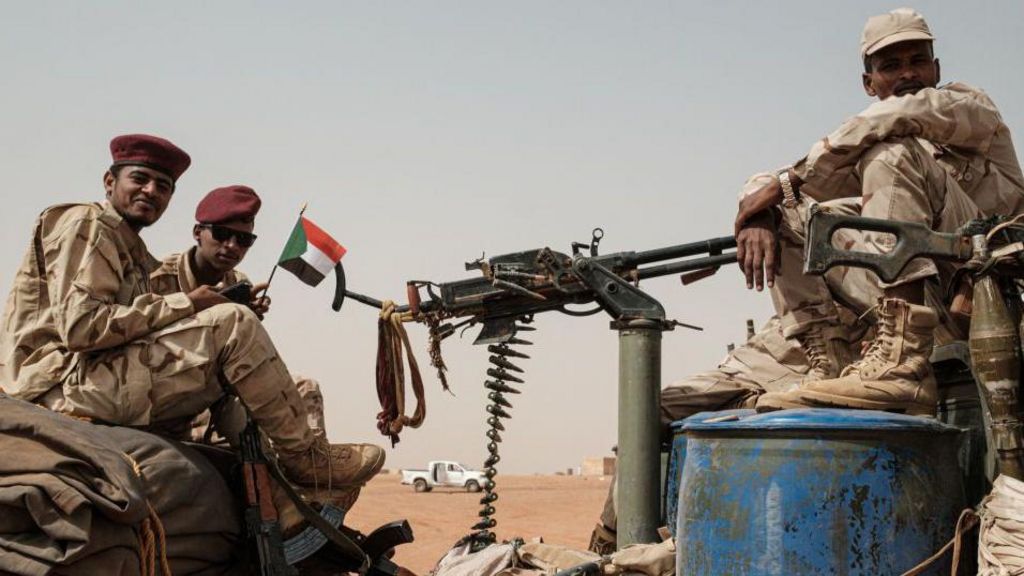
Two years into Sudan’s devastating civil war, a damning new investigation from global human rights watchdog Human Rights Watch (HRW) has uncovered an elaborate cross-border network that recruited Colombian former soldiers to fight alongside the Rapid Support Forces (RSF), the paramilitary group accused of widespread war crimes across the conflict-torn nation. The report directly ties the recruitment operation to a company based in the United Arab Emirates, with mercenaries transiting and training at official UAE military facilities before being deployed to frontline combat zones where mass atrocities have been documented.
Sudan’s conflict ignited on April 15, 2023, when long-simmering tensions between the RSF, led by Gen Mohamed Hamdan Dagalo, and the country’s official national army boiled over into open armed conflict. Since fighting began, UN and independent estimates place the death toll at more than 150,000 people, with over 12.9 million Sudanese displaced from their homes—millions of whom have fled across international borders into neighboring countries such as Chad to escape the violence. The RSF has seized control of large swathes of western Sudan’s Darfur region and made major territorial gains in other parts of the country, including the key city of el-Fasher, which fell to RSF forces last year amid reports of systemic mass killing.
HRW’s investigation, carried out between March and September 2025, drew on first-hand interviews with multiple Colombian mercenaries who participated in the deployment, alongside forensic analysis of social media content, videos, and photos to verify travel routes, locations, and military equipment. The findings align with earlier research published last month by independent security analysis firm Conflict Insights Group, which first flagged the presence of Colombian mercenaries in RSF-controlled Darfur.
According to mercenary testimonies collected by HRW, the recruitment network targeted retired Colombian army personnel with deceptive job advertisements offering work as drone pilots in Africa. Once recruited, fighters traveled through a string of transit airports across the UAE, Libya, Chad, and Somalia, before heading to Darfur frontlines. Multiple mercenaries described off-the-books travel through Abu Dhabi, with no entry stamps placed in their passports, before being transferred directly to UAE military bases for training. “They didn’t stamp our passports,” one unnamed mercenary told HRW. “We went in and went out and there was a bus waiting for us to take us to a military base.”
The report confirms that recruits received tactical and technical training at two UAE military facilities in Ghiyathi and Al Wathba, run by the Abu Dhabi-based firm that organized the operation. Once deployed to Sudan, the Colombian contractors filled a range of combat roles for the RSF, serving as infantry troops, artillery operators, drone pilots, vehicle crew, and combat instructors for RSF fighters. Crucially, HRW has documented multiple eyewitness accounts placing Colombian mercenaries in el-Fasher during the mass killings that followed the RSF’s capture of the city in 2025. The UN Human Rights Office has confirmed that more than 6,000 civilians were killed in just the first three days of the RSF’s offensive on the city.
Six el-Fasher residents interviewed by HRW in late 2025 confirmed they observed men they believed to be Colombians operating alongside RSF fighters during the October 2025 mass killings. One survivor detained by RSF forces told investigators he saw foreign fighters standing by silently as RSF fighters opened fire on unarmed civilian crowds. Another witness reported seeing white fighters alongside RSF militants who killed three civilians, noting: “They were there when the executions happened, but they didn’t execute.” After international outcry over the el-Fasher atrocities, RSF leader Dagalo announced a domestic investigation into alleged violations by his fighters, but no independent accountability has been delivered to date.
HRW investigators also recovered unused UAE armed forces munitions from locations where Colombian mercenaries were captured inside Sudan. While the weapons were originally manufactured in Serbia and Bulgaria, HRW confirmed they had been purchased by the UAE prior to being diverted to RSF forces in Sudan.
The UAE has repeatedly and forcefully denied all allegations of state backing for the RSF or enabling mercenary recruitment through its territory. In an official statement to the BBC, the UAE’s Ministry of Foreign Affairs said: “The UAE does not permit its territory to be used for the recruitment, training, financing or transit of foreign fighters to any conflict, including Sudan.” The government added that relevant Emirati authorities have opened investigations into all public claims of involvement by Emirati-based entities, noting that any unauthorised support for armed non-state groups violates UAE law and would result in criminal prosecution. The UAE also reaffirmed its public commitment to facilitating a lasting ceasefire in Sudan and supporting an inclusive transition to a civilian-led government to end the country’s suffering.
International action on the issue has already begun: in December 2025, the United States imposed targeted sanctions on a network of Colombian individuals and entities that US authorities confirmed were recruiting and training former Colombian soldiers to deploy to Sudan. HRW is now calling on the United Nations, African Union, and the governments of the US and UK to publicly condemn the alleged UAE role in the conflict and hold all actors accountable for facilitating atrocities in Sudan. Colombian President Gustavo Petro has previously condemned the cross-border mercenary trade, calling Colombian fighters deployed to foreign conflicts “spectres of death” and describing their recruitment as a “form of human trafficking”.