Global equity markets across Europe and Asia slid into negative territory on Wednesday, as a sharp upward climb in global bond yields intensified downward pressure on risk assets, erasing gains from the recent artificial intelligence-fueled tech stock rally. The upward trend in bond yields is being driven by persistent uncertainty stemming from the ongoing conflict in Iran, which has stoked widespread investor anxiety that inflation will remain elevated for far longer than previously projected.
U.S. equity futures pointed to a mixed open following three consecutive days of losses for major domestic indexes that followed their recent record highs. S&P 500 futures gained 0.2% in early pre-market trading, while Dow Jones Industrial Average futures ticked 0.1% lower. On Tuesday, the benchmark S&P 500 closed 0.7% lower at 7,353.61, the Dow fell 0.6% to 49,363.88, and the Nasdaq composite dropped 0.8% to 25,870.71, extending the recent pullback from all-time peaks.
In early European trading, benchmark indexes showed mild but uneven losses and gains. Germany’s DAX held nearly steady at 24,390.32, posting a marginal change that left it effectively flat. Paris’s CAC 40 inched up 0.1% to end the early session at 7,992.24, while the United Kingdom’s FTSE 100 dropped 0.3% to 10,303.23.
Across Asian markets, losses were more broadly consistent. Japan’s Nikkei 225 fell 1.2% to close at 59,804.41, even as the yield on 10-year Japanese government bonds slipped slightly to just under 2.8%, holding near its highest level since 1997. Currency markets saw small shifts: the U.S. dollar edged down to 159.05 Japanese yen, from 159.09 yen on Tuesday evening, while the euro slipped modestly to $1.1591 from $1.1608.
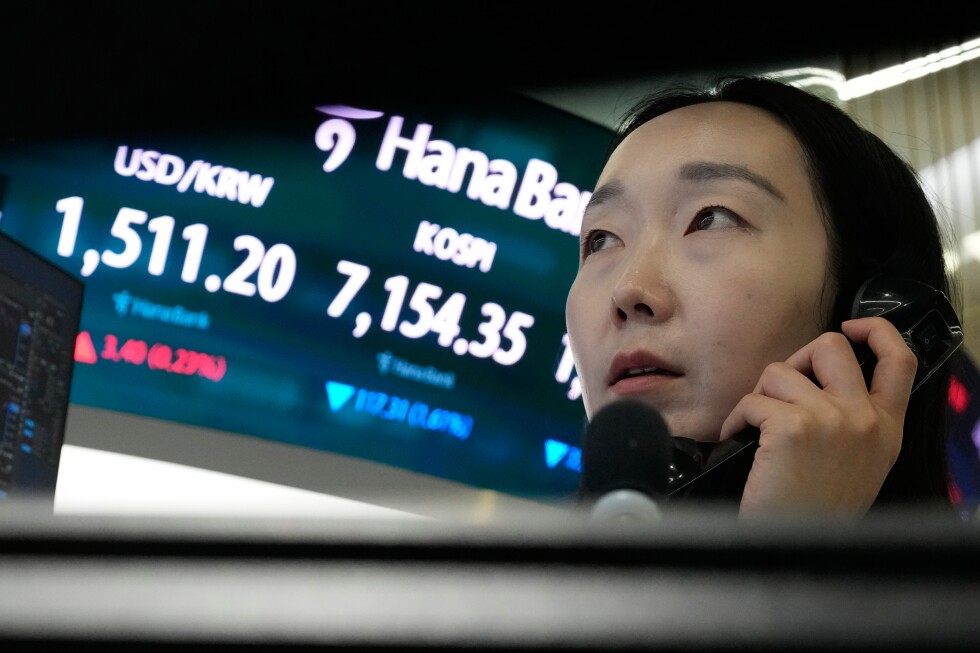
Other Asian benchmarks also closed in negative territory. Hong Kong’s Hang Seng Index dropped 0.6% to 25,656.12, while mainland China’s Shanghai Composite shed 0.3% to 4,162.10. Australia’s S&P/ASX 200 fell 1.3% to 8,496.60, and South Korea’s Kospi dropped 0.9% to 7,208.95, extending a broad sell-off from the prior session. Taiwan’s Taiex index also gave up 0.4% by the close of trading.
The sell-off in equities comes as the 10-year U.S. Treasury yield has climbed to 4.66%, up from 4.61% late Monday and from less than 4% before the Iran conflict began. This sharp, rapid increase in sovereign bond yields is a global trend that pushes up borrowing costs for corporations and consumers, while also making stretched equity valuations look far less attractive relative to low-risk government debt. Higher yields also lift interest rates for mortgages and corporate loans earmarked for AI data center construction, one of the single largest drivers of U.S. economic growth in recent quarters.
Tech stocks have been hit particularly hard in the pullback, after months of double-digit gains driven by investor excitement over artificial intelligence. Many market critics have warned for months that AI enthusiasm pushed tech valuations to unsustainable levels, leaving the sector vulnerable to a correction as borrowing costs rise. All eyes this week are on Nvidia, the leading AI chipmaker that has become the face of the AI boom, which is set to release its latest quarterly earnings results on Wednesday. The company has repeatedly smashed analyst earnings and growth forecasts quarter after quarter, and its performance this time around is widely expected to set the tone for whether the broader tech sector and U.S. stock market can resume their earlier rally. Nvidia already fell 0.8% on Tuesday, making it one of the largest single drags on the S&P 500 due to its massive market capitalization.
Other U.S. stocks also moved on individual news on Tuesday. Cybersecurity and cloud computing firm Akamai Technologies dropped 6.3%, one of the steepest losses on Wall Street, after announcing plans to raise $2.6 billion through a convertible note offering. Home Depot outperformed, rising 0.9% after reversing an early loss following its quarterly report. The home improvement retailer posted profit and revenue that edged past analyst expectations, though its key metric for same-store sales, closely watched by retail analysts, came in below projections. Home Depot CEO Ted Decker noted that customer demand remained consistent with levels seen throughout last year, “despite greater consumer uncertainty and housing affordability pressure.”
So far this earnings season, a large share of large U.S. companies have reported better-than-expected quarterly profits, a trend supported by continued resilient consumer spending even in the face of high gasoline prices and broader economic headwinds. This stronger-than-forecast earnings growth helped push U.S. stock indexes to record highs in recent weeks, but the sudden unrest in bond markets now threatens to derail that momentum.
Oil prices, a key driver of inflation pressures, edged lower early Wednesday even as conflict continues to disrupt shipping through the Strait of Hormuz, a critical chokepoint for global oil supplies. U.S. benchmark crude fell $1.15 to $103.00 per barrel, while international benchmark Brent crude dropped $1.29 to $109.99 per barrel. The national average for a gallon of regular gasoline in the U.S. currently sits at $4.51 per AAA data, around 43% higher than the average price at this time last year. Persistent uncertainty around how long the conflict will disrupt Hormuz shipping has kept oil prices volatile in recent weeks, amplifying broader inflation concerns that have pushed bond yields higher.