Against the backdrop of accelerating habitat loss across Southeast Asia, one grassroots conservation initiative in Penang, Malaysia, is turning to low-cost innovation and local community participation to pull the iconic dusky leaf monkey back from the brink of extinction. Listed as endangered by global conservation bodies, the distinct primate—easily identified by the crisp white fur mask that frames its dark eyes—faces three interconnected existential threats: fragmented forest territories cut off by urban development, growing conflict with human communities expanding into historic monkey habitats, and persistent poaching.
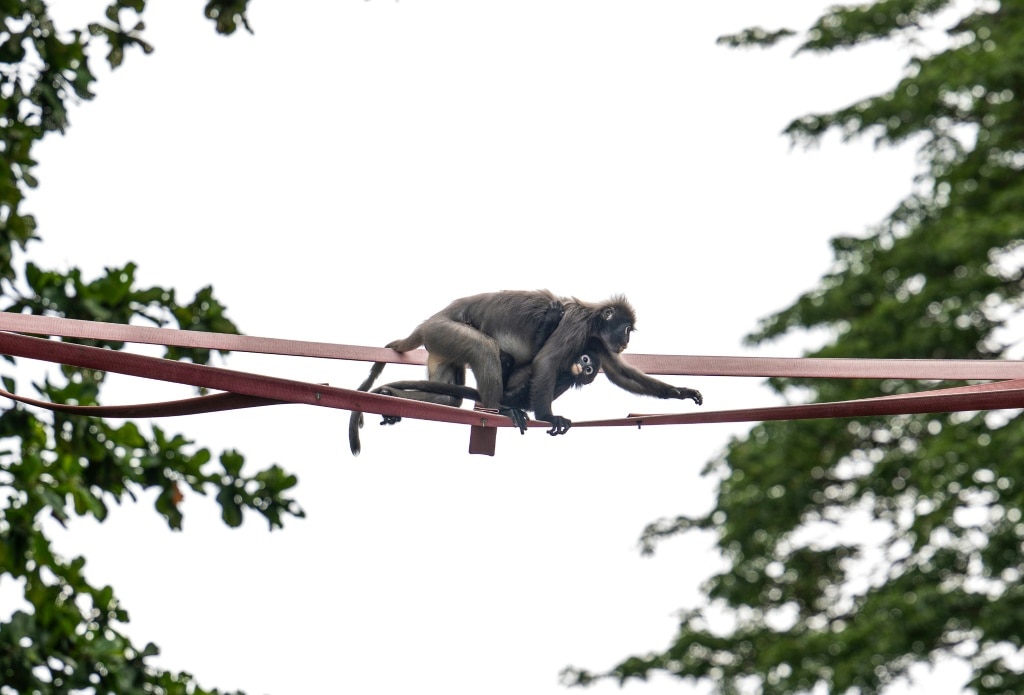
On a recent afternoon, a female dusky langur carefully picked her way across a swaying red rope canopy bridge strung high above a busy residential thoroughfare in Penang, her movements documented by a team of local conservation volunteers who have become the species’ most dedicated advocates. For these primates, survival today hinges on two simple, effective tools: these man-made sky crossings and the growing network of ‘citizen scientists’ who track and protect the langurs day-to-day.
The work is led by Langur Project Penang (LPP), a community-focused conservation organization founded by wildlife researcher Yap Jo Leen. The idea for the crossing project grew out of a sobering observation Yap made during 2016 fieldwork: langurs were repeatedly risking their lives darting across multi-lane roads to reach coastal foraging areas, since urban development had split their once-continuous forest habitat into isolated pockets.
“At the time, the idea was wild because no one in Malaysia had actually done it before,” Yap told Agence France-Presse. While canopy bridges had been used successfully to protect other endangered primates across the region—including a recent sighting of orangutans using similar structures in Indonesia—no program had yet tested the model for Penang’s dusky langurs.
After experimenting with multiple materials, Yap’s team settled on a low-cost, eco-friendly design: upcycled fire hoses twisted to mimic the texture and shape of natural tree branches, suspended between existing trees on one side of the road and custom-installed steel poles on the other. To date, LPP has installed three bridges across the region, including the latest structure added in April in the popular coastal tourist suburb of Batu Ferringhi.
Early data confirms the approach is working. At one busy crossing site, eight langurs died in vehicle collisions between 2016 and 2018. Since the bridge was installed in 2019, there have been zero recorded road fatalities for the primate population at that location. Beyond saving individual lives, the crossings also reconnect genetically isolated groups of langurs, allowing them to expand their ranges into less populated forest areas higher up Penang’s hills.
“They have more opportunity to venture closer to the hills… and find their way to a safe haven,” Yap explained. A secondary benefit has been a sharp reduction in human-wildlife conflict: as langurs gain access to more natural foraging territory, fewer hungry groups wander into residential neighborhoods searching for food, cutting down on friction between humans and primates.
Addressing remaining community tension is the second core pillar of LPP’s work, which leans heavily on local citizen science engagement. The organization recruits residents from all walks of life to train as volunteer citizen scientists, who track langur movements, log population data, and record GPS coordinates using simple tools including spreadsheets and the Wikiloc trail navigation app. In exchange for committing to three months of regular tracking work, volunteers receive a small stipend and hands-on field training.
The resulting dataset gives researchers critical insight into langur home ranges, feeding patterns, and population dynamics, information that will guide future reforestation and conservation planning. Today, LPP’s volunteer team ranges in age from 17 to 65, and volunteers have affectionately nicknamed themselves the “monkey stalkers” and “monkey whisperers.”
Teo Hoon Cheng, a 65-year-old former IT manager, signed up more than a decade ago after encountering the langurs on local hiking trails. “You don’t need background knowledge in zoology or biology. Anyone can be a citizen scientist,” he said. For local residents like retired graphic designer Tan Soo Siah, the work extends beyond tracking to mediating communication between unhappy residents and the langur population.
Many Penang locals complain about loud langurs crossing rooftop structures, or occasional break-ins when residents leave windows open. Tan works directly with communities to explain why langurs are entering residential areas, and shares simple, non-harmful tactics like spraying a light stream of water to gently encourage langurs to leave. The work, he said, has fundamentally shifted his perspective on sharing space with wildlife.
“Somebody needs to step up to act as a bridge for this communication,” the 64-year-old said. “It’s good that we can use my experience to show how we can live in harmony with the primates.”
Fellow resident Lim Hock Cheng, 66, noted that community attitudes have gradually shifted as more locals buy into the coexistence model. “We’ve encroached into their habitat… We have to coexist, learn to live with each other,” he said. “The dusky langurs are also part of our society.”
This reporting is part of a collaborative project between Mongabay and Agence France-Presse.