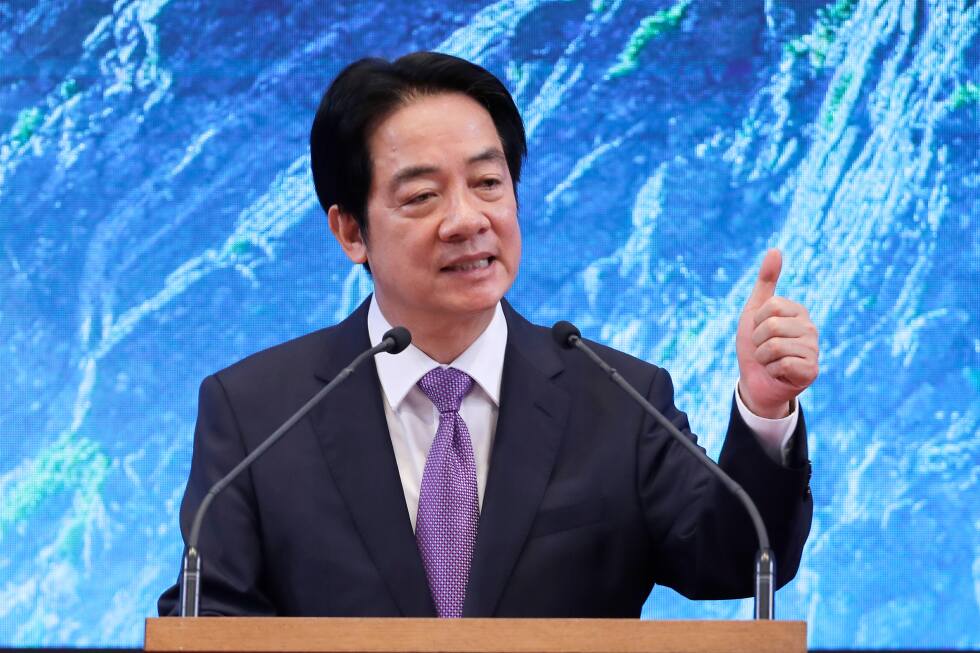
As Lai Ching-te reaches the midpoint of his four-year term as Taiwan’s leader, cross-strait relations and the island’s security partnerships with Washington have emerged as the defining flashpoints of his administration, with growing pressure from Beijing and shifting rhetoric from U.S. leadership raising new uncertainty for the region. In a press briefing Wednesday, Lai laid out his vision for Taiwan’s defense and sovereignty, revealing what message he would deliver to U.S. President Donald Trump if given the opportunity to speak directly.
Lai’s core priority, he emphasized, would be to secure continued U.S. arms sales to the island, a policy he frames as non-negotiable for maintaining cross-strait peace. He argued that peace and stability across the Taiwan Strait are foundational to global security, and went on to claim China is the primary force undermining that stability. Repeating his belief that “only strength can bring peace,” Lai noted that Taipei has steadily increased its defense budget in response to growing regional threats, and purchases of U.S. military equipment remain an essential pillar of the island’s deterrence strategy.
“No country has the right to annex Taiwan,” Lai said. “Democracy and freedom should also not be seen as provocation.”
The midterm briefing comes against a backdrop of intensifying geopolitical friction. China has long maintained that Taiwan is an inalienable part of its territory, and has ramped up diplomatic and military pressure on Lai’s administration, which Beijing labels as separatist. Just one week before Lai’s remarks, Chinese President Xi Jinping delivered a stark warning to Trump during their summit in Beijing, calling the Taiwan question the most sensitive issue in U.S.-China relations, and warning that mishandling it would lead to direct clashes and conflict between the two powers.
Recent comments from Trump have also fueled concerns about the future of longstanding U.S. support for Taiwan, even in the absence of formal diplomatic ties. Late last year, Trump approved a historic $11 billion arms package to Taipei, but during his recent visit to China, he suggested that a proposed $14 billion follow-up arms deal would be used as a negotiating lever with Beijing, telling Fox News its approval would depend on China’s cooperation. He later added that he planned to speak with Taiwan’s leader, without naming Lai directly.
Lai pushed back on the idea that Taiwan’s future could be determined by outside powers, stating: “Taiwan’s future cannot be decided by external forces, nor can it be hijacked by fear, division, or short-term interests.” While he said Taipei is open to peaceful, equal, and dignified cross-strait exchanges with Beijing, he firmly rejected Chinese unification overtures that frame political integration as a path to peace, calling these coercive united front tactics unacceptable.
Beyond security and cross-strait policy, Lai also addressed domestic economic priorities, responding to concerns over Taiwan’s heavy reliance on its booming tech sector, which has surged on the back of the global AI boom. The island is the world’s leading producer of advanced semiconductors and AI server hardware, and top tech firms have posted record profits in recent quarters, but analysts have warned that overreliance on AI-related manufacturing leaves the economy exposed if the current AI boom deflates into a bubble. To diversify Taiwan’s economic base, Lai announced a NT$100 billion (US$3.1 billion) initiative to support the upgrading and transformation of small and medium-sized enterprises and traditional manufacturing sectors, with the goal of leveraging the tech industry’s growth to lift all segments of the economy.
Beijing has rejected Lai’s framing of cross-strait tensions outright. Zhu Fenglian, a spokesperson for China’s Taiwan Affairs Office, labeled recent claims by Lai that China is responsible for altering the cross-strait status quo as a web of “lies and deception, hostility and confrontation,” according to China’s state-run Xinhua News Agency. She accused Lai of clinging to a separatist pro-independence agenda and deliberately inciting confrontation across the Taiwan Strait, countering his claim by saying that Lai himself is the true “destroyer of the status quo of the Taiwan Strait.” The remarks cap off a week of escalating verbal exchanges between the two sides, as geopolitical shifts continue to reshape the future of the region.