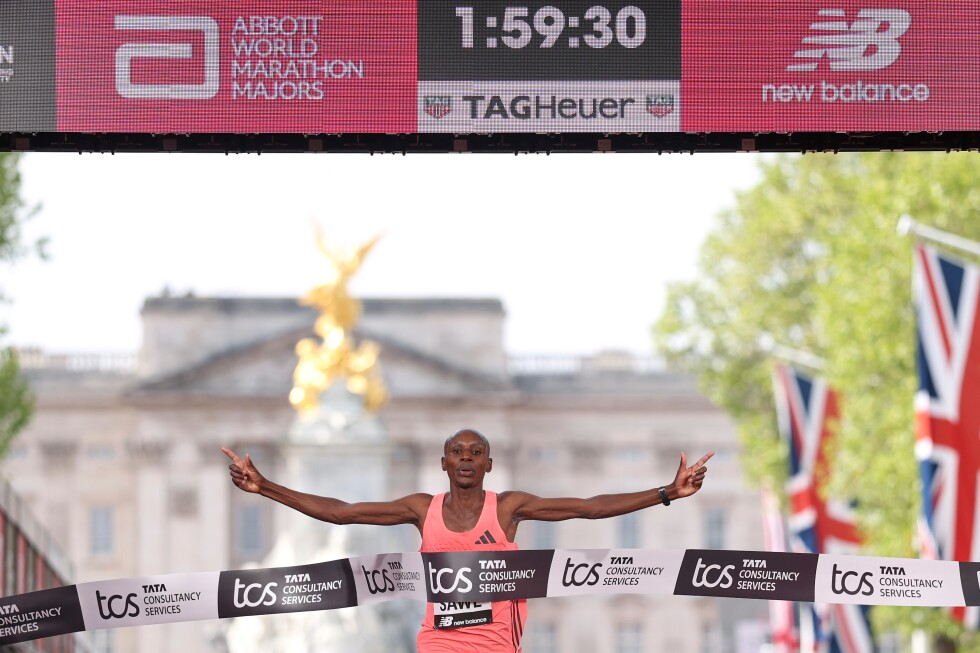
In the heart of Kenya’s Rift Valley, the small town of Eldoret has long been known as the global cradle of elite long-distance running, turning out dozens of the world’s top champions over decades. Now, this quiet running hub is drawing new global attention for an unexpected reason: a historic record-breaking win that has put the deep connection between Kenyan elite runners and their Christian faith front and center.
Thirty-one-year-old Kenyan runner Sabastian Sawe entered the 2025 London Marathon as one to watch, but few predicted the magnitude of what he would achieve on April 26. Maintaining a searing, nearly unheard-of pace from start to finish, Sawe crossed the line in a stunning 1 hour, 59 minutes, and 30 seconds, making history as the first athlete ever to complete the official 26.2-mile marathon distance in under two hours. The feat shattered a milestone many in the running community had long considered unachievable in an official, mass-participation race. Ethiopian rival Yomif Kejelcha finished just 11 seconds behind Sawe, also clocking a sub-two-hour time. For Sawe, the historic win comes just months after his 2024 marathon debut in Valencia, Spain, where he claimed victory with an already impressive time of 2:02:05.
News of Sawe’s groundbreaking win sparked widespread, joyful celebrations across Kenya, a nation that has dominated international middle- and long-distance running for generations, earning its reputation as the undisputed home of long-distance running. In the days following the win, new details about Sawe’s pre-race routine emerged that shifted the conversation to the role faith plays in many Kenyan runners’ success: the devout Catholic had stopped at his home parish, Holy Family Catholic Church in Eldoret’s St. Josephine Bakhita Lower Moiben Parish, to attend Mass and ask for prayers from his parish priest just before heading to London.
Parish priest Rev. Pius Tuwei told Religion News Service that when he blessed Sawe ahead of the race, he had no idea the runner would pull off such a historic, world-altering victory. “I was just blessing him like any other athlete or any other person,” Tuwei said. “It was really a surprise for me when I heard he had won.”
Sawe’s faith and commitment to his parish are well-known among his community. Tuwei added that Sawe has long been generous to the church, a trait he likely inherited from his grandmother, a deeply charitable and active member of the congregation. “That could have really given him a very strong foundation on morals, the church and discipline— this could have contributed to his success,” Tuwei explained. “I think giving back to society is also holding him to his faith.”
This link between running success and spiritual belief is not unique to Sawe. Christianity is the dominant religion in Kenya, and public displays of faith are a common sight in international races, where Kenyan runners often make the sign of the cross before starting and after finishing competitions. Many of the nation’s most legendary running champions have openly spoken about how their faith shapes their training and competition. Eliud Kipchoge, the global running icon who first broke the two-hour marathon barrier in a 2019 custom-designed exhibition event in Vienna (a feat that was never ratified as an official marathon record), told a running blog in 2019 that his Catholic faith is a core part of his athletic life. “It keeps me from doing things that could keep me away from my goals. On Sundays, I go to church with my family and pray regularly, even in the morning before a race,” Kipchoge said.
For years, sports analysts have attributed Kenya’s unmatched long-distance running success to a combination of natural genetic advantage, early childhood training on rugged rural terrain, and years of high-altitude intensive training. Now, after Sawe’s historic win, athletes and religious leaders are bringing the role of faith forward as an underdiscussed contributing factor to consistent championship success.
Patrick Makau Musyoki, a former world marathon record holder from Kenya, says that while elite talent is the starting point, spiritual belief drives Christian athletes to push past their limits. “We are able to train very well, but at the end of the day, for us to manage to go to a race and a winner to run the world record, we should have faith in God, who gave us the talent,” Makau said. “And he helps you to keep on improving talent.”
Tuwei echoed this perspective, noting that faith reinforces moral discipline and keeps runners connected to what many see as the divine source of their ability. “When I look at Sawe, it seems his talent is real — not acquired,” he said.
Not all experts agree that faith plays a direct role in race outcomes, however. Brother Colm O’Connell, an Irish missionary and legendary athletics coach widely known as the “godfather of Kenyan running,” said he was not surprised to hear Sawe sought a priest’s blessing before the London Marathon, but argued spiritual intervention had little to do with his record win. “If that was the case, then marathon runners might spend more time in the church than on the road,” O’Connell told Religion News Service. “I think that God helps those who help themselves. So, you know, he gave you a talent, and then you have to get out and use it, and not hide it.”
O’Connell added that incremental improvements to training methods, nutrition, and sports technology will continue to push marathon boundaries lower over time, regardless of spiritual belief. “It’s 1 hour, 59 (minutes) now,” he said. “Then it will be 1 hour, 58, and then it will be 1 hour, 57.”
For his part, Sawe summed up his historic achievement simply after crossing the finish line in London: “Nothing is impossible.”