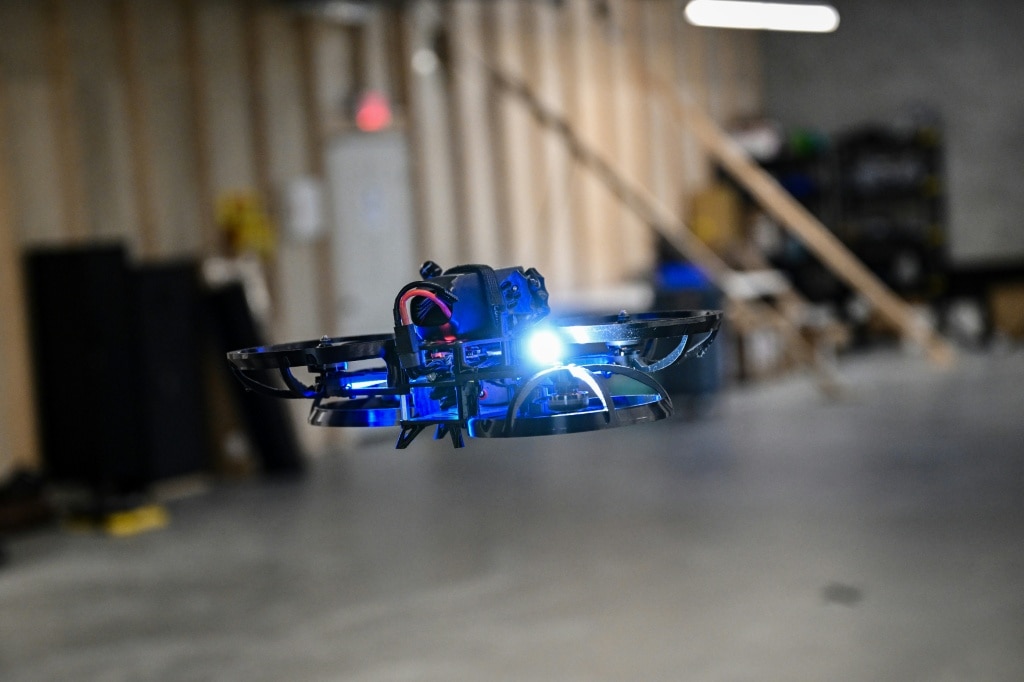
Against the backdrop of a persistent, deadly national gun violence epidemic that has plagued K-12 campuses across the United States, one private company has introduced an unconventional new approach to stopping active shooters before first responders can arrive: human-piloted unarmed drones designed to disable attackers.
The concept is the creation of Campus Guardian Angel, a U.S.-based firm that has already launched pilot programs for the technology at schools in Georgia and Florida, with mounting interest from education communities in Texas — a state that has seen some of the country’s deadliest school shootings in recent years. To date, the system has not been tested in a real active shooter scenario, but its developers say it fills a critical gap in campus safety between the moment an attack is reported and law enforcement reaches the scene.
The framework mirrors a long-running ideological strain in U.S. gun violence policy debates, which argues that the solution to recurring mass shootings is not stricter firearms regulation, but additional defensive technology in public spaces — similar to the controversial push to arm teachers and school staff.
Here is how the system operates: When a potential shooter enters a school campus, a teacher or staff member triggers an alarm via a smartphone app that simultaneously alerts local police. While officers are en route, a drone is immediately activated from a pre-positioned hiding spot inside the school, serving as the first line of defense against the attacker.
These small, black, roughly square craft weigh approximately two pounds (one kilogram) each. Unlike military offensive drones, they carry no bullets or lethal projectiles. Instead, they are controlled remotely by human operators based in Austin, Texas, who navigate the drones through school hallways using custom 3D maps of each campus pre-loaded into the system.
According to Khristof Oborski, Campus Guardian Angel’s director of tactical operations, the idea grew out of observations of small drone effectiveness on battlefields in the war in Ukraine. Bill King, the company’s CEO and a former Navy SEAL, noticed how even lightweight, low-cost drones could disrupt and disable targets, prompting him to adapt the technology for the growing U.S. crisis of school shootings.
Oborski explained that the drone’s response is tailored to the attacker’s actions. If the suspect is still moving through hallways without opening fire, the drone’s built-in two-way radio allows remote operators to communicate directly with the attacker, attempting to persuade them to surrender and lay down their weapon. Operators maintain constant contact with responding law enforcement, guiding officers directly to the attacker’s location to cut down on response time. If the shooter has already begun firing on students and staff, the system immediately escalates to disabling tactics: either direct kinetic impacts by flying into the attacker, or a blast of less-lethal JPX pepper gel to incapacitate them.
Data from the firearms incident database IntelliSee shows that U.S. schools recorded 233 separate incidents involving firearms in 2025 alone. The 2022 mass shooting in Uvalde, Texas — which left 19 children and two teachers dead — highlighted catastrophic delays in law enforcement response, with officers taking 77 minutes to engage and kill the attacker. Proponents of the drone system say it addresses exactly this gap, providing an immediate response while police are on the way.
Campus Guardian Angel offers the system through annual service contracts, with pricing adjusted based on a school’s student population, size and number of campus buildings. Beyond the ongoing pilot projects in Florida and Georgia, the company reports that groups of parents in Houston, Texas have already expressed interest in installing the drones at their local children’s schools.
King emphasized that the ultimate goal of the system is deterrence, rather than active use. “The best-case scenario is we put this in every single school in America and then never have to use it, right? Because it’s got a deterrent quality to it,” he said. King also addressed common concerns about autonomous operation, confirming that no artificial intelligence is used to pilot the drones — a detail that many school stakeholders find reassuring.
Alex Campbell, a 30-year-old system operator and professional drone-racing competitor, framed his role as a quiet contribution to campus safety. “To be the nerd behind the scenes, to help the heroes on this Earth saving us from the bad things happening, it’s really fulfilling to be able to have a hand in that,” Campbell said.