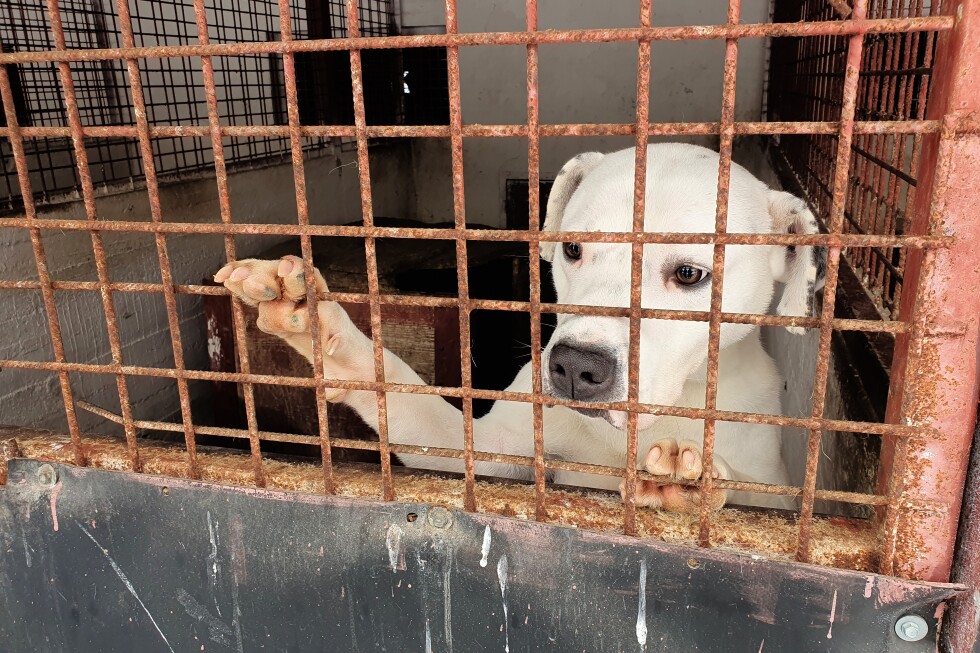
Across a network of publicly funded stray dog shelters scattered across Romania, an undercover investigation has pulled back the curtain on widespread abuse, neglect, and systemic failure that has left tens of thousands of animals suffering in life-threatening conditions. The probe, conducted between January 8 and 18 by Four Paws — the global animal welfare organization also known by its original name Vier Pfoten — sent hidden-camera investigators to nine shelters in different regions of the country, uncovering grim conditions that leaders of the investigation describe as a national crisis.
Graphic footage captured inside one eastern Romanian compound shows a confined space enclosed by steel mesh: one dog struggles to lick ice from a frozen metal water bucket, while another chews apathetically on dried feces scattered across the unforgiving hard packed ground. Across all nine sites, investigators documented overcrowded kennels, dogs with untreated open festering wounds, and packs left exposed to subzero winter temperatures without insulation or heating. The report’s findings detail enclosures constantly caked in waste, overcrowding that sparks violent aggression and inter-dog fighting, and such extreme chronic stress that one dog was observed self-mutilating by biting off sections of its own tail.
Even at one of the highest-quality facilities visited, a public shelter in western Romania’s Arad County, investigators found only cold concrete floors, no heated bedding, and no enrichment or toys for the hundreds of dogs held there. The organization did note that frontline staff at the facility worked diligently to improve outcomes and boost adoption rates, despite the systemic shortcomings that left them without resources to meet even basic animal welfare standards.
Romania is home to an estimated 500,000 stray dogs, one of the largest unhoused canine populations in the entire European Union. Public and private shelters across the country hold thousands of these strays, where animals wait for potential adoption — or, in many cases, legal euthanasia. Four Paws’ investigation, however, found that most public shelters act as little more than holding facilities where dogs are confined to wait for death, with no access to the minimum standards of care required by international norms.
Manuela Rowlings, a stray animal specialist with Four Paws, told the Associated Press that the problematic conditions uncovered are not isolated incidents of mismanagement, but the result of broken national policy that demands full systemic reform. “Public shelters are horrible places in Romania,” Rowlings said. “It’s simply places where dogs are locked up and where they wait to die, and they do not even receive the minimum care or minimum standards.”
Beyond poor living conditions, the report also criticized most participating shelters for actively blocking adoption efforts, and freedom of information requests submitted by the organization revealed profound a lack of transparency around public funding, stray intake numbers, and official euthanasia statistics. To illustrate the scale of unreported mortality, Four Paws shared data from a northeastern Galati County shelter: of 644 strays admitted in 2024, only 134 were adopted, 28 were legally euthanized, and 412 died from what are listed as “other causes” — largely neglect and untreated illness.
Worryingly, current Romanian law does not criminalize the poor conditions documented in the investigation, leaving activists with little recourse to hold facility operators accountable. “There is nothing that can be reported to the authorities, because it is not illegal to keep dogs in very, very poor conditions in the shelters,” Rowlings explained.
The roots of Romania’s stray dog crisis stretch back more than a decade. In 2013, after a four-year-old boy was killed by a pack of strays in the capital city of Bucharest, national lawmakers passed a sweeping law that ordered mass roundups of stray dogs, requiring that any unadopted animal be euthanized 14 days after being taken into custody. But animal welfare advocates have long argued that targeted mass neutering is the only sustainable long-term solution to reduce the stray population humanely.
So far, large-scale sterilization programs have failed to gain traction nationwide, and some insiders say that is no accident. Hilde Tudora, Director of Animal Protection at Ilfov County Council, told AP that the stray dog industry has become a profitable enterprise for private operators funded by public money, giving stakeholders an incentive to keep the population high rather than solving the crisis.
“Private companies have swelled up with public money, and then it turned into a business,” Tudora said. “There must be dogs, because if you castrate en masse, there’s no more merchandise … No one really wants to solve the problem.”
Recent legislative efforts aim to upend this status quo. A bill introduced to parliament in November 2024 would formally recognize animals as “living beings with rights and freedoms” and shift national policy away from mass euthanasia toward expanded sterilization and mandatory microchipping. Andrei Baciu, a National Liberal Party parliamentarian backing the bill, noted that Romania has spent more than 1.3 billion euros ($1.5 billion) on stray dog euthanasia over the past three decades. He pointed out that a single unsterilized pair of dogs can produce more than 67,000 puppies in just six years; capturing and euthanizing that entire resulting litter would cost roughly 13.4 million euros, a sum that could instead fund sterilization for more than 268,000 adult dogs.
As of Tuesday, Romania’s National Sanitary Veterinary and Food Safety Authority, the government body that oversees animal welfare and shelter regulation, had not responded to AP requests for comment on the investigation’s findings.