In an unprecedented development that marks a notable shift in high-level contact between Washington and Havana, CIA Director John Ratcliffe traveled to Cuba for meetings with senior Cuban intelligence officials this Thursday, even as the island nation formally announced it has exhausted its entire oil reserves amid a deepening U.S.-imposed fuel blockade.
The Central Intelligence Agency, which has long been at the center of more than six decades of tense geopolitical rivalry between the two countries, confirmed the visit following an official announcement from the Cuban government. Images shared by the agency on the social platform X show Ratcliffe seated across from Ramon Romero Curbelo, head of intelligence for Cuba’s Interior Ministry, alongside other senior Cuban representatives; the faces of several additional attendees were blurred for security purposes.
The high-stakes meeting unfolds against a backdrop of rapidly escalating crisis in bilateral relations, with widespread, sustained power outages crippling daily life across Cuba, a crisis directly triggered by the Trump administration’s strict fuel trade blockade. Only one oil tanker from Russia, Cuba’s long-standing strategic ally, has successfully reached the island in recent months, and even that limited supply has now been completely exhausted, Cuban Energy Minister Vicente de la O Levy confirmed in an interview with state television.
“The impact of the blockade is indeed causing us significant harm…because we are still not receiving consistent fuel supplies,” de la O Levy stated.
For years, the Trump administration has maintained an explicit goal of forcing regime change in Cuba, cutting off most economic channels and tightening trade restrictions. Recent reporting from CBS News, citing anonymous senior U.S. officials, also revealed that the administration is moving forward with plans to indict 94-year-old Raúl Castro, the former Cuban leader and brother of late revolutionary icon Fidel Castro.
Despite the deep underlying tensions, Cuban authorities framed Ratcliffe’s visit as a constructive opportunity to de-escalate friction between the two nations. In an official government statement, the meeting was characterized as taking place “in a context marked by the complexity of bilateral relations, with the aim of contributing to the political dialogue between both nations.”
Cuba used the dialogue to firmly reject long-standing U.S. accusations, stating that the exchanges “made it possible to demonstrate categorically that Cuba does not constitute a threat to U.S. national security, nor are there any legitimate reasons to include it on the list of countries that allegedly sponsor terrorism.” The statement also pushed back against recent claims of unauthorized Chinese military activity on Cuban soil, emphasizing: “Cuba has never supported any hostile activity against the United States, nor will it permit actions against any other nation to be carried out from Cuba.”
The current energy emergency is the result of a series of U.S. actions that have cut off Cuba’s last remaining major economic lifelines. In January, U.S.-backed forces removed Venezuelan strongman Nicolás Maduro from power, ending the discounted oil shipments that sustained Cuba’s economy for years, and a full fuel blockade was enforced immediately after. U.S. Secretary of State Marco Rubio has recently reiterated a $100 million humanitarian aid offer, but with a strict condition that all assistance be distributed by the Catholic Church, completely bypassing the sitting Cuban government.
Cuban President Miguel Díaz-Canel has pushed back on that framework, calling on Washington to end the decades-old trade embargo instead. “The damage could be eased in a much simpler and faster way by lifting or relaxing the blockade, since it is known that the humanitarian situation is coldly calculated and induced,” Díaz-Canel wrote in a post on X.
Remarkably, even amid soaring tensions, formal intergovernmental discussions have continued. A high-level diplomatic meeting was held in Havana on April 10, marking the first time a U.S. government plane has landed in the Cuban capital since the re-opening of diplomatic relations in 2016.
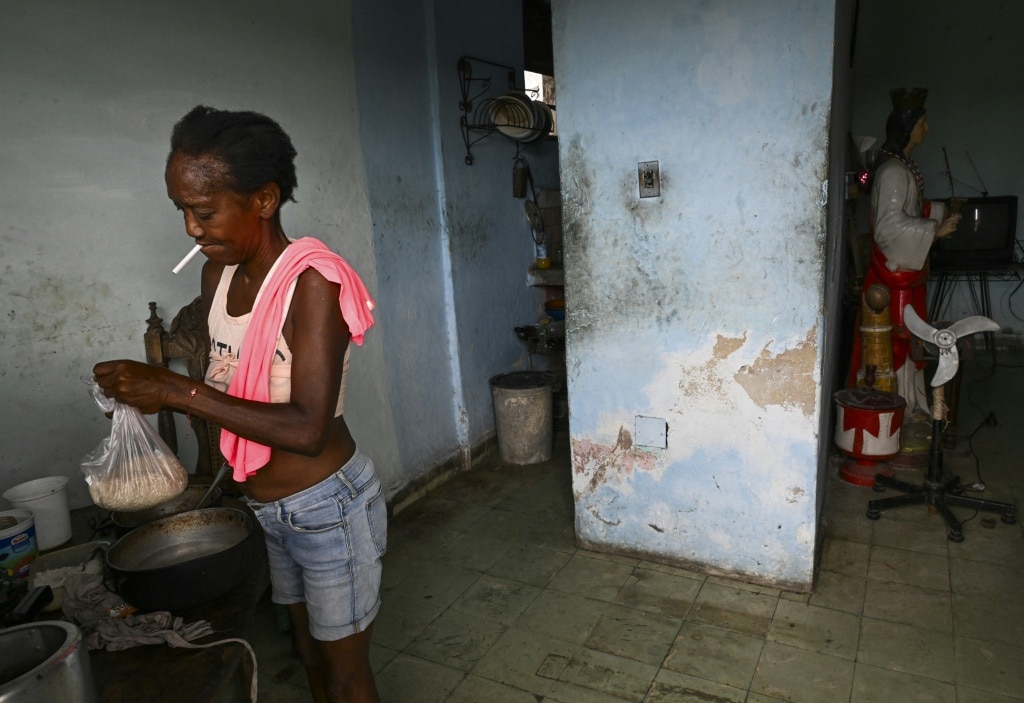
On the ground, the energy crisis has sparked growing public discontent. On Thursday, eastern Cuba was hit by a full national blackout, the latest in a string of widespread outages that have left millions without power for extended stretches. Power was partially restored to some regions later in the day, but rolling outages continue across most of the island.
AFP collected on-the-ground accounts confirming that small, spontaneous protests have broken out in residential neighborhoods across Havana. On Wednesday evening, residents of the San Miguel del Padrón suburb demonstrated by banging pots and pans, a traditional form of public protest in Cuban culture. Similar small demonstrations were reported in multiple other neighborhoods across the capital. In the western Havana district of Playa, residents chanted “Turn on the lights!” as they gathered to express their frustration.
Data compiled by AFP shows that Cuban power infrastructure is now facing record generation shortfalls, with blackouts stretching on for 12 hours or more in most regions. On Tuesday alone, 65 percent of the country’s territory was without power simultaneously.
Speaking to Fox News, Rubio doubled down on the administration’s stance, arguing that the crisis confirms the failure of Cuba’s current economic and political system. “It’s a broken, nonfunctional economy, and it’s impossible to change it. I wish it were different,” Rubio said. “I don’t think we’re going to be able to change the trajectory of Cuba as long as these people are in charge.”