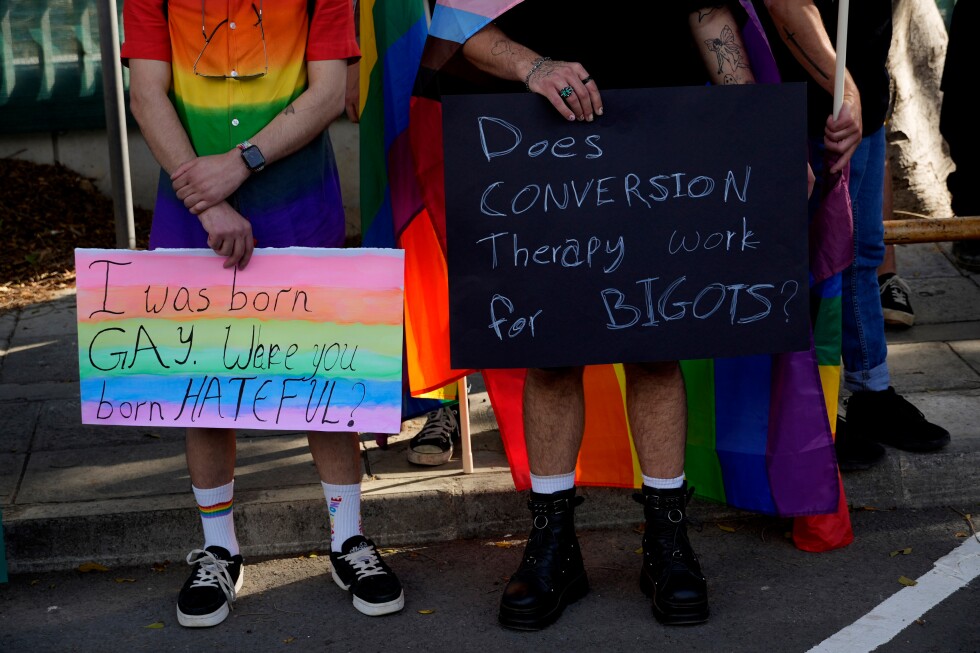
BRUSSELS – Days ahead of the capital’s annual Brussels Pride celebration of LGBTQ+ rights and culture, the European Commission announced Wednesday it will formally request all 27 European Union member states enact legal bans on discredited gay ‘conversion therapy’ practices, responding to a mass public campaign that has drawn support from more than a million EU residents.
The policy push delivers on a long-standing commitment LGBTQ+ protections that Commission President Ursula von der Leyen made when she took office in 2019. In her statement Wednesday, von der Leyen emphasized that so-called conversion practices, which aim to change a person’s sexual orientation or gender identity, have ‘no place in our Union.’
Data from the EU’s Agency for Fundamental Rights collected in 2024 underscores the urgency of this action: one in every four LGBTQ+ EU residents surveyed reported they had been subjected to the thoroughly discredited practice. The highest rates of documented conversion therapy attempts were recorded in Greece, Cyprus, the Czech Republic, Estonia, and Slovakia. Currently, only 10 of the bloc’s 27 member states have implemented full or partial prohibitions on the practice, according to regional advocacy group ILGA-Europe (the International Lesbian, Gay, Bisexual, Trans and Intersex Association Europe).
Malta made history as the first EU country to ban all attempts to alter the sexual orientation of LGBTQ+ people back in 2016. Following Malta’s lead, France enacted its own ban, imposing criminal penalties including jail time and monetary fines for anyone who performs conversion therapy targeting the LGBTQ+ community.
European Commissioner for Equality Hadja Lahbib called out the harmful foundation of the practice, noting that conversion practices are rooted in a dangerous falsehood: the claim that LGBTQ+ people need to be ‘fixed’ because there is something inherently wrong with their identity. ‘There is, of course, nothing to fix, there is nothing to cure, and there is no one to change,’ Lahbib stated. ‘You cannot torture away a person’s identity, and you cannot legislate it away. And yet these practices continue, unfortunately.’
The commission’s announcement comes just three days before Brussels’ 30th annual Brussels Pride parade, which organizers expect will draw tens of thousands of marchers to the streets of the EU’s institutional capital to celebrate LGBTQ+ culture and demand expanded equal rights protections across the bloc.