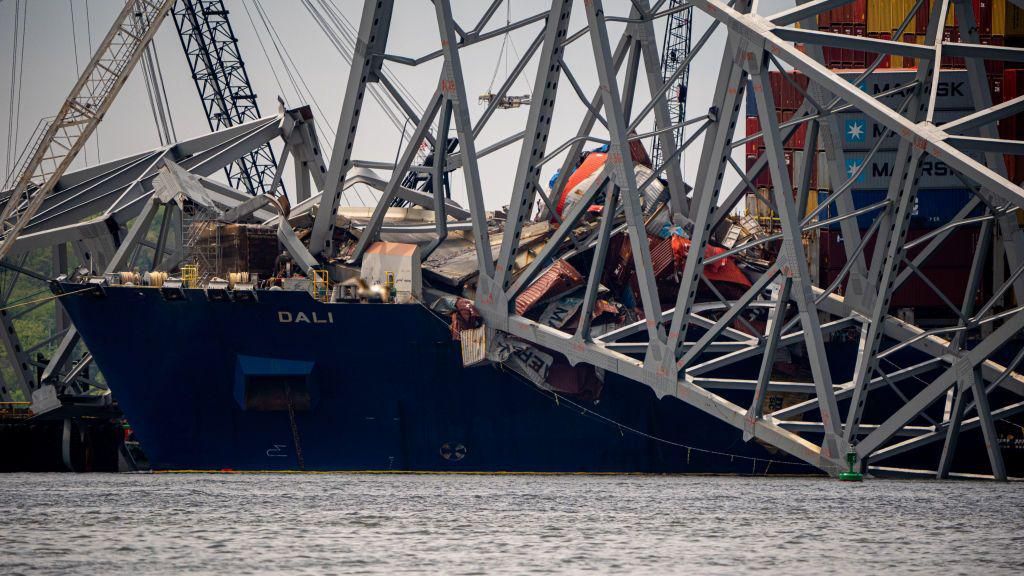
It has been two years since the cargo ship Dali crashed into Baltimore’s iconic Francis Scott Key Bridge, triggering a catastrophic collapse that claimed six lives and upended regional commerce. Now, federal prosecutors have brought formal criminal charges against the vessel’s operator and a senior company employee over the disaster.
Synergy Marine, the Singapore- and India-based firm that managed the Dali’s operations, and Radhakrishnan Karthik Nair, the ship’s technical supervisor, face a slate of charges including conspiracy, obstruction of justice, and misconduct leading to death, according to the recently unsealed indictment. Prosecutors allege the company and its staff intentionally misled federal investigators and hid critical safety hazards from the U.S. Coast Guard in the wake of the March 26, 2024 collision.
In court documents, prosecutors laid out a detailed timeline of preventable failures that led to the crash. They say the Dali lost electrical power twice in just four minutes before striking the bridge. The first outage stemmed from a loose wire in the ship’s switchboard, while the second was caused by the crew’s reliance on an unapproved flushing pump to supply fuel to the vessel’s generators. Unlike purpose-built fuel pumps, this flushing pump was not designed to automatically restart after an outage, meaning the crew could not restore power in time to avoid the collision. Prosecutors argue that with a properly configured fuel system, the ship would have regained power before hitting the bridge.
The indictment further alleges that Synergy employees were fully aware of the improper use of the flushing pump not only on the Dali but across other vessels in the company’s fleet, and actively took steps to cover up the noncompliant practice. Prosecutors also accuse the firm of falsifying official safety records to hide the violations from regulators.
Acting U.S. Attorney General Todd Blanche framed the charges as a long-awaited step toward accountability in a tragedy he called entirely preventable. “This indictment is a critical step toward holding accountable those whose reckless disregard for maritime safety regulations caused this disaster,” Blanche said in a public statement released Tuesday.
In response to the charges, a Synergy Marine spokesperson told The New York Times that the company “will defend against these allegations with vigor.” The BBC has also reached out to the firm for additional comment, and no further response has been issued as of publication.
The disaster itself unfolded in the early hours of that March morning, when the powerless Dali drifted into the bridge, collapsing the entire span within minutes. Six construction workers who were conducting maintenance on the bridge were killed when their work vehicles plunged into the Patapsco River below. The collapse shut down the Port of Baltimore for weeks, triggering massive shipping disruptions that rippled through regional and national supply chains, costing billions of dollars in lost economic activity.
Reconstruction of the Key Bridge is still ongoing, with officials projecting the project will take several years and cost billions of dollars to complete. Prior investigations by the National Transportation Safety Board identified multiple contributing factors to the disaster, beyond the ship’s mechanical and operational failures, including a lack of protective design measures to reduce the bridge’s vulnerability to ship strikes.
This is not the first legal action stemming from the collapse. The Dali’s owner has already paid more than $100 million to the U.S. Department of Justice to settle a civil claim for bridge damage, plus an additional $350 million to Maryland’s state insurance agency. Another separate civil trial against Synergy Marine is scheduled to begin next month.