Renewed naval hostilities in the Persian Gulf have thrown US-Iranian peace diplomacy into uncertainty, with Tehran leaving Washington waiting for a formal response to a US-backed truce proposal as both sides trade accusations of ceasefire violations. The unfolding crisis, which entered its 10th week following the opening US-Israeli strikes on Iran, has put fragile diplomatic efforts at risk and raised new concerns over global energy security and regional stability.
On Friday, US President Donald Trump publicly stated he expected Tehran to deliver its answer to the latest negotiating proposal, shared via Pakistani mediators, by the end of the day. As of Saturday, no official public response had been announced, with Iranian Foreign Ministry spokesperson confirming only that the plan remained “under review”. In a call with his Turkish counterpart, Iranian Foreign Minister Abbas Araghchi cast serious doubt on Washington’s commitment to diplomacy, pointing to repeated US violations of the existing fragile ceasefire.
“The recent escalation of tensions by American forces in the Persian Gulf and their numerous actions in violating the ceasefire have added to suspicions about the motivation and seriousness of the American side in the path of diplomacy,” Araghchi said, according to an account of the conversation published by Iran’s ISNA news agency. Trump nonetheless told French broadcaster LCI reporter Margot Haddad in a brief interview Saturday that he still anticipated receiving Iran’s response “very soon”.
The latest escalation came Friday, when a US fighter jet attacked and disabled two Iranian-flagged tankers that Washington accused of violating its blockade of Iranian ports. A senior Iranian military official told local media that the Iranian navy had retaliated with defensive strikes against US assets. The incident followed a separate flare-up just one day earlier in the Strait of Hormuz, the world’s most critical chokepoint for global oil shipments.
Iran has long sought greater control over the strategic waterway as a tool to exert economic leverage against the US and its Western and regional allies, a goal Washington has repeatedly described as unacceptable. The US proposal delivered via Pakistan would extend the current fragile truce across the Gulf to create space for negotiations on a permanent end to the conflict, which began 10 weeks ago with joint US-Israeli military strikes on Iranian targets.
Beyond the direct military clashes, the conflict has already created new environmental and economic risks. Satellite imagery collected by global monitoring firm Orbital EOS shows an oil slick spreading across more than 20 square miles off the west coast of Iran’s Kharg Island, the linchpin of the country’s oil export industry and a core asset for its war-battered economy. By Saturday, the UK-based Conflict and Environment Observatory reported the slick had shrunk significantly, adding that the leak likely stemmed from damaged or neglected oil infrastructure affected by ongoing conflict. Iran shut down most traffic through the Strait of Hormuz immediately after the war began on February 28, sending shockwaves through global energy markets and pushing oil prices sharply upward. The US responded with a full blockade of Iranian ports, and earlier this week Trump announced he was ending a short-lived US naval mission aimed at reopening the strait to commercial shipping.
On Saturday, Britain announced it would deploy HMS Dragon, a Royal Navy destroyer, to the region as part of a joint British-French coalition planning to support commercial shipping and mine clearance once a durable ceasefire is reached. UK defence officials said the deployment is part of “prudent planning” intended to boost confidence among commercial vessel operators navigating the strategic waterway.
Diplomatic efforts to de-escalate received support from Qatar, whose Prime Minister Sheikh Mohammed bin Abdulrahman Al Thani met with US Vice President JD Vance in Washington DC Friday to discuss Pakistan’s brokered peace initiative. Qatar has nonetheless been drawn into the conflict: Iran has launched multiple attacks on Qatari territory in recent weeks, citing the country’s hosting of a major US military air base.
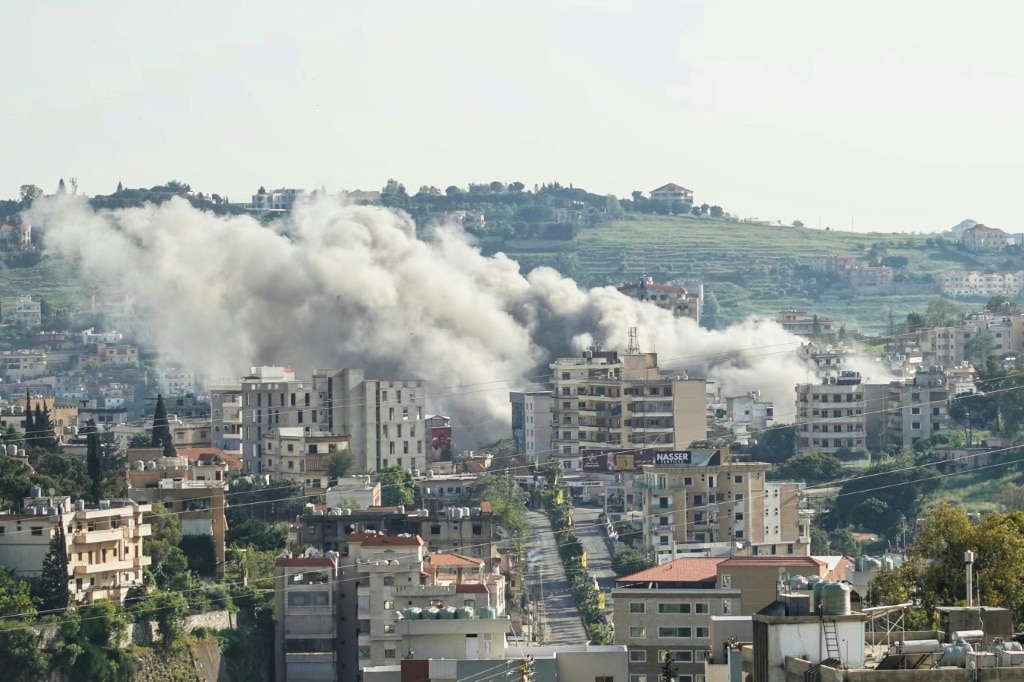
Tensions are also running high on the conflict’s secondary front in Lebanon, where a parallel ceasefire between Israel and Iran-backed Hezbollah is also teetering amid daily cross-border exchanges of fire. Eight people were killed in Israeli air strikes across southern Lebanon Saturday, according to Lebanese authorities, while state media reported additional raids on a highway south of Beirut, an area outside Hezbollah’s traditional southern strongholds. An AFP correspondent on the scene documented two destroyed vehicles and emergency response teams working roughly 12 miles outside the Lebanese capital.
Hezbollah retaliated Saturday by launching an armed drone attack targeting Israeli soldiers in northern Israel. The Israeli military confirmed multiple explosive drones crossed into its territory, reporting one army reservist suffered severe wounds and two other service members sustained moderate injuries in the attack. The fresh escalation comes just days before Lebanon and Israel — which have been officially at war since 1948 — are set to hold direct peace negotiations in Washington next week, a process Hezbollah has publicly and vehemently opposed.