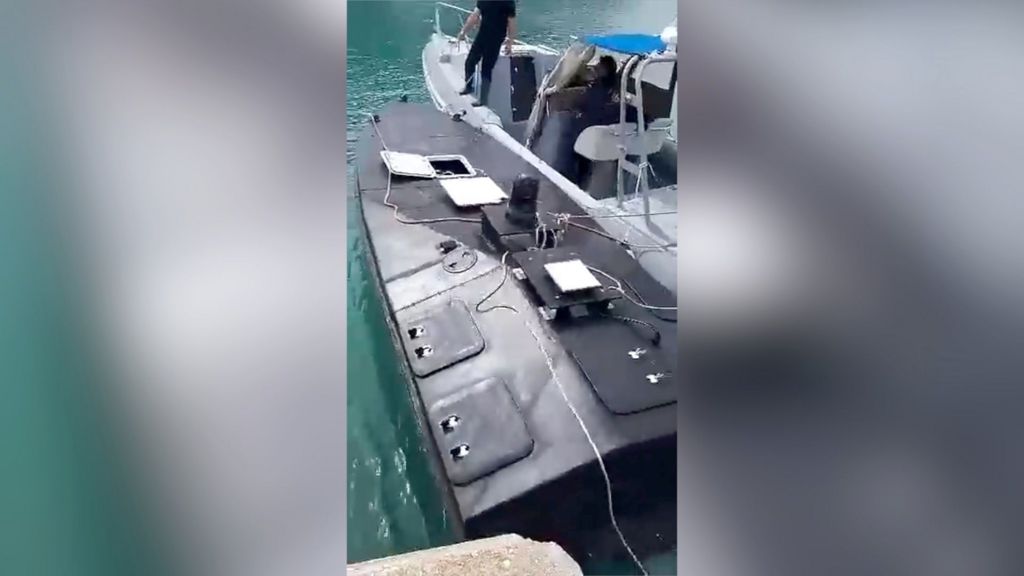
A dramatic maritime security incident has unfolded off Greece’s western coast after local fishermen stumbled on an operational explosive-carrying naval drone hidden in a coastal cave near Lefkada in the Ionian Sea, prompting a major bomb disposal operation and reigniting fierce debate over the country’s preparedness for modern, asymmetric maritime threats. The unmanned surface vessel, which was found still running its engine on Thursday, was quickly secured by Greek coastguard vessels, towed to the nearby port of Vasiliki, and handled by specialist bomb disposal teams who safely removed its detonators and power battery before moving the 100 kilograms of estimated explosives to be disposed of via controlled detonation off the coast of Astakos. Multiple independent Greek media outlets have confirmed that the drone matches the design of Ukraine’s domestically produced Magura naval drone, a type of attack uncrewed vessel Kyiv has deployed extensively against Russian military and commercial maritime targets since Russia launched its full-scale invasion in 2022. Reporters also confirm handwritten notes in the Ukrainian language were recovered from the vessel’s onboard storage, though Kyiv has so far declined to issue any official comment on the incident. Greek armed forces specialist technical teams are currently conducting a full forensic inspection of the recovered drone components to trace its origin and intended mission. Two leading working theories have emerged from official and media sources, outlined by Greek newspaper Ta Nea: the drone either fell overboard during transit by sea, or it lost contact with its operators while en route to target Russian commercial shipping in the Mediterranean, a mission that would expand Kyiv’s naval drone campaign far beyond its traditional operating area of the Black Sea. Public broadcaster ERT added that faulty sensors and GPS interference from recent bad weather in the region likely caused the drone to drift off course before it was found by local fishermen. The discovery has triggered intense political backlash in Athens, with opposition figures and minor parties slamming the ruling government for gaps in Greece’s maritime surveillance and defense capabilities. Opposition defense spokesman Michalis Katrinis warned that the incident exposed Greece’s unprotected maritime borders, while the country’s Communist Party issued a series of pointed questions demanding clarity on whether the Greek government was aware the drone was operating in its territorial waters, and if similar uncrewed vessels from allied nations are regularly active in Greek sovereign waters. The pro-Russian nationalist party Hellenic Solution went further, labeling the incursion a deliberate military provocation against Greece. Speaking on Saturday to defuse rising political tension, Greek Defense Minister Nikos Dendias sought to downplay the security risks of the incident, stating that authorities had fully contained the threat and that the government is already moving to modernize Greece’s naval fleet. Dendias confirmed that Athens is pursuing policies to domestically produce advanced drones and deploy cutting-edge anti-drone defense systems to protect Greek territorial waters. The incident has already put Greece’s national intelligence agency, armed forces, and multiple relevant government ministries on heightened security alert. This discovery comes amid already tense context for Greek-Ukrainian defense cooperation: in November last year, the two nations signed a landmark agreement to jointly produce naval drones, granting Greece access to Ukrainian drone technology for its own domestic defense needs. However, just one week prior to this incident, leading Greek newspaper Kathimerini reported that Kyiv has recently demanded a veto over any Greek use of the jointly produced drones, out of concern that Athens could deploy them against Turkey – a NATO member with long-running maritime territorial disputes with Greece and close ties to Moscow. Beyond cooperation, the incident also fits a broader pattern of expanding naval drone activity in the Mediterranean: back in March, Russia accused Ukraine of attacking a Russian LNG tanker carrying sanctioned cargo with uncrewed sea drones in the Mediterranean between Malta and Libya, marking one of the first confirmed attacks of its kind outside the Black Sea. As the investigation continues, Greek authorities are still working to answer core questions about how the drone entered its territorial waters and what its ultimate target was, with the incident serving as a stark wake-up call for Southern European nations to adapt their maritime security frameworks to the growing threat of uncrewed attack vessels.