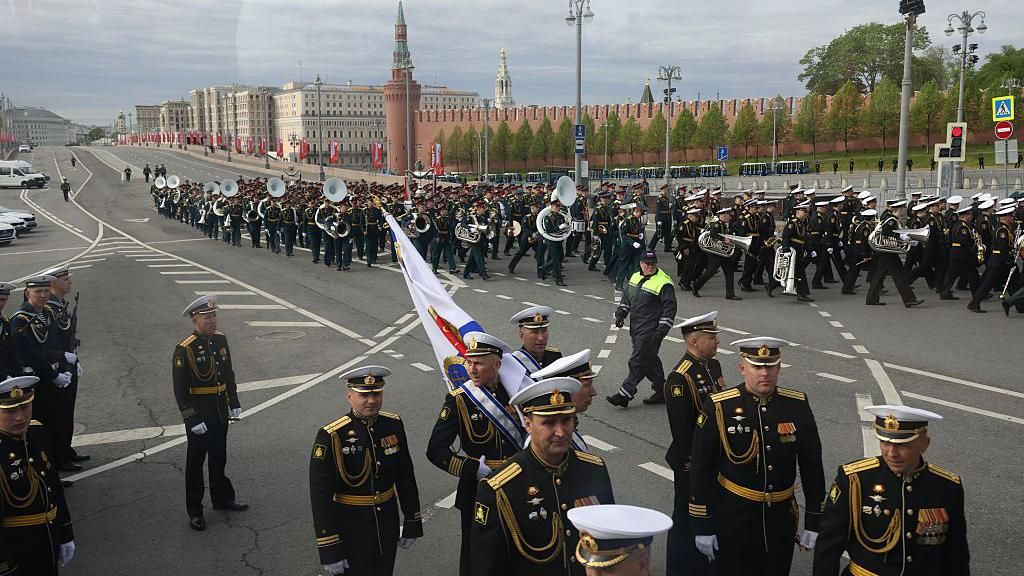
For veteran foreign correspondent Steve Rosenberg, who has covered dozens of Victory Day parades on Moscow’s iconic Red Square, the 2026 iteration stood out as fundamentally unlike any he had witnessed before. In years past, Rosenberg recalled scrambling from media drop-off points near St. Basil’s Cathedral to claim a usable spot in the overcrowded press pen, a race that was completely unnecessary this year. Attendance for international press was sharply curtailed: most foreign news outlets were denied press credentials entirely, leaving only a tiny handful of foreign journalists on site.
When Rosenberg took his place on the press stand, a Russian television crew approached him to film a segment framing his presence as proof that international access remained open. Rosenberg’s dry response cut through the narrative: he could not spot a single other foreign reporter on the entire square.
Beyond the depleted press corps, the event saw far fewer dignitaries in the guest stands, with only a small handful of foreign leaders traveling to Moscow for the annual commemoration. But the most striking departure from tradition only became clear once the parade officially got underway: none of the massive rolling military armor that the Kremlin typically displays to project Russian power to a global audience – no tanks, no rocket launchers, no intercontinental ballistic missiles – rolled across Red Square this year.
Russian authorities explained the dramatic downsizing by citing urgent security concerns, revealing that intelligence pointed to a high risk of Ukrainian drone strikes targeting the Red Square event. For President Vladimir Putin, the choice to scale back the parade – a carefully choreographed centerpiece of Russian national pride that has long been used to showcase military strength – was undoubtedly a difficult one, but the threat of an attack left no other viable option.
In a last-minute turn of diplomacy, former U.S. President Donald Trump brokered a temporary ceasefire between Moscow and Kyiv that eliminated the immediate threat of an attack during the event. In the end, the parade concluded without any security incidents. Still, Kyiv’s public framing of the ceasefire move drew sharp pushback from the Kremlin: Ukrainian President Volodymyr Zelenskyy issued an official decree “permitting” Russia to hold its parade on Ukrainian territory that Moscow currently occupies, a deliberate act of political trolling that Kremlin spokespeople rejected out of hand, noting that Russia required no permission from any third party to hold its national commemorations.
While live military hardware was absent from the streets of Red Square, the Kremlin found a work-around: pre-recorded footage of tanks, multiple rocket launchers, fighter jets, submarines and other advanced weapons systems was broadcast on massive digital screens erected across the square. It was a clear signal that the leadership remained determined to highlight its military capabilities, even without a live display.
In his keynote address to the gathered crowd, Putin struck a familiar defiant tone, declaring “We always were and always will be victorious!” The 2026 parade marks 81 years since the Soviet Union’s victory over Nazi Germany in 1945, a historical event Russia calls the Great Victory – a milestone that holds deep legitimate national meaning, marking the Soviet Union’s defeat of an invading aggressor.
Yet the context of 2026 casts a very different shadow over the commemoration. More than four years have passed since Russia launched its full-scale invasion of Ukraine, and as the parade unfolded, there was no visible path to a Russian victory in the ongoing conflict, turning this year’s muted celebration into a quiet reflection of the current strains of Moscow’s ongoing military campaign.