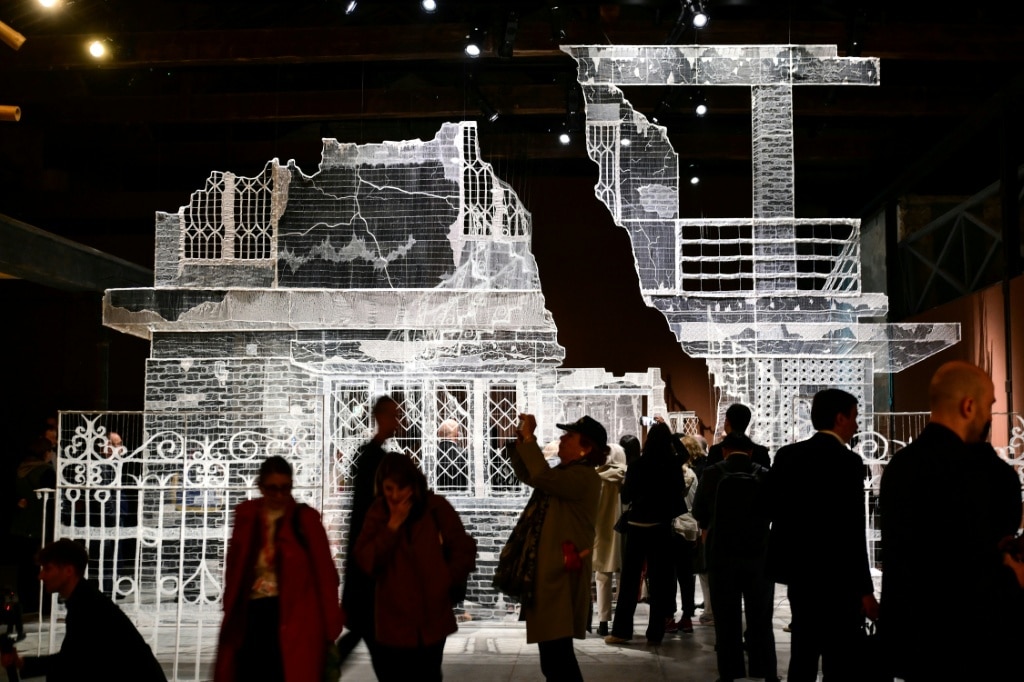
The world’s most prestigious contemporary art gathering, the Venice Biennale, opens its doors to the public this Saturday against a backdrop of searing global geopolitical tension, as competing representations of warring nations have turned the iconic event into a flashpoint for international conflict. The proximity of participating pavilions for Russia, Ukraine, Israel, and Palestinian artistic collectives has sparked heated debate, with one key stakeholder comparing the arrangement to hosting a violent offender at a private gathering of friends. Just meters from Russia’s exhibition space in the Biennale’s central gardens sits a deer sculpture recovered from active front lines in Ukraine, a quiet but visceral symbol of the war that has split the artistic community since Moscow’s full-scale invasion in February 2022. Russia’s return to the Biennale, after a two-year absence following the invasion, triggered widespread international condemnation when the participation was announced in early March. Speaking on the ground in Venice Thursday, Ukrainian Culture Minister Tetiana Berejna delivered a scathing rebuke of the decision to allow Russia to participate. “Having them here in the Biennale is like inviting a serial killer to a dinner with your friends,” Berejna said, rejecting arguments that art should remain a space separate from geopolitics and welcome all participants regardless of state actions. She added that more than 340 Ukrainian artists have been killed by Russian forces since the start of the full-scale invasion, and that Russian forces have deliberately targeted Ukrainian cultural infrastructure. “When Russia comes to our country, they destroy our libraries, they burn our books, they destroy our museums,” she said. “Culture is targeted during this war.” The friction extends far beyond the ongoing war in Ukraine, as multiple other regions in active conflict have a presence at this year’s event. The United States and Israel, which launched a targeted strike on Iranian territory in late February, both maintain official pavilions; Iran, which was originally slated to participate, ultimately pulled out of the exhibition. Israel’s pavilion at the Arsenale, the Biennale’s sprawling secondary exhibition space housed in a former 19th-century shipyard, sits just a short walk from Ukraine’s national pavilion. While Palestine does not hold official state recognition from Italy and thus cannot host its own official national pavilion, a dedicated group exhibition focused on Gaza is being held at Venice’s Palazzo Mora, titled “Gaza – No Words – See the Exhibit”. Curator Faisal Saleh, founder of the Palestine Museum based in Connecticut, United States, said the exhibition was created to amplify Palestinian experiences amid ongoing military operations in Gaza. “There’s really no way to describe the horror that was inflicted upon the Palestinians in Gaza, and I don’t think we would want to be in the same place as the people who did that,” Saleh said. The heightened tensions have forced Italian authorities to deploy a permanent police presence near the Russian, Israeli, and U.S. pavilions, a visible reminder that the rifts from global war have the potential to spill over into the art event. According to Italian national news agency Ansa, roughly 2,000 protesters gathered in Venice Friday for a pro-Palestinian demonstration calling for the removal of Israel’s official pavilion from the Biennale. Earlier in the week, Russia’s pavilion became the site of a high-profile joint protest by members of Russian dissident group Pussy Riot and Ukrainian feminist collective Femen, where demonstrators marched with covered faces and bare chests to oppose Moscow’s participation. Biennale President Pietrangelo Buttafuoco defended the decision to include all participating entities, arguing that barring artists based on their nationality would undermine the event’s core purpose. “If the Biennale were to start selecting not works but affiliations, not visions but passports, it would cease to be what it has always been: the place where the world comes together, and all the more so when the world is torn apart,” Buttafuoco said Wednesday. That view is shared by many artists and Italian political leaders who argue art should not be reduced to a tool of political division. Israeli sculptor Belu-Simion Fainaru, whose installation “The Rose of Nothingness” features a water basin fed by a slow drip irrigation system, said the growing political rifts are eroding art’s fundamental mission. “The divisions at the Biennale were destroying the meaning of art… to unite people,” Fainalu told AFP. “I don’t think we should reduce the art world to a political arena.” Italian Deputy Prime Minister Matteo Salvini echoed that sentiment during a visit to the Biennale Friday, noting that individual artists should not be treated as official spokespeople for their governments’ military or political actions. “I don’t think American, Chinese, Israeli, or Russian artists are spokespeople for ongoing conflicts,” Salvini said. At the Palazzo Mora Gaza exhibition, around 100 hand-embroidered works created by Palestinian women living in refugee camps bring to life the experiences of people in Gaza over the past two years, with Saleh noting the pieces carry a raw power that outstrips even journalistic photography. In a bid to de-escalate tensions and center the theme of coexistence, event organizers scheduled three evenings of reflection focused on the theme of peace during the pre-opening week, featuring appearances by exiled Russian filmmaker Alexander Sokurov and prominent Palestinian writer and architect Suad Amiry.