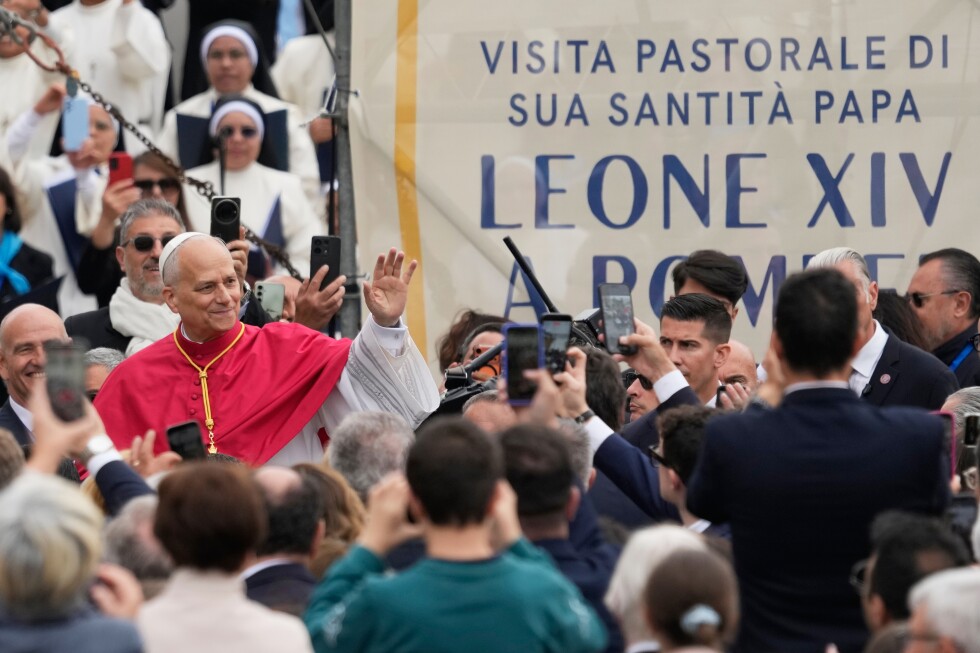
POMPEII, Italy – On the first anniversary of his historic election as the first American-born pope, Pope Leo XIV traveled to the ancient Roman city of Pompeii on Friday to mark the occasion with quiet prayer and commemoration of a beloved Marian feast day that aligned perfectly with the start of his pontificate.
Flying by helicopter to the archaeological hub near Naples, the pontificate dedicated his full day visit to honoring the Feast of Our Lady of Pompeii, a date that also carries historic meaning for the global Catholic Church: it was on this same day in 1876 that the cornerstone was laid for the city’s iconic sanctuary dedicated to the Virgin Mary.
Nestled steps away from the ongoing excavations of Pompeii, the Roman town that was entirely buried under volcanic ash and gas when Mount Vesuvius erupted in 79 AD, the sanctuary draws a different crowd than the ancient ruins that welcome millions of tourists annually. For decades, it has been a major pilgrimage site for Catholics, particularly those devoted to the rosary prayer tradition.
Standing before crowds of gathered faithful ahead of celebrating Mass inside the sanctuary, Pope Leo shared his reflections on the meaningful occasion, saying, “What a beautiful day, how many blessings the Lord wanted to give to all of us. I feel I am the first blessed to be able to come here to the sanctuary of the Madonna on the day of her feast and on this anniversary.”
This Pompeii pilgrimage marks the opening of a months-long series of day trips Pope Leo will take across the Italian peninsula over the coming weeks. The journey comes as the Bishop of Rome, who hails from the United States as former Cardinal Robert Prevost, deepens his connection to the Italian national church he serves as its symbolic head.
The pope’s pontificate was literally launched with a prayer centered on this very feast day. On the night of his election, when he first stepped out onto the loggia of St. Peter’s Basilica to be introduced to the world, Pope Leo immediately referenced the Feast of Our Lady of Pompeii before leading crowds gathered in St. Peter’s Square in a public prayer for his new papacy. That night, he emphasized Mary’s constant presence for believers, saying, “Mary, the mother of Christ, always wants to walk at our side, to remain close to us, to help us with her intercession and her love.” He asked the crowd to join him in praying for grace for his new mission, for the global church, and for peace across the world.
The Pompeii sanctuary is forever tied to St. Bartolo Longo, the founder who built the basilica and is widely venerated across Italy for his lifelong charitable outreach to orphans, prisoners, and other marginalized communities. In a full-circle moment for the site, the late Pope Francis approved the miracle required for Longo’s canonization from his hospital room just weeks before Francis’s death, and Pope Leo formally canonized Longo as a saint last October.
Pope Leo opened his visit on Friday by meeting with sick and disabled people supported by a charitable center affiliated with the sanctuary, a site that was named a pontifical basilica in 1901 by Pope Leo XIII, the current pope’s namesake. In his opening remarks, he retraced Longo’s work in the region, recalling that when Longo first arrived in the Pompeii valley, “he found a land plagued by great poverty, inhabited by a few very poor farmers, and ravaged by malaria and bandits.”
Yet despite the harsh conditions, Longo “was able to see, however, the face of Christ in everyone: in the great and the small, and especially in the orphans and the children of prisoners, to whom he made the beating of God’s heart felt through his tenderness,” the pope added.
Thousands of cheering Italian faithful lined the pope’s route, with many reporting they had waited since the middle of the night to catch a glimpse of the new pontiff. Many attendees made clear they were paying close attention to the recent public disagreement between Pope Leo and U.S. President Donald Trump over the escalating conflict in Iran, and they expressed strong approval of the pope’s response.
“He doesn’t let anyone intimidate him. Look at the recent issues with Trump,” said Rita Borriello, a resident of nearby Torre del Greco. After Trump publicly criticized the pope, Leo “simply answered, ‘I preach the Gospel’. I see him as a very humble pope, very close to us, a pope who entered in our hearts.”
Reporter Nicole Winfield contributed reporting from Rome. This coverage of religion comes via the Associated Press’s collaboration with The Conversation US, with funding provided by Lilly Endowment Inc. The AP retains full editorial responsibility for all content.