The United Arab Emirates has transferred $100 million to the US-backed Board of Peace to fund the training of a new Palestinian police unit earmarked for deployment in the Gaza Strip, The Times of Israel reported in a story citing anonymous diplomatic sources. This single contribution marks the largest individual donation the transitional governance body has received to date, coming after nine initial board members pledged a combined $7 billion, and the United States added an additional $10 billion in commitments during an international donor conference held in February.
Per details shared by a senior U.S. official and a Middle Eastern diplomat, new police recruits will undergo training in neighboring Egypt and Jordan, while a private Emirati security firm has been contracted to build out the full force, which is planned to number roughly 27,000 serving officers. Earlier reporting from the same outlet quoted an anonymous Arab diplomat, who confirmed that former Palestinian civil servants who held roles in Gaza prior to the current conflict will be eligible to apply to join the new force, though all candidates must pass a strict vetting process carried out by Israel’s internal security agency before receiving final approval.
The ongoing violence against Palestinian security personnel in Gaza has persisted even after a ceasefire agreement was reached in October. In the most recently documented violation of the truce on Wednesday, a high-ranking officer with the Palestinian interior ministry was killed in an Israeli strike. Since the ceasefire took effect on October 10, at least 837 Palestinians have been killed by Israeli forces, pushing the total death toll from Israel’s military campaign in Gaza to at least 72,619, a figure widely cited in regional humanitarian and political reporting.
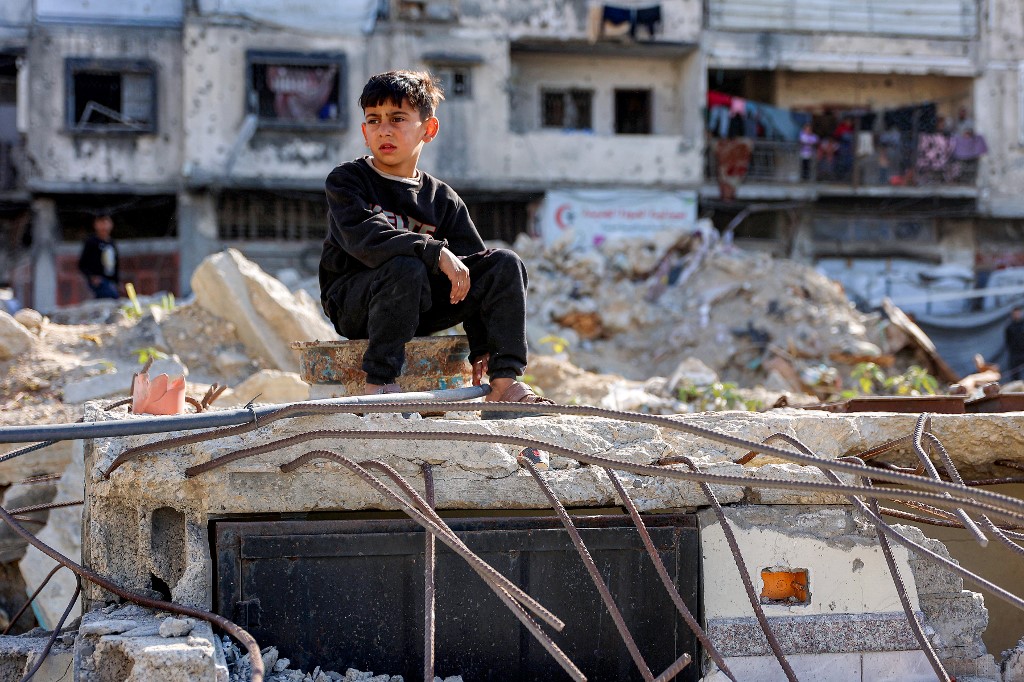
Ali Shaath, the Palestinian technocrat tapped to lead the National Committee for the Administration of Gaza (NCAG) — the interim technocratic governing body set up to oversee Gaza’s transition — confirmed that recruitment for the new police service is already active across the Strip. Speaking at the February donor conference, Shaath emphasized the urgent need for the force, noting that much of Gaza lies in catastrophic ruin, with widespread destruction leaving acute unmet humanitarian needs and fragile public security. “Large parts of [the] Gaza Strip are severely damaged. Destroyed, actually. Humanitarian needs are acute. Law and order remain fragile. This is not [a] normal operating environment… which is precisely why discipline and prioritisation matter,” Shaath stated. The new police force will operate under the direct oversight of the NCAG.
The initiative aligns with a 20-point plan released by former U.S. President Donald Trump in September that outlines a framework for ending the current war in Gaza. Under that plan, Washington will partner with Arab and international stakeholders to establish a temporary International Stabilization Force (ISF) that will deploy to the Strip, and work in tandem with the newly trained Palestinian police force.
Amid continuing Israeli strikes on Gaza, Nickolay Mladenov, the Board of Peace’s high representative for Gaza, noted in late March that “the truce is holding despite challenges.” Mladenov also confirmed that the NCAG has been formally established and has already “made progress on vetting thousands of civilian police candidates.”
“The National Committee exercises authority solely on an interim basis. The end state is a reformed Palestinian Authority capable of governing Gaza and the West Bank, and ultimately a pathway to Palestinian self-determination and statehood,” Mladenov explained. He added that the Palestinian security force, operating under the interim national committee’s authority, will enable the dismantling of all armed factions in Gaza and the consolidation of all weapons under a single civilian governing authority.
Several other board member nations — including Indonesia, Morocco, Kazakhstan, Kosovo, and Albania — have also pledged military personnel to join the international stabilization force that will coordinate with the local Palestinian police service.
The UAE’s $100 million donation comes months after Abu Dhabi drafted plans in February to construct a new administrative compound for Palestinian use in the section of Gaza already under Israeli military occupation. That proposal has already stoked regional tensions, putting the UAE at odds with other regional powers and multiple Palestinian groups, who argue the plan amounts to a de facto partition of Gaza, a outcome they strongly oppose.
This reporting comes from Middle East Eye, a outlet that provides independent, on-the-ground coverage and analysis of the Middle East, North Africa, and surrounding regions.