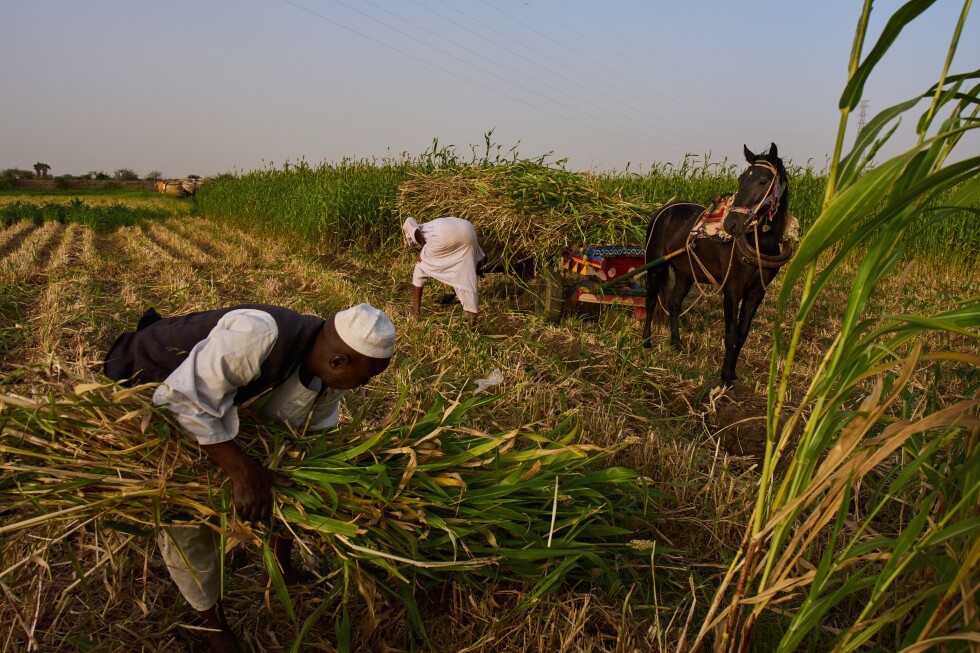
Two years after Sudan’s brutal civil war drove him from his small family farm, Omer al-Hassan finally made the journey back to his land in Omdurman, clearing weeds, plowing dry soil, and preparing to plant for the first time since he fled. But a new wave of unrest sweeping the Middle East has now derailed his hopes, sending critical agricultural input prices soaring and pushing him and millions of other Sudanese farmers further into financial ruin and food insecurity.
Al-Hassan and thousands of small-scale producers across Sudan are now bracing for one of the costliest planting seasons in recent memory. Many have already announced deep cuts to planned production, while some vulnerable smallholders have opted to skip planting entirely—a devastating development for a nation already grappling with three straight years of armed conflict that has left more than half its population facing acute hunger.
“The conflict linked to Iran has upended every part of our agricultural work,” al-Hassan told the Associated Press during an interview as he and his crew harvested onions from his recently cleared plot. After two months of backbreaking work to restore the overgrown land, he said, “We put our faith in God, but even after all that struggle, we still go without meals some days. We simply can’t keep up with the costs.”
Along with the 10 seasonal workers who help tend his farm, which also produces potatoes and tomatoes, al-Hassan says the group cannot cover operating costs without government financial support. That has already forced them to slash planted acreage and ration fertilizer use across the property. Another local farmer, Mohammed al-Badri, confirmed he can only afford to plant half of his arable land this season, leaving the rest uncultivated: “The other half is just wasted. We can’t do anything with it.”
The root of this new crisis lies in disruptions to global trade chokepoints tied to Middle East tensions. More than half of Sudan’s imported fertilizer arrives by sea through the Gulf region, where hundreds of commercial vessels have been stranded for weeks amid heightened tensions around the Strait of Hormuz. The resulting supply crunch has pushed up domestic fuel prices by roughly 30% nationwide, with fertilizer costs skyrocketing even faster.
Those increases have in turn driven sharp spikes in retail food prices across Sudan, hitting already cash-strapped households the hardest. The nation’s core staple crops—sorghum, millet, and sesame—are now at severe risk of production shortfalls this growing season. Farmers already reeling from the ongoing internal conflict between Sudan’s military and the paramilitary Rapid Support Forces now face cascading cost increases for fertilizer, gasoline for farm tractors, and diesel to power irrigation pumps.
Abdoun Berqawi, a farmer in Gezira, Sudan’s most productive agricultural heartland, described the situation as a “dangerous reality” that will collapse small-scale farming without urgent government intervention. He shared data showing the cost of a 50-kilogram bag of urea fertilizer has jumped from $11 a year ago to roughly $50 today, while tractor fuel has surged from $2.50 to $8 per gallon over the same period. Officials from Sudan’s Ministry of Agriculture have not yet responded to requests for comment on what steps the government is taking to address the emergency.
Melaku Yirga, regional vice president for the international aid organization Mercy Corps, who recently traveled to Sudan’s key agricultural states of Kassala and Gedaref, warned the timing of the crisis could not be worse. The Middle East tensions have triggered a “dangerous chain reaction” just as farmers begin preparing for planting, he explained. “People are already buying less food, cutting or skipping meals entirely, selling off critical household assets, and taking dangerous risks just to put food on the table,” Yirga said. “Mothers are forced to make impossible choices about which of their children get to eat the little food available, and some families are even eating wild leaves or animal feed to stay alive.”
For farmers who borrowed money from banks to cover planting costs, poor harvests this year could lead not just to bankruptcy but jail time for unpaid debts, said Merghany Omar, a farmer based in al-Matammah, River Nile province. He added that even onion farming, a reliable cash staple for smallholders in the area, no longer generates enough revenue to cover basic input costs.
Samy Guessabi, country director for Action Against Hunger in Sudan, noted this new crisis is layered on top of pre-existing systemic vulnerabilities, including dramatic currency depreciation that has already eroded purchasing power across the country. The hardest-hit communities are in remote agricultural regions including Kordofan, White Nile, Darfur, and Blue Nile, Guessabi said, where “farm zones are cut off from major markets and have very poor transport connections.”
Even in Sudan’s urban centers, retail prices for fresh vegetables and dairy products have risen by roughly 40% in recent weeks, driven directly by fuel price increases. Before the latest crisis sparked by Middle East tensions, the ongoing civil war had already pushed millions of Sudanese into hunger. The United Nations World Food Program currently estimates 19 million Sudanese face acute food insecurity, with millions more on the edge of famine. Famine was officially declared in two major regions, Darfur and Kordofan, last year.
The emergency has also severely disrupted international humanitarian aid efforts already stretched thin by the conflict. WFP says food assistance shipments bound for Sudan are now forced to travel more than 5,500 additional miles to reach their destinations, adding massive extra costs and weeks of delays. That diversion is largely a result of commercial vessels avoiding the Bab el-Mandeb Strait at the southern end of the Red Sea, another critical global shipping chokepoint, where Iranian-backed Houthi rebels in Yemen have threatened commercial traffic.
Mubarak al-Nour, a veteran farmer and former parliamentarian in Gedaref, said even when farmers do manage to secure fertilizer, ongoing shipping delays mean many will miss the critical June-to-November planting window entirely. In response, some producers have already shifted away from high-value, fertilizer-intensive crops like corn and sesame, switching to lower-yield crops that require little to no chemical fertilizer.
Even if agricultural supplies do reach Sudan in time for planting, the challenges do not end there. Mathilde Vu, advocacy manager with the Norwegian Refugee Council, explained that fuel shortages in many parts of the country are also worsened by warring factions blocking supply routes, while local fuel markets have been heavily damaged by bombing in recent months amid a sharp escalation of drone attacks across the nation.
Reporting for this story was contributed by Khaled from Cairo. The Associated Press receives financial support for global health and development coverage in Africa from the Bill & Melinda Gates Foundation. The AP maintains full editorial independence over all content.