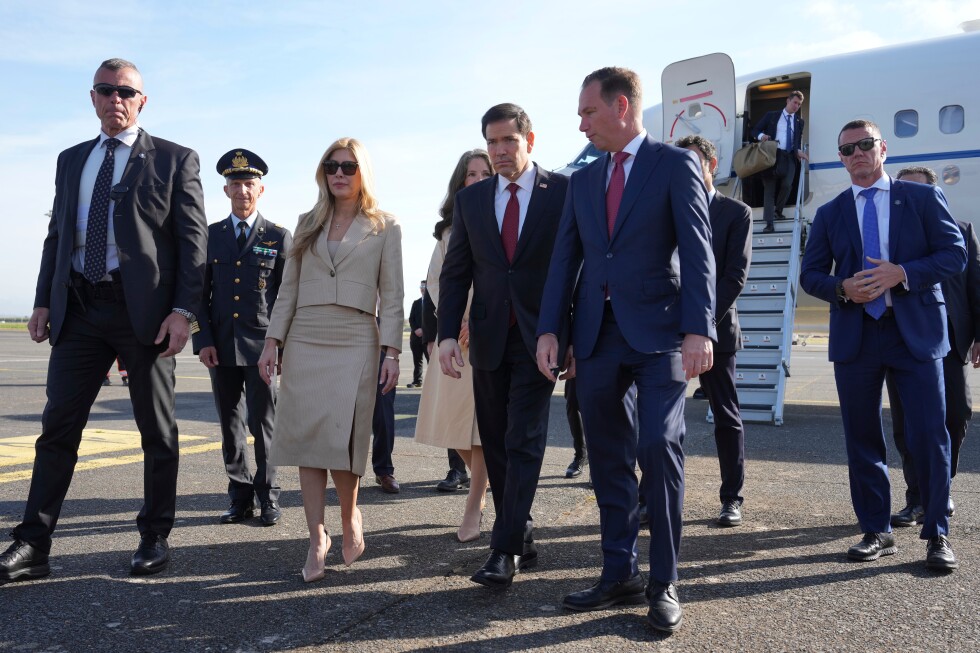
On Thursday, May 7, 2026, U.S. Secretary of State Marco Rubio touched down in Rome to kick off a high-stakes fence-mending visit to the Vatican and Italy, a trip upended by repeated public attacks from President Donald Trump against Pope Leo XIV that have plunged U.S.-Holy See relations into one of their deepest rifts in recent memory.
A devout practicing Catholic, Rubio was scheduled to hold a formal audience with the Chicago-born Pope Leo XIV later that day, a meeting that nearly fell apart after Trump launched another last-minute broadside against the pontiff, twisting his public stances on the U.S.-Israeli war in Iran and nuclear non-proliferation. The pope has forcefully pushed back against Trump’s misrepresentations, clarifying that his repeated calls for dialogue over conflict align with centuries of Catholic teaching on peace and the Gospel message, not softness on security threats.
The friction between the American president and the head of the Catholic Church stretches back to last month, when Trump launched a social media tirade against Leo, criticizing the pontiff’s comments on U.S. immigration policy, mass deportations, and the ongoing military campaign in Iran. The clash escalated after Leo stated that God does not hear the prayers of those who choose to wage aggressive war. Tensions spiked further when Trump shared a social media graphic that appeared to compare himself to Jesus Christ; the post was removed after widespread public backlash, and Trump has refused to apologize, later claiming he thought the image depicted him as a physician.
Vatican Secretary of State Cardinal Pietro Parolin waded into the dispute on the eve of Rubio’s visit, issuing a carefully worded but firm rebuke of Trump’s attacks. “Attacking him like that or criticizing what he does seems a bit strange to me, to say the least,” Parolin said Wednesday.
In his scheduled meetings, Rubio is also set to hold talks with Parolin, before traveling to Rome on Friday to meet Italian Prime Minister Giorgia Meloni and Foreign Minister Antonio Tajani. That meeting is expected to be equally tense: both Italian leaders have publicly defended Pope Leo and labeled the U.S.-Israeli invasion of Iran illegal, drawing sharp criticism from Trump in return.
Rubio pushed back against suggestions this trip was hastily arranged to repair broken ties, telling reporters at the White House earlier this week that the visit had been planned for months, while acknowledging “obviously we had some stuff that happened.” He also attempted to frame Trump’s repeated criticisms of the pope as rooted in legitimate security concerns, arguing that Trump opposes any pathway for Iran to acquire nuclear weapons — a stance he says is shared by most of the international community.
Pope Leo has repeatedly refuted Trump’s false claim that he accepts Iran developing a nuclear arsenal. In comments Tuesday night, the pontiff noted the Catholic Church has opposed all nuclear weapons for decades, emphasizing that his mission is simply to spread the Gospel message of peace. “If someone wants to criticize me for announcing the Gospel, let him do it with the truth,” he said. Leo also clarified his position: the Church upholds the just war tradition and recognizes the right of nations to self-defense, but the advent of nuclear weapons requires a fundamental reevaluation of armed conflict in the modern era. “I always believe that it’s much better to enter into dialogue than to look for arms,” he added.
This is not the first time Rubio has been called upon to de-escalate tensions and soften the edge of Trump’s unorthodox rhetoric. Trump has also turned his criticism on other NATO allies over their lack of support for the Iran war, recently announcing plans to withdraw thousands of U.S. troops from Germany in the coming months.
Vatican observers note that the Holy See’s decision not to cancel the scheduled audience with Rubio signals a clear willingness to maintain open diplomatic channels, even amid the public acrimony. But many analysts question what substantive progress Rubio can achieve on this trip. Former ANSA news agency chief Giampiero Gramaglia argued that Rubio is as motivated by his own political future as he is by repairing U.S.-Vatican relations, ahead of upcoming midterm congressional elections and the 2028 presidential race. As a prominent Catholic Republican, Gramiglia told the Foreign Press Association in Rome, “I doubt Rubio has the role of conciliator for Trump. I have the perception that Rubio’s mission is more about himself.”
Rev. Antonio Spadaro, undersecretary of the Vatican’s culture office, wrote this week that Rubio’s visit is less about convincing the pope to adopt Trump’s position on Iran, and more about a quiet recognition from Washington that Leo’s global voice carries significant influence that cannot be simply dismissed. “The situation created by President Trump’s remarks required a high-level, direct intervention, conducted in the proper language of diplomacy: a semantic corrective to a narrative of frontal conflict with the church,” Spadaro noted.
For Italy’s government, the path forward is far more complicated, even if Vatican relations can be partially smoothed. Italian public opinion is overwhelmingly opposed to the Iran war, and Prime Minister Meloni’s balancing act — maintaining the U.S.-Italian alliance while criticizing Trump’s policies — is becoming increasingly unsustainable, prominent Italian journalist Massimo Franco wrote in the Corriere della Sera.
Beyond the tit-for-tat over Iran and the Trump-Leo clash, Cuba is also expected to feature prominently in Rubio’s talks with Vatican officials. The Holy See has raised sharp concerns over the Trump administration’s repeated threats of military action against Cuba, which came after the ouster of Venezuelan leader Nicolás Maduro in January. Trump has repeatedly stated that Cuba could be “next” for regime change, even suggesting that U.S. naval assets deployed to the Middle East for the Iran war could stop in Cuba on their way back to the United States once the conflict concludes.
Rubio, the son of Cuban immigrants and a longstanding hardliner on U.S. policy toward Havana, noted that the U.S. has provided $6 million in humanitarian aid to Cuba, but the Cuban government has blocked official distribution. So far, aid has been distributed through the Catholic Church, and Rubio said Washington hopes to expand that cooperation.