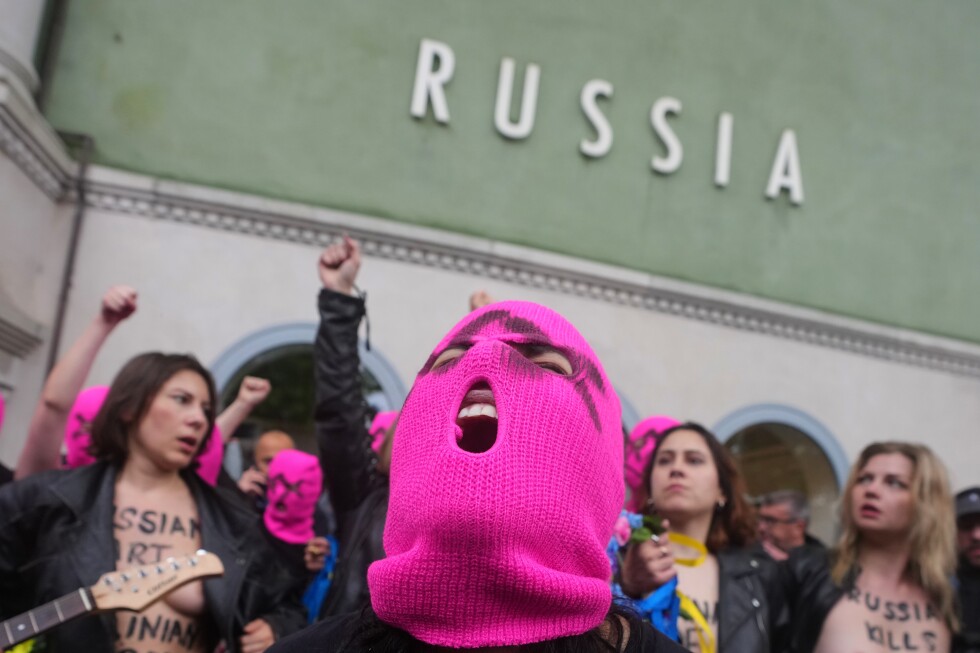
VENICE, Italy — A high-stakes demonstration rocked the prestigious Venice Biennale on Wednesday, as two prominent activist collectives—Russian punk protest group Pussy Riot and Ukrainian feminist organization FEMEN—joined forces to block the opening of Russia’s national exhibition space at the world’s most influential contemporary art event. Chanting slogans including “Russia’s art is blood” and “Disobey” amid a cloud of colored smoke matching the blue and yellow of Ukraine’s national flag mixed with pink associated with the groups’ feminist messaging, the masked activists, who covered their faces with pink balaclavas, advanced toward the Russian pavilion in the Biennale’s central Giardini exhibition district. Italian law enforcement officers quickly formed a line at the venue’s entrance, and the demonstration successfully halted access to the space for roughly 30 minutes, delaying Russia’s return to the Biennale after its years-long absence.
Speaking after the protest, Nadya Tolokonnikova, founder of Pussy Riot, emphasized that only art created by Russian dissidents imprisoned on what she called absurd politicized charges deserves to represent Russia on the global stage. “Those people make art, and I want that art to represent Russia, because they represent the real face of Russia,” Tolokonnikova told reporters. She added that repeated attempts to open a dialogue with Biennale organizers about the controversy went unanswered, and she was forced to register for entry to the Giardini under a false name to pass security screening and join the demonstration.
This year’s Biennale marks Russia’s first participation in the event since Moscow launched its full-scale invasion of Ukraine in 2022. The controversial decision to allow the Russian pavilion has already triggered sweeping fallout: the European Union stripped 2 million euros ($2.5 million) in funding from the art fair over the inclusion, and last week the entire international jury tasked with awarding the Biennale’s coveted Golden Lion prizes resigned in protest. The jury stated it would not issue awards to any countries under investigation by the International Criminal Court for alleged human rights abuses, a position that targets both Russia and Israel, drawing broader controversy to the 2024 event.
Organizers of the Venice Biennale have stood by their decision to include Russia, releasing a statement noting that any country maintaining formal diplomatic relations with Italy is eligible to participate in the national pavilion program. While the Italian national government in Rome has publicly opposed the inclusion of Russia, it has acknowledged that the Venice Biennale operates as an independent cultural institution and has not moved to block the pavilion’s opening. For 2024, the Russian pavilion is centered around a series of live musical performances held in a lower-level gallery space, and it is currently only scheduled to operate during the first week of previews leading up to the Biennale’s official opening to the public on May 9.