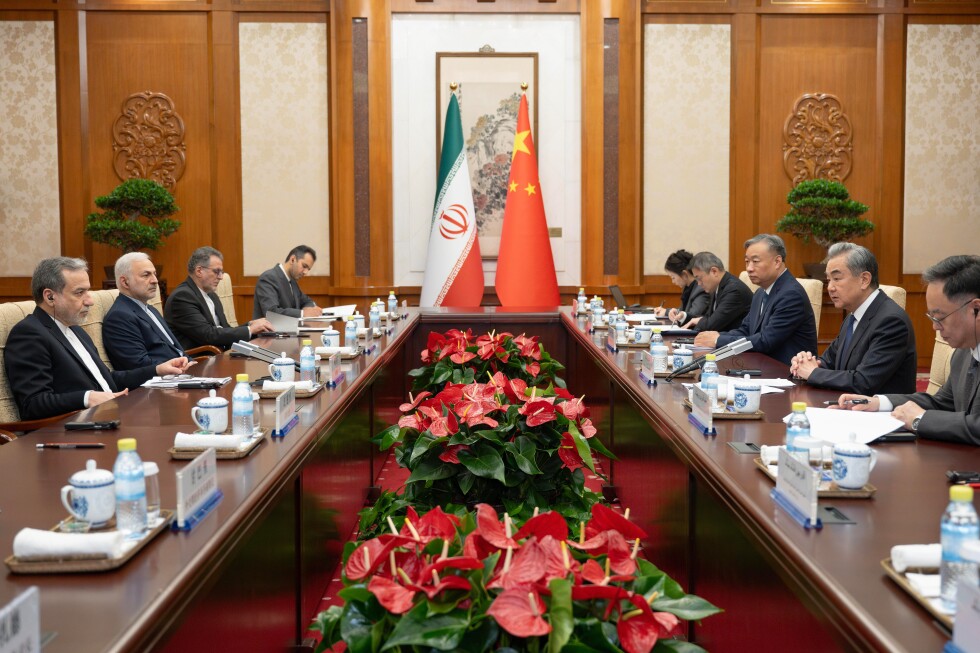
As a highly anticipated bilateral meeting between U.S. President Donald Trump and Chinese President Xi Jinping approaches, China’s growing diplomatic influence in the ongoing Iran conflict has moved into the global spotlight, following high-stakes talks Wednesday between the two nations’ top foreign policy officials in Beijing.
Over the past decade, Beijing has steadily expanded its footprint in global diplomacy, shifting from its long-standing policy of avoiding entanglement in distant regional conflicts to emerge as a key power broker mediating disputes spanning from Southeast Asian border tensions to the war in Eastern Europe. While Beijing has not taken on the formal title of mediator in the Iran war, both Washington and Tehran have publicly acknowledged its outsized quiet influence in pushing for de-escalation of the conflict.
The Trump administration has repeatedly pushed Beijing to leverage its close economic ties with Tehran to force the reopening of the Strait of Hormuz, a critical global oil chokepoint that Iran has blockaded amid the fighting. During Wednesday’s talks with Iranian Foreign Minister Abbas Araghchi — his first visit to Beijing since the war began on February 28 — Chinese Foreign Minister Wang Yi reiterated China’s call for an immediate comprehensive ceasefire, stating that Beijing is deeply troubled by the human and security costs of the ongoing conflict.
“The entire international community shares a urgent collective goal of restoring normal, secure passage through the Strait of Hormuz, and China hopes all relevant parties will move quickly to answer the strong calls from the global community,” Wang told Araghchi, according to China’s official state news agency Xinhua. Wang also added that Beijing recognizes Iran’s legitimate right to develop peaceful nuclear energy and welcomes Tehran’s long-standing pledge to refrain from pursuing nuclear weapons.
The timing of Araghchi’s visit is not accidental, with the Trump-Xi summit scheduled for next week in Beijing, where the Iran conflict is expected to top the bilateral agenda. A day ahead of the Beijing talks, U.S. Secretary of State Marco Rubio urged Chinese officials to use the meeting to pressure Tehran to lift its blockade of the strategic waterway.
Araghchi signaled that progress on reopening the strait could be within reach, telling reporters through Xinhua that “currently, it is possible to resolve the issue of reopening the Strait of Hormuz as soon as possible.” Wang’s renewed public call for the strait’s reopening has already created new momentum for behind-the-scenes negotiations between Washington and Tehran to end the conflict, analysts note.
Regional and global policy experts have offered mixed assessments of what the high-profile meeting signals about China’s evolving role. Tuvia Gering, a nonresident fellow at the Atlantic Council’s Global China Hub, noted that the coordinated visit demonstrates Beijing and Tehran’s aligned messaging, and reinforces China’s ambition to secure a permanent seat at the table for any future regional security agreement. “However, unless Beijing rolls out a concrete, actionable peace initiative, I would not characterize this as a meaningful shift in China’s approach to the conflict,” Gering added.
Hoo Tiang Boon, a professor of Chinese foreign policy at Singapore’s Nanyang Technological University, pointed out that the visit was arranged at Beijing’s initiative, marking a deliberate display of China’s leverage over Tehran. “By summoning the Iranian foreign minister and holding high-profile talks, Beijing cannot be accused of sitting on the sidelines and refusing to engage,” Hoo noted.
Many analysts highlight that China holds a unique position in any mediation efforts thanks to its status as a leading economic power with deep ties to all key stakeholders in the conflict, from Iran to major Gulf Arab states and Pakistan. Unlike most other global powers, Beijing is positioned to offer large-scale postwar reconstruction investment and targeted economic relief to war-impacted regions, tools few other actors can match.
George Chen, a partner at the international advisory firm The Asia Group, argued that China’s role in the Iran dispute is irreplaceable. As Tehran’s largest crude oil buyer, Beijing’s policy positions carry significant weight with Iranian leadership, he noted, adding that China is also one of the few major powers that has publicly expressed sympathy for Iran’s position at the United Nations. The U.S. government has additionally noted that Iran’s ballistic missile program was developed with early Chinese technology support, and Beijing continues to sell Iran dual-use industrial components that can be repurposed for missile manufacturing.
This is not China’s first high-profile mediation success in the Middle East. In 2023, Beijing played a central role in brokering the restoration of formal diplomatic relations between longtime regional rivals Saudi Arabia and Iran, a breakthrough that drastically reduced the risk of direct and proxy conflict across the Gulf. Muhammad Zulfikar Rakhmat, a researcher at Indonesia’s Center of Economic and Law Studies, called the 2023 deal a major geopolitical win for China, but noted that Beijing is deliberate about when it chooses to engage. “Its mediation tends to be opportunistic and low-risk, often occurring when conditions are already ripe for an agreement,” Rakhmat explained, noting that both Riyadh and Tehran already had strong incentives to re-engage before Beijing stepped in.
Beyond the Middle East, Beijing has built a growing track record of conflict mediation in recent years. It hosted multiple rounds of talks between Thailand and Cambodia during their 2024 border conflict, and joined the U.S. for initial ceasefire negotiations in Malaysia, helping broker a second ceasefire when fighting resumed late last year. Beijing has also put forward formal peace proposals for the war in Ukraine, and even hosted Ukraine’s foreign minister for talks, despite its public “no-limits” strategic partnership with Russia.
Experts note that China’s diplomatic messaging in global conflicts follows a consistent pattern, with Beijing repeatedly emphasizing respect for the U.N. Charter and national sovereignty. Amid the Iran conflict, President Xi last month reiterated this framing, calling for “upholding the principles of peaceful coexistence, upholding national sovereignty, upholding the rule of international law, and coordinating development and security.” Hoo noted that this consistent messaging has become a hallmark of China’s mediation efforts.
Thitinan Pongsudhirak, a professor of international relations at Thailand’s Chulalongkorn University, argued that for distant conflicts, Beijing often faces low tangible stakes but can reap major diplomatic benefits, particularly as the world adjusts to the Trump administration’s unconventional negotiating style. “What the U.S. is doing under Trump is deeply damaging, and everyone suffers from it … and China is displaying global leadership and exerting its global role by speaking to the rules-based international system,” Pongsudhirak said. “It’s an inescapable contrast” between the two approaches to global diplomacy, he added.
Wu contributed reporting from Bangkok.