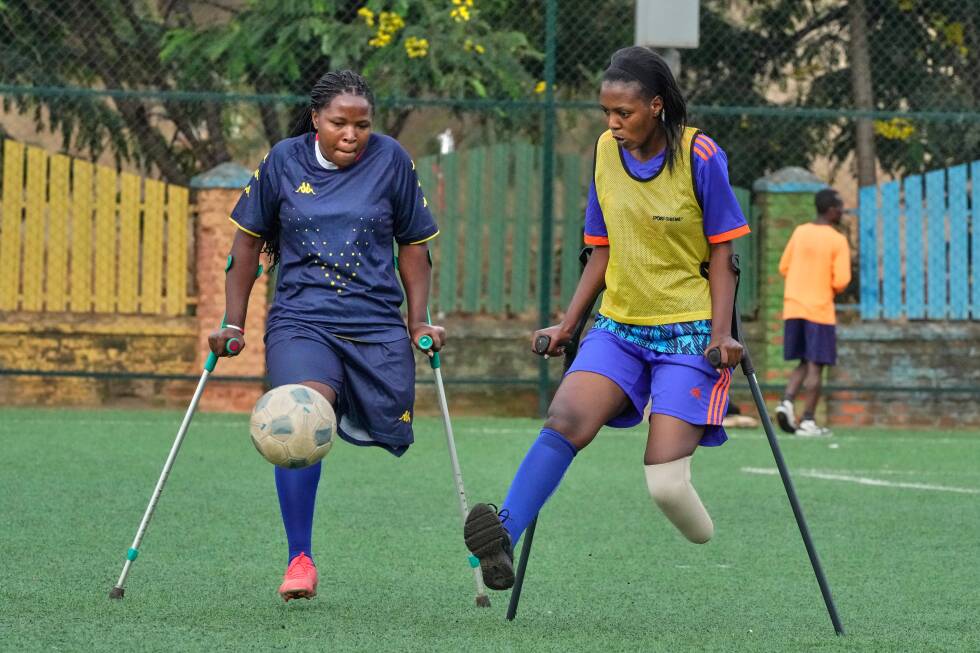
Against the backdrop of Kigali, Rwanda’s rolling hills, a revolutionary form of athletic competition is transforming lives and stitching together the fabric of a nation still healing from deep historical trauma. On grassy community pitches, athletes balance on crutches, striking them against one another in playful competition as they chase a football — and a shared, ambitious dream of competing on the world’s biggest stage for their sport. In the stands, young children scream with delight as a one-armed goalkeeper dives full-stretch to block a shot with her only functional hand, a moment that captures both the grit and joy that define this growing movement.
Amputee football, a modified seven-a-side variant where outfield players maneuver across the pitch on crutches and goalkeepers are restricted to one functional arm, has expanded steadily across Rwanda over the past 10 years. For athletes who once assumed competitive sport was forever out of reach after limb loss, the pitch has become more than a place to play: it is a community, a path to physical rehabilitation, and a space to reclaim a sense of belonging after life-altering injury or trauma.
Much of the sport’s growth in Rwanda is rooted in the country’s long road to recovery from its darkest chapter: the 1994 genocide, where an estimated 800,000 Tutsis and moderate Hutus were killed in a 100-day campaign of violence, leaving thousands of survivors living with amputations and other permanent disabilities. Today, amputee football brings together people from all backgrounds — genocide survivors, accident survivors, and people who have lost limbs to illness — to build connection across divides.
For Nyiraneza Solange, the sport has been life-changing. Born two years after the genocide, Solange lost her leg at age 5 following a fall that developed into a severe infection. She was drawn to the sport after witnessing the extraordinary resilience of genocide survivors who had limb loss, and was encouraged by the coach of Rwanda’s first-ever amputee football team, who told her she could adapt her crutches to compete. She quickly cast aside her fears, and now says she rarely thinks about her amputation while playing. “I don’t even think about I don’t have a leg,” she explained. On the pitch, she feels completely free, and has overcome the deep social stigma that once surrounded her status as an amputee.
Official estimates place the number of lower-limb amputees in Rwanda at more than 3,000, a population encompassing genocide survivors, road accident victims, and people affected by chronic illness. Louise Kwizera, vice president of the Rwanda Amputee Football Federation, says the sport does more than build physical fitness: it helps people learn to trust one another again, rebuilding unity in a society that was once torn apart by division. “In communities affected by conflict or trauma, the playing field becomes a place of peace,” Kwizera told the Associated Press. “People who may have different pasts come together as teammates.”
Today, that growing community has its sights set on a major global milestone: Rwanda is preparing to field a full national women’s team for the second women’s amputee football World Cup, scheduled to take place in 2025 in either Poland or Brazil. The 2024 inaugural edition of the tournament only included one Rwandan competitor, making next year’s event a historic step forward for the country’s program. Amputee football, overseen globally by the World Amputee Football Federation, is now played in more than 50 countries, and Rwanda has built a robust domestic structure: five professional women’s teams and 10 men’s teams across the country.
Fred Sorrels, manager of the Haitian women’s amputee football team, recently traveled to Rwanda to support the development of the local program, and has thrown his support behind a potential future Rwandan bid to host the World Cup. While Rwandan sports authorities have not yet submitted a formal bid, Sorrels says he has seen firsthand the life-changing impact the sport has on participants. “It’s a win psychologically and mentally for these ladies to have an opportunity to experience wholeness and wellness again,” he said.
Gilbert Muvunyi Manier, director general of sports development at Rwanda’s Ministry of Sports, echoed that sentiment, describing amputee football as a “powerful tool” for national healing, intergroup reconciliation, and building social cohesion across the country.
Athletes acknowledge that the sport comes with unique challenges. Goalkeeper Nikuze Angelique, for example, notes that defending shots that bounce toward the side of her missing arm presents a constant technical hurdle. But like Solange, she emphasizes that the community she has found on the pitch far outweighs any challenges. As players posed for selfies after a recent training match, Angelique shared her hope that the team will qualify for next year’s World Cup — a milestone that would mark the fulfillment of a decades-long dream for Rwandan amputee athletes. “It will be a dream come true,” she said.