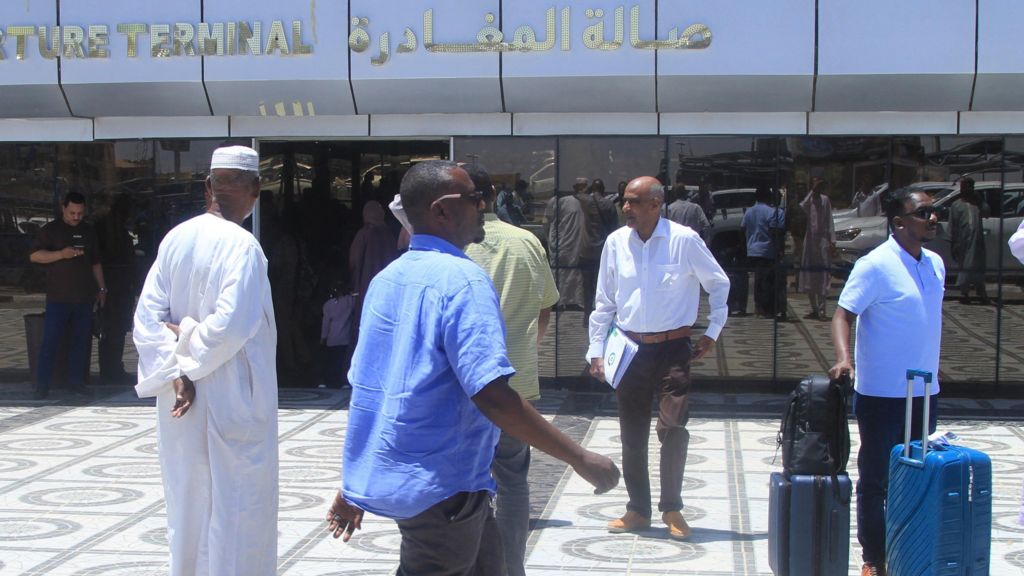
A brazen drone strike on Sudan’s primary international gateway in Khartoum has ignited a sharp diplomatic row, with the Sudanese government formally accusing neighboring Ethiopia and the United Arab Emirates of orchestrating the attack that it labels an open act of direct aggression against Sudanese sovereignty.
The assault, carried out on Monday, targeted not only Khartoum International Airport but also multiple military sites across the wider Khartoum metropolitan region. This attack breaks a months-long stretch of relative calm in the capital, a period of stability that followed the Sudanese Armed Forces’ successful ousting of the paramilitary Rapid Support Forces (RSF) from Khartoum last year.
Sudan’s state-run Sudan News Agency (Suna) quoted military officials as saying the country holds conclusive proof that the drones used in Monday’s assault were launched from Bahir Dar Airport located in northern Ethiopia. This accusation builds on prior claims made by Sudan’s military back in March, when it said the RSF had launched air attacks from Ethiopian soil. On that earlier occasion, Sudanese forces tracked and shot down a drone they confirmed was owned by the United Arab Emirates after it crossed into Sudanese airspace from Ethiopian territory. Military spokesmen now confirm that the drone used in Monday’s strike traces back to the same origin point.
Ethiopia has swiftly rejected the Sudanese accusations, labeling them completely baseless. The United Arab Emirates, which has repeatedly and forcefully denied allegations of providing military support to the RSF throughout Sudan’s ongoing civil conflict, has not yet issued an official statement on the latest accusation. Following the attack, Sudan’s Foreign Minister Mohieddin Salem announced that the country has recalled its ambassador to Ethiopia for urgent consultations in response to the incident.
Officially, no casualties were reported in the strike, Sudan’s Information Minister confirmed to Reuters. Minor damage was however sustained by an administrative building near the airport tarmac. The timing of the attack is particularly sensitive: it comes just one week after the first direct international commercial flight landed at Khartoum International Airport in three years, a milestone that was meant to mark the capital’s gradual return to normalcy after years of war. In the wake of the strike, airport authorities immediately ordered a 72-hour full suspension of all operations, with plans to resume activity once mandatory security inspections are completed.
Back in February, Reuters reporting exposed that Ethiopia had hosted a training camp for RSF fighters and upgraded military infrastructure at the nearby Asosa Airport to support drone operations, moves that the report claimed were backed by the UAE, a close Ethiopian ally. Both Ethiopia and the UAE denied those allegations at the time, just as they have denied involvement in the latest strike. Eyewitnesses contacted by AFP on Monday confirmed hearing multiple powerful explosions and seeing plumes of smoke rise from areas adjacent to the airport, matching official accounts of the attack.
In comments following the strike, Sudan’s Foreign Minister emphasized that even though Ethiopia has long been considered a brotherly neighbor to Sudan, the two nations have chosen the wrong path in their alleged involvement and will ultimately come to regret their actions. For its part, Ethiopia’s Foreign Ministry struck a measured but firm tone in its Tuesday response, noting that Sudan and Ethiopia share centuries of historic, enduring friendship. The ministry added that Ethiopia has so far refrained from publicizing grave violations of its own territorial integrity and national security committed by belligerent parties in Sudan’s civil war, and called for constructive dialogue between all warring factions in Sudan to end the ongoing conflict.
The conflict between Sudan’s regular armed forces and the RSF erupted in April 2023, and has since spiraled into one of the world’s worst humanitarian catastrophes. United Nations officials estimate that more than 150,000 people have been killed since fighting began, while over 12 million have been forced to flee their homes. The conflict has triggered widespread famine across large swathes of the country, and credible reports of systematic genocide in the western Darfur region have drawn international condemnation.