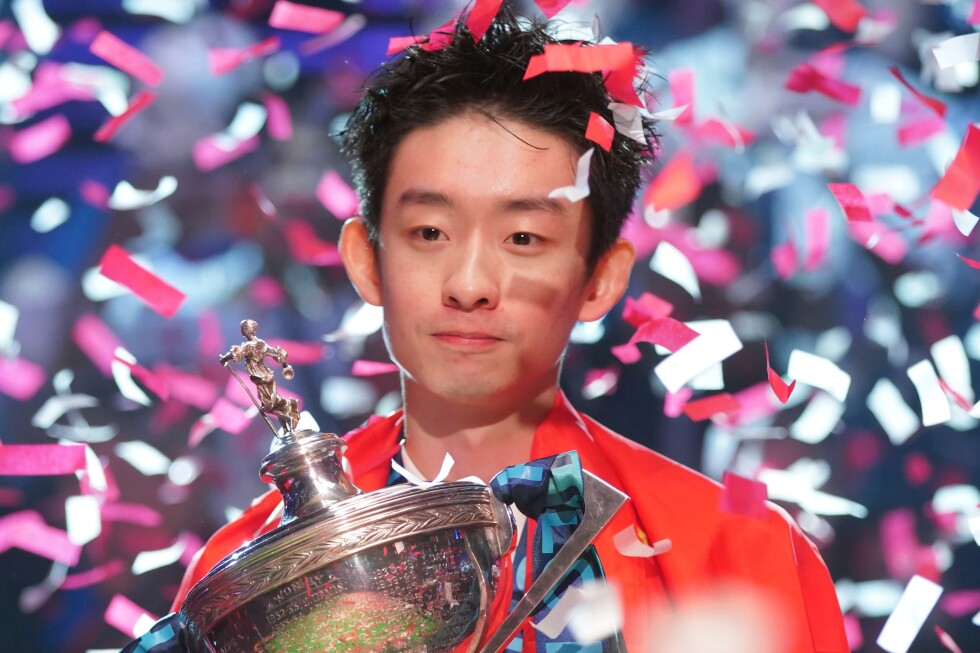
Snooker’s decades-long push to secure a spot in the Olympic Games has received a transformative boost from a historic milestone: two consecutive world titles claimed by Chinese players, according to the sport’s global governing body chief.
In a tense, last-frame decider at Sheffield’s iconic Crucible Theatre on Monday, 22-year-old Wu Yize edged out England’s Shaun Murphy by a razor-thin 18-17 score to lift the world championship trophy. His victory comes exactly one year after compatriot Zhao Xintong made history as the first Asian player to claim snooker’s most prestigious title, marking the first time the sport’s world crown has stayed in Chinese hands for back-to-back tournaments.
For decades, the United Kingdom dominated professional snooker as its unchallenged traditional heartland. But over the past two decades, China has emerged as the sport’s fastest-growing powerhouse, boasting an estimated 300,000 registered snooker clubs nationwide. This year’s world championship main draw featured 11 Chinese players out of 32 total competitors, with five holding spots in the sport’s top 16 global rankings — a clear marker of the nation’s rising competitive depth.
Snooker’s Olympic journey has been marked by setbacks so far: bids for inclusion in the 2020 Tokyo and 2024 Paris Games were both unsuccessful. But the sport’s leadership is now gearing up for a new bid for the 2032 Brisbane Olympic Games, and the recent run of Chinese success has positioned the campaign far more strongly than ever before.
Jason Ferguson, chairman of the World Professional Billiards and Snooker Association (WPBSA), told the Associated Press in an interview that the International Olympic Committee (IOC) has already been closely monitoring the sport’s growth, and the consecutive Chinese world titles can only strengthen the bid. “It’s vitally important,” Ferguson said. “China is a very important country to the IOC — it has hosted the Games on multiple occasions and invests heavily in global sport development, which carries significant weight for the IOC. So the fact that China is a key market for snooker is a really important part of any Olympic bid.”
Ferguson also highlighted that snooker’s global expansion extends far beyond East Asia. This year’s world championship welcomed its first ever Polish competitor, Antoni Kowalski, marking growth across eastern Europe. Today, nearly 100 countries have established national snooker governing bodies and grassroots infrastructure — a dramatic shift from the early days of the Olympic bid, when only a small handful of nations had organized competitive programs. “When we started this idea of going to the Olympics, we only had a handful of countries playing,” Ferguson noted. “But we are ready (to be in the Olympics). And that’s an exciting proposition.”
Beyond the Olympic bid, the WPBSA is also finalizing a separate application to reinstate snooker to the Paralympic Games program, where the sport was featured from 1960 to 1988. A final decision on which sports will join the 2032 Brisbane Olympic and Paralympic programs is expected by next spring, timed to coincide with the next running of the snooker world championship. Local support from Brisbane organizing officials is widely viewed as a critical factor for any new sport seeking inclusion.
Wu’s historic win caps a remarkable underdog story. Six years ago, he left his hometown of Lanzhou in northwest China and relocated to the United Kingdom with his father to chase a professional snooker career, leaving his mother behind in China. The pair lived in a cramped, windowless small apartment; Wu later recalled that poor air quality in the space even left him prone to acne. But he embraced the hardship for his love of the sport. “If you really love snooker, it is the path you have to go through and fight through,” he said.
Entering this year’s world championship, Wu had never won a single match at the Crucible, making his run to the title a major upset. Now ranked world No. 4 following his victory, Wu joins Zhao in hoping his journey will inspire the next generation of Chinese snooker players. “I hope younger players can stay true to their passion, be a bit braver, and go after their dreams,” he said.