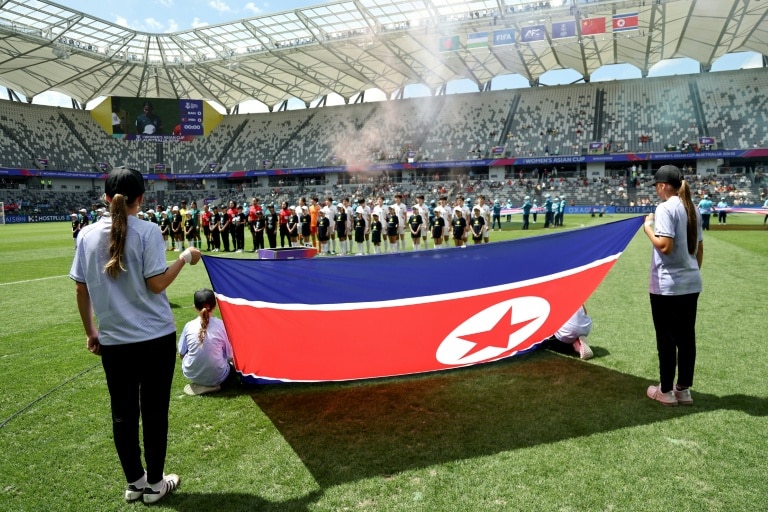
In a groundbreaking moment for inter-Korean sporting exchange, South Korea’s unification ministry confirmed Monday that a North Korean women’s football club will travel to the South this month to compete, marking the first visit by a North Korean sports delegation to the country in seven years. Decades after the Korean War concluded with an armistice rather than a formal peace treaty, the two neighboring states remain technically at war, making cross-border cultural and athletic exchanges extremely uncommon.
Naegohyang Women’s Football Club, a Pyongyang-based side founded in 2012, is set to face South Korea’s Suwon FC Women in an Asian Women’s Champions League semi-final clash at the Suwon Sports Complex on May 20. The North Korean traveling party will comprise 27 players and 12 club officials, who are scheduled to arrive at Incheon International Airport on May 17 via an Air China flight routed through Beijing, according to a senior unification ministry official. The semi-final loser will return to North Korea just one day after the match on May 21, as no third-place playoff is planned for the competition. The winner will advance to the continental club final on May 23, where they will face either Australia’s Melbourne City or Japan’s Tokyo Verdy Beleza for the continental title.
This upcoming fixture is the first appearance by a North Korean sports team on South Korean soil since mixed delegations for shooting, youth football and table tennis visited in 2018. The last time a North Korean women’s football side competed in the South was a decade ago, when the North Korean national team took part in the 2014 Asian Games hosted in Incheon. Observers note that most of Naegohyang’s roster is made up of current and former North Korean national team players, a squad drawn from one of Asia’s most dominant women’s football programs. North Korea’s national women’s sides have claimed multiple major international titles in recent years, most recently winning the 2024 U-17 Women’s World Cup with a dominant 3-0 victory over the Netherlands in the final.
Beyond the pitch, the match carries major geopolitical weight, coming as South Korea’s new dovish administration under President Lee Jae Myung pursues rapprochement with Pyongyang after years of escalating cross-border tensions. Lee has repeatedly called for unconditional talks with North Korea, framing the two Koreas as being destined to “make the flowers of peace bloom” through dialogue. To date, Pyongyang has not responded to Lee’s outreach, and has continued to label Seoul its “most hostile” adversary. Even so, regional analysts see the club’s visit as a small but meaningful opening for inter-Korean engagement.
For the South Korean government, the fixture represents an opportunity to establish at minimum a basic line of communication between the two governments, according to Lim Eul-chul, a leading North Korea researcher at Kyungnam University. “It could become a chance to test peaceful coexistence,” Lim told Agence France-Presse. The historic match comes amid heightened international concerns over Pyongyang’s military activities: North Korean leader Kim Jong Un has publicly committed to expanding the country’s nuclear arsenal, and Pyongyang conducted four intercontinental missile tests in April, the highest number of tests recorded in a single month in more than two years. Pyongyang has also deepened its military and economic alignment with Moscow in recent months, with widespread international reports indicating it has sent artillery shells and troop deployments to support Russia’s full-scale invasion of Ukraine. Western defense observers broadly expect Pyongyang to receive advanced military technology from Russia in exchange for its military support.