Across the Gulf Arab states and broader Middle East, millions of low-wage migrant workers from impoverished South Asian, Southeast Asian and African nations are facing an impossible choice rooted in the ongoing conflict between the U.S.-Israel alliance and Iran. For many, the decision is not even their own to make, as the violence has already claimed their lives.
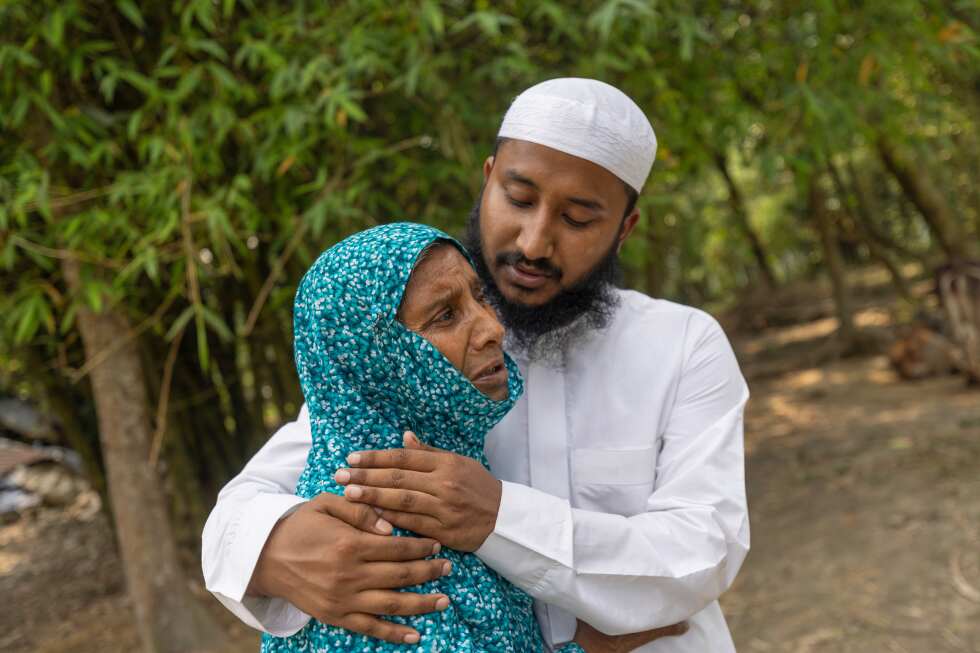
For 35-year-old Mohammad Abdullah Al Mamun, a Bangladeshi migrant worker who spent 15 years laboring in Saudi Arabia to support his family, the dream of coming home for good ended on March 8. Mamun had only met his 6-year-old son once, just a few short days in a lifetime of separation. This year, he had drawn up careful plans: return to Bangladesh’s Cox’s Bazar, one of the country’s poorest regions, use his years of savings to build a larger family home, and finally build a relationship with the child he barely knew. That dream died when a missile struck the workers’ camp where he was staying. He suffered catastrophic burns and did not survive, becoming one of more than two dozen foreign migrant workers killed in cross-regional attacks since the conflict erupted in February. Earlier this month, Mamun’s body arrived home in a coffin, leaving his widow, mother and siblings to grapple with an uncertain future. “We don’t know what we will do next,” said his widow Sadia Islam Sarmin. His mother Shahida Khatun added, “The pain of losing a child. There are no words to describe the agony.”
Migrant workers have long been the unseen backbone of the Gulf’s modern oil-fueled economies, making up a majority of the population in many Gulf states. While Western, Arab and Indian professionals hold upper-tier roles in business and finance, low-income laborers from poor Asian and African nations work grueling long hours in extreme desert heat at oil facilities, construction sites and factories, often with minimal legal or safety protections. That lack of protection has been thrown into sharp relief by the recent conflict.
The Coalition for Labour Justice for Migrants in the Gulf, an advocacy group tracking the crisis, reports that few migrant workers had access to emergency bomb shelters when attacks began, and many were left stranded as conflict disrupted travel and evacuation routes. Waves of missile and drone strikes launched by Iran and its allied armed groups have killed at least 24 foreign workers across the Gulf and another four in Israel, including eight mariners killed at sea. “It’s a very precarious situation for migrant workers,” explained Udaya Wagle, a migration and labor researcher at Northern Arizona University.
A fragile ceasefire was announced in early April, but efforts to negotiate a permanent end to hostilities have repeatedly stalled. Iran has blockaded the Strait of Hormuz, the world’s most critical chokepoint for global oil and gas exports, stating it will only reopen the waterway if the war ends and the U.S. lifts its economic blockade of Iran. The disruption to global energy supplies has sent prices of gas, fertilizer and essential commodities soaring, hitting already vulnerable importing nations across South and Southeast Asia particularly hard.
For the low-wage migrant workers caught in the middle, this creates a devastating dilemma. If they stay in the Middle East, they face the constant risk of renewed fighting, but they can earn far higher wages than they could ever access at home—remittances that are often the only lifeline keeping their families out of poverty. If they return home, they leave behind that critical income to return to nations already reeling from skyrocketing prices and economic instability brought on by the conflict.
Low-wage laborers like Mamun are the most exposed to harm, experts say. They fill what development advocates call the “3D jobs”—dirty, dangerous and difficult—with little access to emergency support. In Qatar, a 27-year-old Bangladeshi factory worker who earns less than $400 a month, sending two-thirds of that salary home to his family, has already seen shrapnel from a strike land near his living quarters. Even as missiles fly overhead, he continues working 12-hour shifts, with no other option to support his family. He spoke on condition of anonymity, fearing retaliation from local authorities. “We have no choice but to keep working,” he said.
While Qatar introduced limited labor reforms ahead of the 2022 FIFA World Cup, including partial rollback of the controversial kafala system that tied workers’ visas to a single employer, activists say widespread labor abuses persist, and workers have almost no avenues to seek justice for exploitation or danger. That vulnerability is compounded for workers in informal roles, who rarely have fixed contracts or access to emergency benefits.
Ahmed al-Aliyli, an Egyptian taxi driver based in Qatar, has not been able to send any money home to his family in Egypt for two months. Before the conflict, he earned up to $3,000 a month; now his income has plummeted to just a third of that pre-war level as conflict has disrupted travel and tourism. “We are the collateral damage of this war,” he told reporters.
Shariful Islam Hasan, a researcher with BRAC, Bangladesh’s largest development organization, warns that an impending slowdown in key Gulf sectors like construction and real estate will hit migrant workers directly. Workers from Bangladesh and Pakistan are disproportionately at risk, he says, because most hold informal, contract-free positions. The labor advocacy coalition adds that even where reforms have been made, many workers’ work permits remain tied to individual employers, leaving them effectively trapped in place even if they want to leave. There are also growing fears that some employers are using the chaos of the conflict to withhold wages, deny emergency leave and carry out arbitrary dismissals with no consequences.
For most migrant workers, returning home permanently is simply not a viable economic option. Remittances from Gulf workers make up roughly 1% of India’s total GDP, 3% to 5% of GDP for Bangladesh, Pakistan and Sri Lanka, and nearly 10% of Nepal’s entire national output. These remittances are more critical than ever now, as household incomes stagnate across South Asia, and governments struggle to secure enough foreign currency to import energy and essential goods. With their home nations already reeling from economic crisis, giving up Gulf wages would leave many families unable to afford food, energy or education.
Marlene Flores, a Filipino migrant worker in Qatar, says she feels the shockwaves every time a missile is intercepted over the country. But even with the safety risk, she says the tax-free salary and health benefits she gets in Qatar are more stable than what she could access back home, where the Philippines has declared a national energy emergency. “It’s not easy for me to say,” she admitted, “But I would really stay here.”
Even in Israel, which hosts a large population of foreign migrant care workers, many face the same impossible calculation. Jeremiah Supan, a Filipino caregiver, continues to care for his two elderly clients even as daily missile alerts force him to dash for cover, sometimes running through active danger to fetch food or medicine for the people he cares for. He knows he could die at any moment, but he cannot see how his family would survive if he gave up his job and returned to the Philippines. “I know that in the blink of an eye, one can die,” he said. “But what life shall we return to?”
This report is sourced from on-the-ground contributions from journalists across Manila, Dhaka, Cairo and Kuala Lumpur, with reporting coordinated by the Associated Press.